
Indian government's decision to cut GST rates on various products will increase purchasing power of consumers and boost demand for residential properties in the upcoming festive season, according to realtors' body CREDAI. The association, which has a 13,000 members from across India, said the construction cost is expected to come down because of reduction in GST rates on cement and few other building materials.

Realtors' apex body CREDAI described the RBI decision to cut repo rate by 50 basis points as a bold step and said this will help boost sales of residential properties.

Indian Real Estate Investment Trusts (REITs) are generating an average yield of 6-7.5 per cent for unitholders, better than many mature markets, including the US, according to a report by CREDAI and Anarock. CREDAI, the apex body of Indian real estate developers, and property consultant Anarock released a report 'Indian REITs - A Gateway to Institutional Real Estate' at an event in Singapore.

Since the first Reit listing in 2019, the sector has grown to a market capitalisation of about $18 billion as of August 2025, and is projected to cross $25 billion by 2030.

Senior Congress leader Shashi Tharoor says US tariffs are negatively impacting India, leading to job losses, and criticizes President Trump's diplomatic behavior.

After three straight quarters of decline, India's housing market is pinning hopes on the ongoing festival season to revive sales momentum. While 2025 may still end with sales volumes below 2024 levels, developers believe the seasonally strong October-December quarter could narrow the gap, aided by stable interest rates, festive incentives, and resilient demand in the premium segment.

BCCI's vice-president Rajiv Shukla said the Indian cricket team's new jersey sponsor will be finalised in the next two to three weeks.

'Every delay directly increases the cost burden on developers. Land holding charges, financing costs, and compliance expenses escalate as approvals drag on.'
Housing prices appreciated at an average of 10 per cent during the December quarter across eight major cities on strong demand, higher input cost, according to a report by CREDAI, Colliers and Liases Foras. Realtors' body CREDAI, real estate consultant Colliers India, and data analytic firm Liases Foras on Tuesday released their joint report, which showed that Delhi-NCR saw a maximum appreciation of 31 pc annually during the October-December period of 2024.

Developers based outside Mumbai are making a beeline for India's largest real estate market through redevelopment projects. These include Delhi-based DLF, Bengaluru-based Prestige Estates and Puravankara, Pune-based Kolte-Patil Developers and Vascon Engineers, and Hyderabad-based Ramky Estates.
While demand for sub Rs 50-lakh affordable housing prevails, market players cite increased land rates, escalated construction costs and low margins as key prohibiting factors.

Housing demand should improve nationwide after the Reserve Bank of India (RBI) cut the repo rate by a larger-than-expected 50 basis points (bps) on Friday, said real estate industry executives. The rate cut comes after housing sales in top Indian cities in the first quarter of 2025 dipped 28 per cent due to skyrocketing residential property prices and geopolitical headwinds, according to Anarock.

The 31st meeting of the Goods and Services Tax (GST) Council, held in December 2018, deferred a decision to reduce the GST rate for cement from 28 per cent to 18 per cent. This was despite recognising that cement - along with automobile parts - remained among the few mass-consumption items still taxed at the highest slab, which was originally meant for luxury and sin goods.

Credai is the apex body for real estate developers in the country and represents over 9,000 developers through 128 chapters in 20 states
In an effort to change perceptions and build trust, 6,000 real estate developers across the country, who are members of the Confederation of Real Estate Developers' Association (Credai), will sign on a self-imposed code of conduct that embraces best practices in the business, the core team of Credai said at a press meet in Delhi.

Indian real estate sector saw more land deals in 2024 at over 2,200 acres as developers were looking to expand the business, according to CBRE. Real estate consultant CBRE data showed that land deals of more than 2,200 acres last year as against about 1,900 acres in the preceding year. Out of the total land transactions in 2024, around 2,000 acres were located in the eight major cities -- Delhi-NCR, Bengaluru, Mumbai, Chennai, Pune, Hyderabad, Kolkata and Ahmedabad.
Realty developers' body, Credai, on Tuesday said the property prices will only go up from here on increased demand, though the pace of appreciation will be slow.
As the Union Budget 2025-2026 (FY26) inches closer, the Indian real estate industry is seeking stamp duty cuts, revised home loan limits and updated affordable housing norms through Pradhan Mantri Awas Yojna (PMAY), single-window clearance and eco-friendly policies, among others. Industry leaders and consultancy firms, including Anarock, Raheja, Gaurs, Kanodia Group, Reach, Urban Space, Justo and Eros Group, have shared their expectations.

The association demanded that the interest rates for developers as well as home buyers should be brought down to boost realty sector, which is facing a slowdown in demand.

Association points out that over 40 clearances from various agencies are required for real estate projects.

The government on Tuesday proposed reducing the long-term capital gains tax on immovable properties to 12.5 per cent from 20 per cent, but removed the indexation benefits to adjust for inflation, a move experts termed as "negative" for sellers.

'There will be 200 ITIs developed as hubs, while 800 will be developed as spoke, connected with five National Skill Training Institutes.'

Locals have witnessed real estate prices skyrocket from a historic low of Rs 6,000 per square yard (in 2020) during Jagan Mohan Reddy's regime to around Rs 40,000 to Rs 50,000 per square yard after elections.

India's real estate market is poised for growth across categories - residential, commercial, and rental. Currently valued at Rs 24 trillion, or about $300 billion, it is projected to surge to $1.3 trillion by 2034, and then grow further to $5.17 trillion by 2047, indicates a report by the Confederation of Real Estate Developers Associations of India (Credai).
Realtors' body CREDAI on Monday said the cost of construction has gone up by 20-25 per cent, mainly during the last 45 days, due to steep rise in prices of raw materials like steel, and builders will be forced to increase property prices from next month by an average 10-15 per cent. CREDAI-MCHI, the Maharashtra chapter of CREDAI, demanded that the central as well as state governments consider giving relief to the industry by reducing stamp duty and GST rates, besides allowing input tax credit (ITC) to developers. The association said it would not advise member developers to stop construction works as of now, but if the price rise continues then builders would have no option but to halt works at project sites and defer purchase of raw materials.
'Some buyers believe prices may correct in the future.' 'This is unlikely. Many developers are increasing prices amid strong sales and inflationary trends.'

Credit outstanding to the housing sector rose by nearly Rs 10 lakh crore in the last two fiscals to reach a record Rs 27.23 lakh crore in March this year, according to RBI's data on 'Sectoral Deployment of Bank Credit'. Experts from banking and real estate sectors attributed this growth in housing credit outstanding to a strong revival in the residential property market post-COVID pandemic on pent-up demand. According to the data of the Reserve Bank of India (RBI) on sectoral deployment of bank credit for March 2024, the credit outstanding to the housing (including priority sector housing') stood at Rs 27,22,720 crore in March 2024, up from Rs 19,88,532 crore in March 2023, and Rs 17,26,697 crore in March 2022.

Housing prices increased by up to 11 per cent annually across eight major cities during January-March period of this year due to a rise in demand for residential properties and a sharp hike in rates of construction raw materials, according to a joint report by CREDAI, Colliers and Liases Foras. Delhi-NCR witnessed highest rise in housing prices by 11 per cent to Rs 7,363 per sq ft during January-March 2022 as compared to the year-ago period, as per the first edition of Housing Price-Tracker report by realtors body CREDAI, real estate consultant Colliers and data analytics firm Liases Foras. Hyderabad witnessed 9 per cent increase in housing prices to Rs 9,232 per square feet, while Ahmedabad saw a 8 per cent appreciation to Rs 5,721 per square feet and Kolkata 6 per cent to Rs 6,245 per square feet.

Around 58 per cent of developers expect housing prices to increase this year because of rise in input costs, while 32 per cent builders feel it will remain stable, according to a survey. According to the 'Real Estate Developers Sentiment Survey', by Realtors apex body CREDAI, real estate consultant Colliers India and property research firm Liases Foras, 43 per cent of developers expect residential demand to remain stable in 2023, while 31 per cent feel the demand would increase up to 25 per cent. As many as 341 real estate developers from various parts of the country participated in the joint survey conducted during the last two months.

About 25-30% of total units launched are unsold across country.
CREDAI Chairman Lalit Jain said a long term status quo on interest rates would not help prospective home buyers.
Housing sales are likely to be hit, especially in affordable and mid-income categories, following the RBI's decision to hike repo rate, according to real estate developers and consultants. However, the impact of RBI's decision to raise the benchmark lending rate by 50 basis points to 5.40 per cent is expected to be for a short term, they added. This is the third consecutive rate hike after a 40 basis points and 50 basis points increase in May and June, respectively.

"Minister Nath has agreed to hold the consultative dialogue from next week in the process of improving the working scenario between developers and the government sectors," he said at the ongoing CREDAI convention being held in Singapore.
Commerce and Industry Minister Piyush Goyal that the players in the sector should start lowering prices and, if the worst comes to the worst, write off investment as bad business decisions.

India's residential market is expected to sustain demand momentum despite rise in mortgage and property rates as sales this year across the top 7 cities are likely to breach pre-pandemic level of 2.62 lakh units, industry players said. After braving four back-to-back disruptions in form of demonetisation, RERA, GST and COVID-19 in the last 6 years, industry experts feel the housing market is going through a lot of structural changes and is now at the start of a long-term upcycle. Homebuyers body FPCE gives credit to the Real Estate Regulatory Authority (RERA) under the Real Estate (Regulation & Development) Act, 2016 for this improved buying sentiment.

The move is likely to help 4.59 lakh housing units across the country.
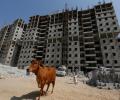
CREDAI-MCHI, a body of developers in Mumbai, has pegged the drop in sales booking at around 80 per cent in the February-March period this year. This is the second highest fall in residential sales in the past five years, after Q1, 2017, when the decline, due to the note ban, was 37 per cent.

Increase in service tax would make properties costlier to buyers.
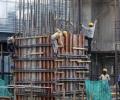
Real estate biggies unhappy with status quo on RBI rate cut.
 © 2026 Rediff.com - Advertise with us - Disclaimer - Privacy Policy - Sitemap - Feedback - About us - Terms of use - Grievances