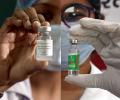
There were apprehensions in the SII about rival Bharat Biotech's 'indigenous' tag, opening up shortcuts for it. One senior person, who was very familiar with the sector, told me, 'The message has gone out from the very top. Somani (V G Somani -- drug controller general of India) has told me "Bharat ka karna hai".' A fascinating excerpt from Abantika Ghosh's Billions Under Lockdown: The Inside Story Of India's Fight Against COVID-19.

An important focus of the dry run will be on management of any possible adverse events following immunisation.

'Even after vaccines are given, precautions like using a mask and maintaining social distancing have to be taken.'

'Forcing the development of an indigenous vaccine as a cure for COVID-19, bypassing all health & safety norms, to be announced by PM Modi on Independence Day is fraught with horrendous human costs'
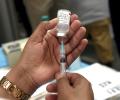
The first 100 beneficiaries of such foreign vaccines shall be assessed for seven days for safety outcomes before it is rolled out for further immunisation programme within the country, the Union health ministry said.
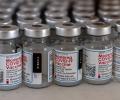
Currently, the country is using two 'made-in India' jabs -- Covishield and Covaxin -- to inoculate its billion-plus population and has administered 20 crore doses since launching the world's largest vaccination drive in mid-January. A third vaccine, Russian-made Sputnik V, has been approved by the government and is being used on a smaller scale at present.
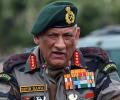
The Padma Bhushan was conferred on 17 personalities including N Chandrasekharan, chairman of Tata Sons, Krishna and Suchita Ella of Bharat Biotech, Cyrus Poonawalla, Satya Nadella, chairman of Microsoft, Sunder Pichai, chairman of Google.

22 cases of the Delta Plus variant of the coronavirus have been detected in India, with 16 of them being reported from Maharashtra and the remaining from Madhya Pradesh and Kerala, the government said.
The teams were from Gennova Biopharmaceuticals Ltd Pune, Biological E Ltd Hyderabad and Dr Reddys Laboratories Ltd Hyderabad.

There is so far no evidence that the second wave of COVID-19 in the country is due to variants of the virus, but it is possible, said noted virologist Shahid Jameel.
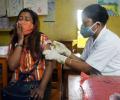
Several private hospitals across the country said they have no clarity on procuring COVID-19 vaccines under the new policy announced by Prime Minister Narendra Modi and that it has led to the vaccination being put on hold at their centres.

'We know, from our experience of this virus, that there's something known as long COVID-19, where you have this persistent fatigue and some people have lost their neurological acuteness and they are not as sharp as they used to be.'

Some states have flagged the shortage of vaccines and expressed their inability to start vaccination of people above 18 years from Saturday
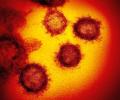
The WHO said that studies have highlighted that the spread of the second wave has been much faster than the first in India.

Out of the 447 adverse events following immunisation, only 3 required hospitalisation.

One 'severe' and 51 'minor' cases of AEFI (adverse events following immunisation) were reported among healthcare workers who were administered the coronavirus vaccine in Delhi on the first day of the COVID-19 vaccination drive on Saturday, official figures showed.
'We will see a kind of disaster which the country has not seen in the last 100 years.'

As India launches the world's most ambitious and biggest vaccination drive against COVID-19, the country will encounter the formidable challenge of rapidly scaling up distribution of the vaccines to secure immunity for its entire population, two prominent Indian scientists at World Health Organisation have said.
Among the other names tipped to make it to the Cabinet are Jyotiraditya Scindia, Sarbananda Sonowal, Baijayant Panda.

'A good 30 per cent of people will still get infected after getting the Covishield vaccine.'
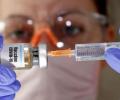
Poonawalla, during an interaction with Odisha Chief Minister Naveen Patnaik through a video conference, expressed optimism that the COVID-19 vaccine could be ready by October-November this year and the next phase of the trial can start in mid-August in India. According to a press note released by the CMO, Poonawalla has informed that the Oxford University vaccine has shown promising results in the first phase trial.

Vaccinating 100-200 people in each session per day, monitoring them for 30 minutes after administering the shots for any adverse event and allowing only one beneficiary at a time are among the guidelines issued by the Centre for the COVID-19 inoculation drive.
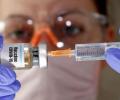
The Indian vaccine industry largely feels there are two ways in which vaccine innovation can be spurred - one, get a high price for the product and two, have the government buy a few hundred million doses of the product at a certain price.
'We really need to look seriously to see if there are any local variants.'
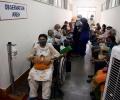
UP Rs 50 billion, followed by Maharashtra, Bihar, and West Bengal which may need close to Rs 25 billion for the massive task.

The PM-CARES fund, which has been set up to provide relief during the coronavirus pandemic, has contributed over Rs 2,200 crore for the first phase of vaccination drive, which is looking to inoculate frontline healthcare workers, the Expenditure Secretary said on Tuesday.
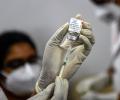
On Wednesday, the Maharashtra government had said that it would not be able to launch the 18-45 age group vaccination drive from May 1 due to the shortage of vaccines.

The Hyderabad-based Bharat Biotech has fixed the price of its COVID-19 vaccine, Covaxin, at Rs 600 per dose for state governments and at Rs 1,200 per dose for private hospitals. The Pune-based Serum Institute of India, the world's largest vaccine maker in terms of volume, has announced a price of Rs 400 per dose for its COVID-19 vaccine, 'Covishield', for state governments and Rs 600 per dose for private hospitals.
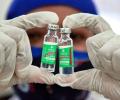
SII said it will address the limited capacity by scaling up the vaccine production over the next two months.
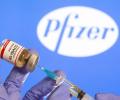
Providing data, it said UK's Public Health England has reported high vaccine effectiveness (87.9 per cent) against the B.1.617.2 variant, most reported in India, in an observational study (concluded on May 22, 2021).
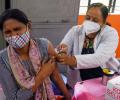
'You have sufficient protection if you take the second dose of the Covishield vaccine at 12 weeks, because this vaccine works in a way where it provides protection in the first dose.'

As the global debate on booster shots gathers momentum, several scientists in New Delhi said the priority must be to ensure that more people are inoculated with at least their first jab.

The first dry run of the vaccination drive took place across 125 districts covering all States/UTs on January 2. The dry run was also conducted to familiarise the state, district, block, and hospital-level officers on all aspects of the COVID-19 rollout.
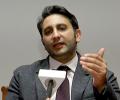
Serum Institute of India CEO Aadar Poonawalla has said that the production of Covid-19 vaccine Covishield is in full swing in Pune and he will review the operations once he is back in the country in a few days. Poonawalla is currently in the UK to meet his family members.

'Mortality or hospitalisation has not increased in South Africa because of the new variant.' 'There is nothing to show so far that it is more infectious.' 'I am of the opinion that at the moment, there is no reason to panic.'

Millions of people across the country stayed indoors on March 22, 2020 in an unprecedented and overwhelming response to Prime Minister Narendra Modi's appeal for the nationwide curfew. People used to come out briefly at 5 pm to show their gratitude to healthcare and other essential service providers with sounds of bells, conches and claps.
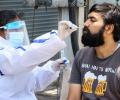
A steady decline in new COVID-19 cases has been recorded in India for the last 20 days, with 24 states witnessing a dip in active cases since the last week, the Union health ministry said.
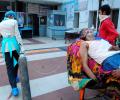
"Despite the high number of cases reported so far, we have been able to contain the spread to under 2 pc of population," said Health Ministry Joint Secretary Lav Agarwal.

During the webinar, 'COVID-19: Vaccination and Potential Return to Normalcy - If and When', Dr Hotez, an internationally-recognised physician-scientist in neglected tropical diseases and vaccine development, said that the COVID-19 vaccine rollout is "India's gift' to the world in combating the virus.
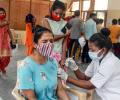
A June 11 survey by cLocalCircles across 299 districts puts overall vaccine hesitancy levels at 18 per cent, with 11 per cent of the respondents saying they were not convinced if the currently available vaccines would protect them against the new strains; and 5 per cent said they do not plan to take the vaccine at all.
 © 2026 Rediff.com - Investor Information - Advertise with us - Disclaimer - Privacy Policy - Sitemap - Feedback - About us - Terms of use - Grievances