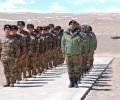
There was no comment from the Indian side on the statement made by the Chinese defence ministry spokesperson Colonel Wu Qian, and carried by China's official media.

'We have to be equally vigilant in the central sector which is where Barahoti lies and also in the Joshimath area.'
Yes, we (Quad) had a discussion on India-China relations because it was part of how we briefed each other about what was happening in our neighbourhood, Jaishankar said.
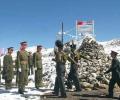
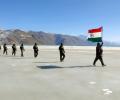
India and Chinese troops on Saturday exchanged sweets and greetings at 10 border posts along the Line of Actual Control (LAC) including in eastern Ladakh to mark the New Year, officials said.

Pakistan Army said on Thursday that it has 'nothing to do with politics' and it will remain apolitical in the future as well, as the powerful institution asserted that its chief General Qamar Javed Bajwa was not seeking an extension and will neither accept one.
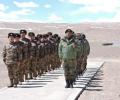
The sources said the ongoing engagement and dialogue at military and diplomatic levels have resulted in complete disengagement of troops at patrolling point 14, 15 and 17 A in eastern Ladakh.
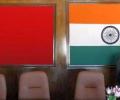
As the border standoff entered the sixth month, an early resolution to the row appeared dim with close to 100,000 Indian and Chinese troops remaining deployed in the high-altitude region and showing readiness for a long-haul. There is no official word on the talks yet but sources said the agenda was to finalise a roadmap for disengagement of troops from all the friction points.

After a gap of over three months, India and China on Wednesday are holding another round of high-level military talks to resolve the 20-month-long military standoff in the remaining friction points in eastern Ladakh, sources in the security establishment said.

India and China are likely to hold another round of diplomatic talks this week on eastern Ladakh with a focus on moving forward in disengagement of troops in the remaining friction points, people familiar with the development said on Tuesday.
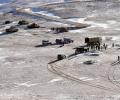
India and China to hold the 11th round of corps commander-level talks at Chushul in eastern Ladakh at 10.30 am on Friday that is expected to focus on disengagement of troops in remaining friction points, sources within the Indian Army said.

India has made it clear to China that peace and tranquillity in border areas is essential for the development of overall bilateral ties and the relationship has to be based on the 'three mutuals' of respect, sensitivity and interest, Foreign Secretary Harsh Vardhan Shringla said.

The strategic advantage accruing to India in Siachen should not be given up for apparent short-term political gains. Giving up Siachen as a gesture of friendship would also mean that its recapture would be extremely expensive to India in men and material, says Vikram Sood.

The talks took place in a beach resort in Benaulim on the sidelines of a meeting of the Council of Foreign Ministers of the Shanghai Cooperation Organisation.
China said on Tuesday that the current situation on the border areas with India was "stable" as it confirmed that the 14th round of Corps Commander-level talks to discuss the disengagement process in the remaining friction points in eastern Ladakh will be held on Wednesday.

'All Pakistan army chiefs follow a consistent line as far as India is concerned.'

Military experts said the aim of constructing the bridge in the Khurnak area could be to ensure that the Chinese People's Liberation Army is able to quickly mobilise its troops in the region.

'The last ten months show that India is not going to trust China.' 'Our military commanders are not going to believe that all is well till it actually is.'
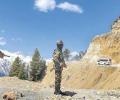
The meeting primarily focused on implementation of certain decisions taken at the fifth round of talks between Corps Commanders of the two armies last week on the disengagement process as well as to bring down prevailing tension in the region, sources said.
At the talks, the Indian side insisted on complete disengagement of Chinese troops at the earliest and immediate restoration of status quo ante in all areas of eastern Ladakh prior to May 5 when the standoff began following a clash between the two armies in Pangong Tso, they said.

The Indian Army on Friday strongly insisted on early disengagement of troops by China from all the friction points in eastern Ladakh at the eighth round of corps commander-level talks between the two sides that primarily focused on a roadmap for restoration of peace and tranquillity in the region, according to people familiar with the developments.
'India's challenge is status quo ante. China's challenge is a face-saving exit'
'By not even acknowledging China's occupation of Indian territory Modi signalled to Beijing that he was not prepared to used forceful means to vacate the Chinese occupation, and that his government was reconciled to this loss of territory and accepted the fait accompli engineered by the PLA.'
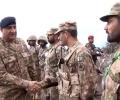
'Given the past practice in the Pakistan army, this delay is most unusual,' notes Rana Banerji, who headed the Pakistan desk at the Research and Analysis Wing, India's external intelligence agency.

The rather amateurish, even ham-handed, attack would lend some credence to a 'false flag' theory, of the PTI leadership staging this incident, to provide new impetus to a flagging agitation, notes Rana Banerji, who headed the Pakistan desk at RAW, India's external intelligence agency.

The incident had taken place at a time when the Indian Foreign Minister, S Jaishankar, was in Moscow for the Shanghai Cooperation Organisation meeting, where he met his Chinese counterpart to address the border issues.

Pakistan's ISI chief Lt Gen Nadeem Ahmed Anjum said on Thursday that Army chief Gen Qamar Javed Bajwa was given a "lucrative offer" in March by the then government amidst the political turmoil, as the powerful top spy launched a veiled attack on ousted premier Imran Khan at an unprecedented press conference.

The sources also said both the Indian and Chinese troops are firmly holding on to their respective positions at the Line of Actual Control.
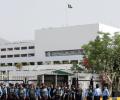
Pakistan's Opposition leader Shehbaz Sharif on Sunday nominated himself for the post of prime minister, while Imran Khan's party threatened to withdraw its lawmakers from Parliament if the former Punjab chief minister was allowed to contest the election for the top post on Monday.
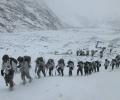
The Indian side has an edge over their Chinese counterparts in terms of battling the weather as a large number of them have already done duty in the Ladakh sector, including the Siachen glacier or other high altitude positions, sources said.
The fresh round of Corps Commander talks are scheduled to start at 10:30 AM at Moldo border point on the Chinese side of the Line of Actual Control in eastern Ladakh, they added.
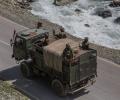
The strengthening of the Mountain Strike Corps is part of the steps taken by the force to rebalance its focus more towards the Chinese border from the western front with Pakistan.

There were reports of lobbying within the Pakistan army for the ISI DG's post, which falls vacant in June, reveals Rana Banerji, who headed the Pakistan desk at the Research and Analysis Wing, India's external intelligence agency.

The two sides have also agreed for a joint mechanism to verify the progress in the disengagement process through delegation meetings as well as using unmanned aerial vehicles.
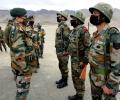
As per the sources, the discussions between the two sides include pulling back tanks and armoured vehicles from their present positions, and some development in this regard is likely to take place in the next few days.

The Indian side is expected to seek disengagement as soon as possible in the remaining friction points besides pressing for resolution of issues in Depsang Bulge and Demchok.
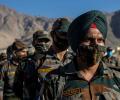
A day after the nearly 13-hour meeting, the two sides in a joint statement on Saturday reaffirmed that such a resolution would help restore peace and tranquillity along the Line of Actual Control (LAC) in eastern Ladakh and facilitate progress in bilateral relations.

"These powers will help Formation Commanders to establish and operate quarantine facilities/ hospitals and to undertake procurement/ repair of eqpt/ items/ material/ stores, besides provisioning of various services and works required to support the ongoing effort against COVID," his office tweeted.

Like the Shourya and Prahar missiles, the Pralay is powered by conventional solid fuel, and its payload is designed to carry only a conventional warhead.

Army Chief General Bipin Rawat on Tuesday made his first visit to the Eastern Command after taking over the office and also went to the forward areas at the international borders with China.

While interacting with jawans, the General highlighted that it was "the dawn of a new era of development, peace and prosperity in Kashmir" and applauded them for their high level of morale and contribution to peace building in Jammu and Kashmir.
