
The Union government's fiscal deficit further widened to Rs 9.53 lakh crore, which is nearly 120 per cent of the annual budget estimate, at the end of October of the current financial year, according to official data released on Friday. The deficit widened mainly on account of poor revenue realisation. The lockdown imposed to curb spreading of coronavirus infections had significantly impacted business activities and in turn contributed to sluggish revenue realisation.
Fiscal deficit had soared to seven-year high of 4.6 per cent of GDP in 2019-20, mainly on account of poor revenue realisation which dipped further towards the close of March because of the lockdown.

The rise in the fiscal deficit, which is a reflection of the government's borrowing, was mainly on account of subdued tax collection. The revenue deficit also rose to 3.27 per cent, up from the revised estimate of 2.4 per cent of the GDP.

Of these 8.5 million additional people employed in September, 6.5 million were in rural India, reveals Mahesh Vyas.
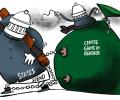
This may lead to the states' combined fiscal deficit to widen much faster, while the Centre may show a smaller or insignificant slippage in meeting its deficit target. The Centre will celebrate over its fiscal prudence, but the states would suffer, A K Bhattacharya points out.

Fiscal deficit is a reflection of government borrowings, which is used to bridge the gap between revenue and expenditure.

The health and family welfare ministry spent 70 per cent of its allocation till October. The ministry may need additional funds for the vaccination drive which is expected to be kicked off from January.

The ministry of health and family welfare spent Rs 3,948 crore in May this year compared to Rs 7,816 crore in the corresponding month of the previous year. On the other hand, at Rs 12,930 crore, the expenditure had risen almost 200 per cent in April against Rs 4,327 crore in the corresponding month of 2019-20.

The 30-share Sensex ended up 219 points at 18,620 and the 50-share Nifty ended up 63 points at 5,472.
The main gainers on the Sensex were Bajaj Auto, TCS, Cipla, HDFC, HDFC Bank.

In absolute terms, the fiscal deficit, or gap between expenditure and revenue receipts, stood at over Rs 5.07 lakh crore (Rs 5.07 trillion) at the end of February, according to the data released by Controller General of Accounts on Thursday.
In absolute terms, revenue receipts stood at Rs 9.07 lakh crore at the end of October. For the entire 2019-20, the revenue receipts have been pegged at Rs 19.62 lakh crore.
Estimates (BE), slightly better than 74.4 per cent in the same period a year ago, according to Controller General of Accounts (CGA) data released on Friday.

This is slightly better than the fiscal deficit position last year when it was 85.6 per cent of the Budget target.
Fiscal deficit in the first four months of 2012-13 stood at 51.5 per cent of the budget estimates -- slightly better compared to 55.4 per cent in the same period a year ago -- according to Controller General of Accounts (CGA) data released on Friday.
The government has budgeted to cut the fiscal deficit to 3.3 per cent of GDP or Rs 6.24 lakh crore in 2018-19, from 3.53 per cent in the previous financial year.
Amidst a debate on controversies surrounding some of the Comptroller and Auditor General reports, the high level committee that went into the Commonwealth Games related projects, has suggested changes in the functioning and structure of top audit and vigilance bodies like the Comptroller and Auditor General making it a three-member body.

To meet the revised estimates for 2019-20, the central government will have to garner Rs 5.03 trillion in total revenues in March, which has seen the worst phase of the coronavirus pandemic so far and the resultant lockdown.
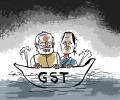
In the current financial year, the Centre released nearly Rs 1 lakh crore compensation to the states till September.
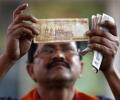
The government's fiscal deficit during 2011-12 worked out to be 5.7 per cent of the GDP, lower than 5.9 per cent projected in the revised estimates in the Budget.

Free provision of food, cash transfers, and jobs in villages see enhanced flow of funds despite a precipitous fall in revenue. Till May, defence spend was nearly 30 per cent less than the previous year.
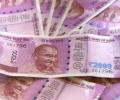
For 2017-18, the government aims to bring down the fiscal deficit to 3.2 per cent of GDP. Last fiscal, it had met the 3.5 per cent target.

While experts pointed out the impact of corporation tax cuts cannot yet figure in collections as most companies are yet to decide on their choice, government officials said a part reason for slow collection is the tax cut.

Almost all infrastructure ministries continued spending on capex throughout the lockdown, even as the Centre tried to maintain some semblance of economic normalcy.
Experts say a large part of the expenditure in April was spent on heads such as creating infrastructure for testing capacity and procuring testing kits, among other things.
Excise collections for April have been badly hit, resulting the fiscal deficit touching 16 per cent of target in the very first month itself, which could douse expectations of interest rate cuts.
Special clearing (with return clearing on the same day) shall be conducted in the evening/night of March 30 and 31, with the approval of the president of the local clearing houses run by the RBI/agency bank. This measure has been taken to avoid operational convenience at the local centres so that the clearing instruments relating to government revenue received from the members of the public are realised and credited to government account by March 31, 2009.

For 2017-18, the government aims to bring down the fiscal deficit to 3.2 per cent of the GDP. Last fiscal, it had met the 3.5 per cent target.
The Centre's fiscal deficit for the first two months (April-May) of the current fiscal has increased to Rs 90,758 crore, which is 27.3 per cent of the Interim Budget estimate, according to the Controller General of Accounts data released on Tuesday. The Budget estimate for the fiscal deficit in the year 2009-10 is Rs 3,32,835 crore.

'Let us hope that this Budget delivers.' 'It needs 10 per cent plus real GDP growth in 2021-22, the rebound year,' notes Omkar Goswami.
India's fiscal deficit has crossed the government's initial estimate of 2.5 per cent of Gross Domestic Product in the eight months up to November 2008.

It was 55.3 per cent for the same period last year, and data shows the fiscal deficit for April-May was kept in reasonable check in spite of heavy frontloading of expenditure.

Shine Jacob & Karan Choudhury highlight the red flags raised by the Controller General of Accounts.
The government is committed to restrict the fiscal deficit at 3.4 per cent of GDP as envisaged in the Budget.

The fiscal deficit situation during April-May of the last fiscal was 37.5 per cent of the Budget estimates.

In absolute terms, the fiscal deficit -- the difference between expenditure and revenue -- was Rs 6.12 lakh crore during April-November 2017-18
The government collected over 40 per cent more revenue from taxes at Rs 44,463 crore (Rs 444.63 billion) during the first quarter of this fiscal against Rs 31,668 during the corresponding period of 2005-06.
The Centre managed to collect only Rs 990 crore as compensation cess in April 2020-21, almost one-ninth of the figure of Rs 8,874 crore mopped up a year ago. The subdued collection would further increase states' problems unless the GST Council, which meets next week, decides to borrow from the market.
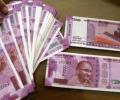
The panel may include or seek inputs from former RBI Governor Urjit Patel, former chief economic advisor Arvind Subramanian, Sajjid Chinoy of the PM-EAC, Rathin Roy, among others.
 © 2026 Rediff.com - Investor Information - Advertise with us - Disclaimer - Privacy Policy - Sitemap - Feedback - About us - Terms of use - Grievances