
The centre's gross tax collection rose by 21 per cent at Rs 2,57,558 crore (Rs 2575.58 billion) till January this fiscal thanks to buoyancy in service tax, income tax and corporate tax receipts.
The Union government's fiscal deficit shot up by about 31 per cent to Rs 54,517 crore (Rs 545.17 billion) in the first quarter of this fiscal due to higher expenditure.
The Centre's gross tax collection was up by about 19 per cent at Rs 2,30,839 crore (Rs 2308.39 billion) till December this fiscal backed by spurt in corporate earnings and imports.

The fiscal deficit, gap between expenditure and revenue.
Fiscal deficit has come down by over 34 per cent to Rs 53,235 crore (Rs 532.35 billion) in the first half of 2004-05 mainly due to government's expenditure control measures and higher tax mop up.
India's fiscal deficit shot up by nearly 50 per cent to Rs 92,068 crore (Rs 920.68 billion) during the first seven months of 2005-06 despite a 24 per cent higher tax mop up.
The central government's fiscal deficit climbed to Rs 81,014 crore (Rs 810.14 billion) for the first six months of the financial year 2003-04.
The Centre's fiscal deficit mounted to Rs 110,470 crore (Rs 1.104 trillion) till February despite higher growth in tax collections.
The Centre's fiscal deficit was up marginally by 1.6 per cent at Rs 1,27,975 crore (Rs 1279.75 billion) during 2004-05 from Rs 1,25,960 crore (Rs 1259.60 billion) in 2003-04, despite efforts to cut wasteful spending and push up revenue.
India's fiscal deficit has come down marginally to Rs 92,435 crore (Rs 924.35 billion) till December this fiscal from Rs 93,656 crore (Rs 936.56 billion) till November.
Fiscal deficit fell marginally by 2.3 per cent to Rs 90,239 crore (Rs 902. 39 billion) in the first nine months of the financial year 2004-05 mainly due to higher tax mop-up.

Direct tax collections grew by a meagre 6.6 per cent during April-July of the current financial year against the Budget target of 14.4 per cent for 2018-19. Corporation taxes, in particular, grew at just 0.57 per cent, the lowest in the first four months in at least seven years.
The fiscal deficit of the Centre surged by 21 per cent to Rs 52,509 crore (Rs 525.09 billion) in the first five months of 2004-05.

The fiscal deficit in the first three months of current fiscal stood at Rs 2.86 lakh crore or 51.6 per cent of Budget estimates for 2015-16.
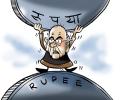
For the first eight months of the current financial year, the figure stood at Rs 7.17 trillion.
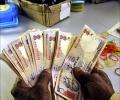
The fiscal deficit touched 61.2 per cent of full year Budget Estimates or over Rs 3.24 lakh crore in end July.

In a circular, the home ministry said the revised cash management system, formulated by the ministry of finance, has to be followed in view of the changes in tax receipt under the GST regime.

Is the curated and limited data put out by the central government sufficient enough to pass a judgement on the trend in GST collections, particularly that of the Centre?

The fiscal deficit in the first five months of the current fiscal ended August stood at Rs 3.69 lakh crore, or 66.5 per cent, of Budget estimates for 2015-16.

In his interim budget on February 17, Finance Minister P Chidambaram said the fiscal deficit would not cross 4.6 per cent of GDP, revising an earlier target of 4.8 per cent.

The government aims to further bring down the fiscal deficit -- the gap between expenditure and revenue -- to 3.5 per cent.

Country's fiscal deficit touched Rs 516,390 crore or 95.2 per cent of the annual target during April-December, the Controller General of Accounts said.
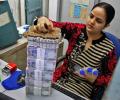
'The Budget numbers presented severely underestimate the magnitude of the unstated fiscal crisis that we went through in 2018-2019, which cannot be conceivably be fully reversed in 2019-2020,' points out Rathin Roy, director, National Institute of Public Finance and Policy.

Nirmala Sitharaman has designed the revenue mix in such a way that while Centre's share in taxes would grow a massive 25 per cent, states' share would grow a dismal 6 per cent.

India's fiscal deficit reached 4.11 trillion rupees ($61.67 billion) during April-October or 74 per cent of the full-year target, government data showed on Monday.

Finance Ministr Arun Jaitley will have to do a balancing act to manage fiscal prudence.

The CAG audit and other data suggests it could be far from the efficient new alternative that was once conceptualised. A conclusive review remains elusive till the government begins to release more granular and comparable data on the complex backend of GST to a deeper scrutiny, by researchers, auditors and the public.
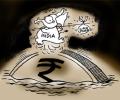
The government is committed to restricting the fiscal deficit at 4.1 per cent of the GDP during the current financial year

The size of the GDP in the second quarter of 2018-19 is estimated at Rs 33.98 lakh crore, as against Rs 31.72 lakh crore a year ago
Unperturbed by the rise in the fiscal deficit, Finance Minister P Chidambaram on Thursday exuded confidence that it would remain within the target of 4.8 per cent of GDP in the current financial year.
The deficit for the first five months of the year stood at 96 per cent of the full-year target of Rs 5.46 lakh crore despite cut in capital expenditure in August.

Net tax receipts in the first half of the fiscal stood at Rs 3.23 lakh crore (Rs 3.23 trillion), or 33.1 per cent of BE, the data released by the Controller General of Accounts today showed.
 © 2026 Rediff.com - Investor Information - Advertise with us - Disclaimer - Privacy Policy - Sitemap - Feedback - About us - Terms of use - Grievances