
"The Prime Minister's unilateral move to conduct fresh election by allowing to dissolve the most representative Constituent Assembly was aimed at capturing power and this has created frustration in the minds of the general public," said a joint statement issued by five parties.

Violence in Nepal continued unabated on Tuesday as thousands of people protesting the proposed new Constitution clashed with police in which one person was killed, taking the death toll to 11 and prompting authorities to deploy army in a riot-hit district bordering India.

Prime Minister Narendra Modi on Sunday met his Nepalese counterpart Sushil Koirala and discussed ways to strengthen bilateral cooperation in key sectors like trade and investment, hydropower and agriculture.

Upset over political developments in Maharashtra, the Congress and other opposition parties boycotted Constitution Day celebrations in the Central Hall of Parliament and held a joint protest in front of the Ambedkar statue inside Parliament complex.
Top leaders of Nepal's major political parties have met over two days in an attempt to arrive at a consensus, but the discussions were inconclusive. Another round of meetings and discussions are due to be held over the weekend before the constituent assembly meets on April 23, says Shubha Singh
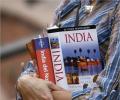
Social activist Niranjan Bhatwal from Maharashtra has moved a Public Interest Litigation in the Supreme Court seeking that the country be called 'Bharat', and not 'India' as the latter is of colonial origin, and that the constitution makers intended that 'Bharat' be used for all official and unofficial purposes, and not 'India'.

Jaganmohan Reddy will be sworn in as chief minister on May 30.

Jammu and Kashmir high court has ruled that Article 370, granting special status to the state, has assumed place of permanence in the Constitution and the feature is beyond amendment, repeal or abrogation.
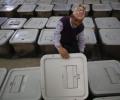
Nearly 70 per cent of Nepal's electorate voted on Tuesday to choose an assembly that will draft a new constitution to end years of turmoil and political uncertainty though balloting was hit by sporadic violence, including vandalism and explosions that injured a dozen.
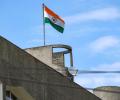
Many Kashmiris termed the removing of that state flag as a "saddest moment for the J&K's history." Umar Ganie/Rediff.com reports from Srinagar.

Jaitley gathered a group of people and burnt an effigy of then prime minister Indira Gandhi, making him, in his own words, the 'first satyagrahi' against the Emergency.

In the light of the efforts being made to forge electoral unity between scheduled castes and Muslims, Mohammad Sajjad examines what the architect of our Constitution, B R Ambedkar, had to say about the Muslim community.

They sought directions declaring presidential orders of August 5 as 'unconstitutional, void and inoperative'.

Shah said nobody can stop him from introducing a resolution on Kashmir in Parliament.
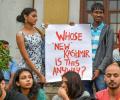
If the apex court agrees to hear the petitions challenging the removal of Article 370, it would be interesting to see if there is an immediate status quo on further proceedings or if it will decide after hearing all the petitions, reports Aashish Aryan.
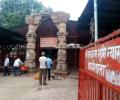
'What is at stake is not one mosque or temple, it is the question of the principle of secularism which is part of the basic structure of the Constitution as declared even by the Supreme Court of India.'
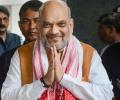
Shah also said that no 'illegal migrant' will be allowed to stay in the country and that the National Register of Citizens exercise in Assam was completed in 'time-bound manner'.

As long as even one Indian holds aloft Ambedkar's portrait and recites the Preamble, the Republic remains alive, says Mihir S Sharma.
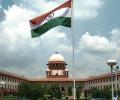
'What the long term repercussions of the Ayodhya judgment are will unfold in time.' 'And I hope the consequences are not going to be as damaging to us as they were to Pakistan,' says Aakar Patel.
Madhav Kumar Nepal was sworn-in on Monday as the Prime Minister of Nepal along with two cabinet ministers, capping the three-week long political crisis in the country that eased Maoists out of power after a confrontation with the army.
Veteran Communist leader Madhav Kumar Nepal was on Saturday elected unopposed as the prime minister of Nepal, bringing to an end the nearly three-week long political crisis in the country. The 56-year-old Communist Party of Nepal (Unified Marxist Leninist) leader, who claims to have the support of 351 lawmakers in the 601-member Constituent Assembly, was the only candidate to have filed the nomination for the top post. The Maoists boycotted the voting process.
Nepalese Prime Minister Girija Prasad Koirala on Thursday resigned from his post, ending a two-month long deadlock to pave the way for the country's first ever Maoist-led government. Koirala, 83, announced his resignation while addressing the Constituent Assembly, which was elected in April to rewrite the constitution and govern the Himalayan nation, Nepali Congress Assembly member Tirtha Ram Dangol said.
The Seven-Party Alliance in Nepal has achieved a major breakthrough in the ongoing political logjam by agreeing to elect prime minister, president and vice-president through a simple majority of the Constituent Assembly, but differences continue to persist over the composition of the National Security Council.

While Rajya Sabha Chairman M Venkaiah Naidu asked the protestors not to make the House a "clog in the wheel" of progress, Lok Sabha Speaker Sumitra Mahajan said they should keep in mind the larger interests of the nation.
The United States is considering removing the Communist Party of Nepal-Maoist from the list of terrorist organisations after its stunning performance in the constituent assembly elections. Earlier, the US ambassador to Nepal had met Maoist chairman Prachanda, where the Maoist chief suggested that the US should remove the Maoists from its terrorist list. The US is also likely to pull out a negative travel advisory about Nepal that lies posted on the State Department's website.
The Communist Party of Nepal Maoist, which emerged victorious in the recent Constituent Assembly polls, decided on Wednesday that the next government should be under its leadership and that party chairman Prachanda' would head the government. The meeting reaffirmed the abolition of monarchy and implementation of republic in the country and concluded to form a coalition government and continue consensus with other parties.
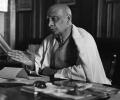
Generations of Indians don't quite grasp that there would barely be an India had it not been for the Sardar whose steadfastness and guile stitched together that which had been united only in philosophy and spirituality and sometimes not even then -- for thousands of years. A fascinating excerpt from Hindol Sengupta's The Man Who Saved India, Sardar Patel and His Idea of India.
The Nepal government and political parties should ensure that the long-awaited constituent assembly elections on April 10 are free of violence, candidate intimidation, and efforts to suppress voter turnout, according to the Human Rights Watch. The newly elected lawmakers will draft a brand new constitution and are expected to ratify a pledge by the main political parties to turn Nepal into a federal republic.The Nepali election campaign has been plagued by violence.

Newly elected Prime Minister Pushpa Kamal Dahal on Saturday said the industries and business enterprises in Nepal which were closed due to the Maoist threats in the past will be reopened.
The 601-member assembly met at the Birendra International Convention Centre on Wednesday evening where a motion was passed to declare the country the world's newest republic. After a series of meetings, the Seven Party Alliance agreed to table the motion of republic in the first meeting of the Constituent Assembly, dominated by Maoists.
Nepal's beleaguered King was on Wednesday given 15-day time to vacate the royal palace as thousands of people poured into the streets and sprinkled vermillion on each other to celebrate the country's transition to a republic.
Ending a political deadlock, Nepalese Prime Minister Girija Prasad Koirala on Saturday invited the Maoists to form a government, more than a month after they emerged as the biggest party in the Constituent Assembly polls.
'We have done majoritarianism through other means.' 'The Citizenship Amendment Act, read together with the National Register of Citizens, will prove what I mean,' notes Aakar Patel.
"We have an organisation being placed on the list of designated foreign terrorists organizations. (It) has legal requirements that are placed on us. We have to honour those legal requirements and we'll certainly do so in the case of Nepal," State Department's Deputy Spokesman Tom Casey said.
Maoist supremo Prachanda, whose party has registered a surprise victory in recent Constituent Assembly polls, on Sunday declared that he would lead the next government in Nepal.As the interim constitution does not have the provision for electing a President, he is expected to head the government as Prime Minister. Prachanda also assured the voters that Nepal would be declared a republic in the first meeting of the Constituent Assembly.
With the Maoists sweeping the Constituent Assembly polls bagging 106 out of the 190 declared so far and leading in 11 others, the party has initiated serious consultations including a meeting with Prime Minister G P Koirala on modalities to form the new government. Results for 50 seats are awaited out of the 240 at stake in direct elections. The Maoists are on track to become the single largest party.
The Maoists in Nepal spearheaded by Prachanda today surged ahead in the landmark constituent assembly polls, winning 14 seats and leading in 65 of the remaining 240 constituencies. Prachanda, 53, chairman of the Communist Party of Nepal-Maoist who led a decade-long insurgency in the country to overthrow the monarchy, defeated his closest rival Rajendra Kumar K.C of the Nepali Congress in Kathmandu.
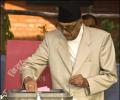
Polling started at 0700 hours (0645 IST) and will end at 1700 hours (1645 IST), election officials said. Some 6,000 candidates are contesting the election under proportionate voting system while 4,021 candidates are in the fray under direct voting system. The country has witnessed a violence-marred campaign for the crucial elections to elect a body that will rewrite the Constitution and decide the fate of the 239-year-old monarchy.

Here's the full text of President Ram Nath Kovind's address to the nation on the eve of 72nd Republic Day.
53-year-old Pushpa Kamal Dahal alias Prachanda was administered the oath of office by President Ram Baran Yadav during a function at the Rastrapati Bhawan in Kathmandu.
 © 2026 Rediff.com - Investor Information - Advertise with us - Disclaimer - Privacy Policy - Sitemap - Feedback - About us - Terms of use - Grievances