
The agency said, 'The downgrade reflects Moody's expectation that China's financial strength will erode somewhat over the coming years, with economy-wide debt continuing to rise as potential growth slows.'

SBI was the biggest loser in the Sensex pack, shedding 2.40 per cent, followed by Yes Bank, Bharti Airtel, L&T, Sun Pharma, M&M, ICICI Bank, ONGC, RIL, Asian Paints, Vedanta and HUL, which lost up to 2.37 per cent.
.jpg)
Economy still faces many challenges and 'relatively big' downward pressures such as increasing difficulties for businesses and the emergence of economic risks, the Central Economic Work Conference said.

Modi is scheduled to meet over 50 CEOs of Fortune 500 companies over dinner hosted in New York on September 24.
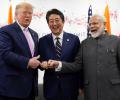
Prime Ministers Modi and Abe enjoyed a close and empathetic relationship and this certainly gave a sustained momentum to the India-Japan strategic partnership. It is necessary for India to reach out and engage with his successor as early as possible, advises former foreign secretary Shyam Saran.

China's economy expanded by 11.1 per cent in the first six months from a year earlier after recording growth of 10.3 per cent for the second quarter, compared with the 11.9 per cent rise in the first quarter.

While edging up China's gross domestic product growth projection for both 2010 and 2011, the report said that growth in domestic demand would remain strong although exports could suffer from a predicted global economic slowdown next year.

The staggering gross domestic product expansion, which beat expectations, has also sparked concerns of further monetary tightening measures, as China is also grappling with rising inflation and risk of overheating.

The new data comes a day after China and the US signed a long-awaited phase one deal, marking a ceasefire in the 18-month-long trade war which saw the world's two largest economies slap 25 per cent tariffs on about half a trillion-dollar worth of each other's exports. The world's second-largest economy grew by 6.1 per cent last year, its worst performance since 1990, but it remained above the psychologically important mark of six per cent, according to the National Bureau of Statistics (NBS).
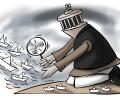
The report by the High Level Advisory Group said India stands to benefit even more when the US and China are locked in a global trade war.

The trade impact of the coronavirus epidemic for India is estimated to be about 348 million dollars (approximately Rs 25 billion) and the country figures among the top 15 economies most affected as slowdown of manufacturing in China disrupts world trade, according to a UN report. Estimates published by United Nations Conference on Trade and Development on Wednesday said that the slowdown of manufacturing in China due to the coronavirus (COVID-19) outbreak is disrupting world trade and could result in a 50 billion dollar decrease in exports across global value chains.

'By causing military humiliation of India it intends to send a signal to other Asian countries to toe the Chinese line,' argues Colonel Anil A Athale (retd).
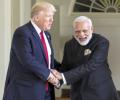
India must be aware that there is no question of the US fighting the Chinese on land. We have to fight our own battles, points out Virendra Kapoor.

India's growth rate, which slowed down to 6.5 per cent this fiscal because of global financial meltdown, is expected to get back to around 9 per cent within two years.

India has progressed further than China in financial liberalisation and its private sector-led model has fostered indigenous entrepreneurship, whereas China is still dominated by highly profitable state monopolies.

The broader NSE Nifty rose nearly 124 points to settle just below the psychological 11,000 level.

The Chinese economy grew by stunning 10.7 per cent in the fourth quarter of 2009, which may see it replacing Japan as the second largest economy in the world.

'He is psychologically preparing the PLA and the Chinese public to avoid a loss of face.'

Unless we control the coronavirus, we are going to struggle to get our economy and country back on track. The spectre of the virus haunts recovery, warns Naushad Forbes.
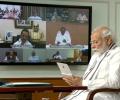
'Anyone familiar with Modi's track record will know he never forgets a slight, a betrayal,' notes Virendra Kapoor.

'The belief that FDI will shift from China appears to be a strategy of politicians to keep the media busy, chasing irrelevant news to ward off pressure and questions about the government's plans to deal with COVID,' observes Debashis Basu.

'If the almost literally heart-stopping Suez block has any positive outcome, it is to be hoped that it will accelerate the setting up of a fab (perhaps Taiwanese) in India,' asserts Rajeev Srinivasan.

The Chinese economy expanded at a rapid rate of 8.9 per cent in the third quarter of 2009 as compared to the year-ago period, mainly boosted by increased infrastructure investment and stimulus measures.

'If the Chinese intent is to be gauged based on its aggression in the South China Sea, greater forays in the Indian Ocean, a hawk's attitude towards Taiwan, flying its fighters repeatedly over the Senkaku islands in the East China Sea and creating strategic assets globally, there would be a requirement for strategic partnerships for India,' says Brigadier S K Chatterji (retd).
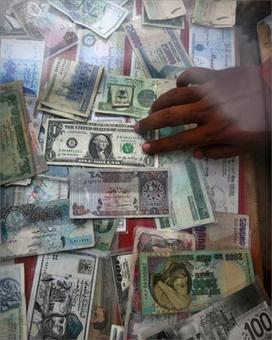
The International Monetary Fund on Wednesday raised India's growth forecast to 5.4 per cent for 2009 and said that the global economy is beginning to pull out of a recession.

'Chinese troops are not geared to fight Indian troops who are battle hardened and acclimatised and are far more hardy.'

With this subdued forecast, India is likely to record its worst growth performance since the 1991 liberalisation. However, it is among the only two major economies, which will register a positive growth rate in 2020. The other being China, for which the IMF has projected a growth rate of 1.2 per cent.
One part of the thesis was that India would sail through a global slowdown, while China's export-centred economy would be crippled. India generates less than 20% of GDP from exports, while the Chinese share is twice as high.
Consumption was the major driver, contributing 58.8 per cent to GDP growth

A strengthening dollar, rising interest rates, tightening liquidity and a surge in oil prices - all are combining to create a toxic atmosphere for EM assets, says Akash Prakash.
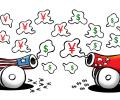
People are interested in the strength of India's economy, the country's stability, and the opportunities, says Stuart Tait, regional head of commercial banking, Asia-Pacific at HSBC.
India and China have some striking similarities and quite deep differences.
Indian economy will compete with the US and Chinese economies by 2020 said Minister of State for Mines T Subbarami Reddy.

Gold and silver have been shining bright in terms of adding to the investors' wealth compared with the other asset class -- stocks -- so far this year.
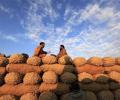
Attributing the growth to an upswing in consumption and investment, the World Bank has said India will continue to be the fastest growing major economy in the world.

Moody's expects growth in G-20 advanced countries to be stable at 1.8 per cent for 2016.

The 30-share Sensex also hit its one-year low of 22,494.61 on February 29 this year.
The greenback's strength against other Asian currencies and lacklustre local equity markets made the rupee depreciate.
If investment continues to be buoyant and efficiency improves, the problems of overheating may turn out to be less real and more imaginary, the mid-year review of the Indian economy said on Tuesday.

'Our biggest advantage is that the troops are much better trained and motivated than the Chinese and can improvise and manage with a part of the resources.'
 © 2026 Rediff.com - Investor Information - Advertise with us - Disclaimer - Privacy Policy - Sitemap - Feedback - About us - Terms of use - Grievances