
Travelling to Durham in North Carolina, Obama said companies in the US are having a tough time in finding right candidates in the field of science and technology, which he argued is not a good sign for the future of the country.
China and India's advantages such as lower costs and greater market opportunity outweigh the higher risk compared with the more established and mature regulatory regimes of Australia, Japan and Singapore.

The report '2014 International Piracy Watch List,' by International Creativity and Theft-Prevention Caucus highlights the high levels of piracy and the lack of legal protections for copyright in China, Russia, Switzerland and India.
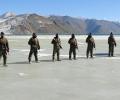
"Against such background, the words and deeds of relevant important military and government officials and military deployments should be conducive to deescalating and cooling down the situation, and to enhancing mutual trust, rather than the opposite", the spokesman said.
'China and India would like to conduct useful and meaningful exploration on this issue,' Chinese foreign ministry spokeswoman Zhang Qiyue said.
Countries like Germany, China and India are working every day to out-educate kids so they can out-compete American businesses and are making more progress than US, President Barack Obama said.
On the Dealogic measures, China and India now account for nearly half of all investment banking fees earned in Asia, outside Japan.
China and India continue to rank first and second respectively in the list of 25 most attractive FDI destinations, according to a study conducted by a global strategic management consulting firm.Brazil, the United Arab Emirates and Russia ranked among the top 10, the findings of the latest FDI Confidence index, a regular survey of global executives conducted by management consulting firm, A T Kearney, revealed.
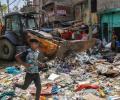
Many of the stories, the pictures going out of India worldwide lately with these provocative processions, taunting of Muslims, bulldozers targeting mostly their properties, the sweeping 'othering' of a community of 200 million are painting the front pages and TV screens in the democratic world. That is where most of the friends we covet lie. Soon enough, these will also make our vital friends among the Muslim nations, from Bangladesh to Saudi Arabia and the UAE, uneasy. The best time for course correction is now, asserts Shekhar Gupta.
'The emerging security environment in the Asia-Pacific is likely to revolve around China and the US with India viewed as a critical balancer in the region. New Delhi will now have to demonstrate that it is capable of thinking strategically.'
Sanjay Gupta, author of The Himalayan Face-off: Chinese Assertion and the Indian Riposte and deputy executive editor with the Hindustan Times, talks to Rediff.com's Vicky Nanjappa on Chinese incursions, Beijing's worrying defence budget, the curiosity generated over ties with our neighbours and more.
The report, Perspectives on Global Development 2010 -- Shifting Wealth, is the centerpiece of a Global Policy Dialogue co-hosted by the OECD Development Center and Global Development Network -- a platform for economic research institutes from developing countries.

The nine nuclear-armed states -- the United States, Russia, the United Kingdom, France, China, India, Pakistan, Israel and the Democratic People's Republic of Korea (North Korea) -- together possessed an estimated 13,080 nuclear weapons at the start of 2021.
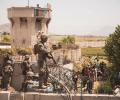
Like China, India too should connect the dots and move ahead with a long-term perspective in Afghanistan, advises Ambassador M K Bhadrakumar.
Nearly six months after New Delhi and Beijing signed a protocol to facilitate the export of Indian basmati rice to China, rice exporters are here in an upbeat mood.

Now, as before, India's vote at the UN was dictated by paramount national interests. Though the Indian vote was 'neutral', its explanation was explicit in its criticism of the Russian actions. India took back with the left hand what it had given with the right, explains Ambassador T P Sreenivasan.

India to become second largest smartphone market by 2016.
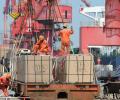
The China-India bilateral trade in the first half of the year totalled $57.48 billion, up 62.7 per cent year on year, perhaps the highest in recent years amid the Ladakh impasse and the COVID-19 pandemic, according to data released by China's Customs. Though Indian exports to China picked up with 69.6 per cent year on year increase, the trade deficit, a structural problem for India for long, climbed to 55.6 per cent. According to data released by China's Customs, India's exports to China reached $14.724 billion, up 69.6 per cent year on year in the first six months and India's imports from China amounted to $42.755 billion, up 60.4 per cent.
Calling for "autonomy from red tape and local politics" in India, Nobel Laureate Indian-American scientist Venkataraman Ramakrishnan on Tuesday said many scientists of Indian origin may return home if the government made "attractive offers" to undertake research in science.

Whether it liked it or not, the Ukraine crisis forced India to choose between the aggressor Russia and the US-led free world, a decision it hated to make, Virendra Kapoor points out. In the end, it abstained from the vote in the Security Council.
India is not intimidated by China and the border dispute between the two countries could be settled by talks, Minister of State for External Affairs Preneet Kaur has said, noting that the media was overplaying the recent tensions between the neighbours."We are not intimidated by China. I think we are very confident of our own strength but certainly we are very confident that this issue can be settled by talks," said Kaur. "There has been a lot of media hype," she added.
"China is our largest neighbour and its rise is a reality that entire world faces today," Rao said in her remarks at the University of California-Berkeley on Monday.
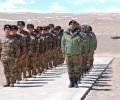
There was no comment from the Indian side on the statement made by the Chinese defence ministry spokesperson Colonel Wu Qian, and carried by China's official media.

'The big power struggle in faraway Europe erupted at a most critical juncture when India has been increasingly sceptical about American policies and statesmanship,' argues Ambassador M K Bhadrakumar.
India should make it clear that relations in the economic and other fields cannot improve without satisfactory progress in the border talks, feels senior analyst B Raman

China on Monday defended its visa curbs which have prevented thousands of stranded Indians from returning to Beijing, saying they are "appropriate" to control the spread of COVID-19 and do not target India alone, but are applied to even Chinese citizens coming back from overseas.

According to the Treasury official, the finance ministers meeting will cover the main topics for the Cannes summit that the G-20 have been working on, which will focus on food security.

China would be an influential player in the bank
India's 'high-calibre satellite' imagery has not shown diversion of Brahmaputra waters by China, official sources said in New Delhi on Thursday responding to criticism that government was turning a 'Nelson's eye' to reports of massive construction plans by Chinese authorities.
Goyal said, there is no proposal under consideration on withdrawal of MFN status to China.
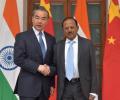
'Both sides had candid and in-depth discussions over easing the current border situation and reached positive common understandings,' it said. 'Both sides welcomed the progress achieved in the recent military and diplomatic meetings, agreed to stay in dialogue and consultation, and stressed the importance to promptly act on the consensus reached in the commander-level talks between Chinese and Indian border troops, and complete disengagement of the front-line troops as soon as possible,' it said.
A great, new book suggests that history favours China's future over India's.

China is rapidly emerging as the country that matters the most to India.
China will lead Asia-Pacific sovereigns in economic growth in 2008, followed by India, Standard & Poor's Ratings Services said. Though Japan is still the largest economy in the region, China' growth could position the country as the biggest economy in Asia-Pacific and the second-largest globally within the next five years.
If one concentrates solely on areas of concern, one will develop an unduly pessimistic attitude. If one looks only at the galloping trade and proliferating exchanges of visits, there could be unwarranted over-optimism. There is a need for a balanced perspective.

'India has to prepare for future warfare where kinetic use of force at the border will be limited. War will take place in the realms beyond the border.'
 © 2026 Rediff.com - Investor Information - Advertise with us - Disclaimer - Privacy Policy - Sitemap - Feedback - About us - Terms of use - Grievances