
Hitting out at Prime Minister Narendra Modi over the issue of tax cuts on petroleum products, Tamil Nadu Chief Minister M K Stalin on Thursday said people were aware of the fact behind the issue and pointed out at his government effecting a Rs 3 a litre cut on petrol earlier.

The October 5 meeting assumes significance as the Centre and states are at loggerheads over the issue of funding Rs 2.35 lakh crore GST collection shortfall.

Does this Budget deserve cheers or boos? You decide

The peak GST rate of 28 per cent as also the 5 per cent ad valorem cess will continue

GST collections crossed the Rs 1 lakh crore-mark for the fifth month in a row in February, rising 7 per cent to over Rs 1.13 lakh crore, indicating economic recovery, the Finance Ministry said on Monday. The collection is, however, lower than the record Rs 119,875 crore collected in the previous month.

In signs of acceleration in economic activity, India's tax collections on goods sold and services rendered returned to over Rs 1 lakh crore in July after the second wave of Covid-related restrictions caused a blip in the previous month. Goods and Services Tax (GST) mop-up grew 33 per cent year-on-year in July to over Rs 1.16 lakh crore, indicating that the economy is recovering at a fast pace. In July 2020, the collection was Rs 87,422 crore. This is the second highest collection so far this fiscal after a record Rs 1.41 lakh crore mop-up in April.

The Budget kept away from mood dampeners such as an increase in taxes (capital gain taxes) and even the much-feared introduction of Covid cess and wealth taxes, says Nimesh Kampani, chairman, JM Financial.

A record GST tax collection, an overhaul of the income tax return filing portal and the landmark move to scrap retrospective taxation have set the stage for the next level of reforms in tax administration that include bringing a framework for cryptocurrencies and rationalising the GST rate structure. With tax reforms such as faceless assessment taking roots, 2021 will go down as the year that pivoted the tax administration in a country aspiring to become the world's favourite investment destination. The task ahead is going to be a tough one as the tax department would grapple with taxing cryptocurrencies, rationalising Goods and Services Tax (GST) rates to shore up revenues and post June 2022, the scenario of how the GST revenue plays out for states without the Centre's support of compensation.

GST revenue remained above Rs 1 lakh crore for the second straight month in August at over Rs 1.12 lakh crore, 30 per cent higher than the collection in the year-ago period, the finance ministry said on Wednesday. "The gross GST revenue collected in the month of August 2021 is Rs 1,12,020 crore of which Central GST is Rs 20,522 crore, State GST is Rs 26,605 crore, Integrated GST is Rs 56,247 crore (including Rs 26,884 crore collected on import of goods) and Cess is Rs 8,646 crore (including Rs 646 crore collected on import of goods)," the finance ministry said in a statement. The mop up in August is, however, lower than Rs 1.16 lakh crore collected in July 2021.

The government on Thursday proposed to tighten the norms for taxation of cryptocurrencies by disallowing set off of any losses with gains from other virtual digital assets. As per the amendments to the Finance Bill, 2022, circulated among the Lok Sabha members, the ministry proposes to remove the word 'other' from section relating to set off of losses from gains in virtual digital assets. This would mean that loss from the transfer of virtual digital assets (VDA) will not be allowed to be set off against the income arising from the transfer of another VDA.
With the first quarter gross tax mop-up reaching Rs 5.6 lakh crore, Icra Ratings on Friday said the government is set to exceed the budgeted tax collection target of Rs 22.2 lakh crore for 2021-22, led by indirect taxes. The government has budgeted a modest 9.5 per cent growth in tax collections at Rs 22.2 lakh crore for FY22, over FY21 collections of Rs 20.2 lakh crore. However, despite the second wave of the pandemic, the April-June quarter tax collections rose to Rs 5.6 lakh crore, which is 39 per cent higher than Q1 of FY20.

The cess levied on top of the maximum 28 per cent tax rate on petrol vehicles with capacity to carry 10-13 persons has been reduced to 1 per cent and the same for diesel vehicles has been cut to 3 per cent.

Apart from Bihar, Chhattisgarh and Jharkhand, where none of the estimated 6.7 million construction workers got cash transfer benefits, the coverage of the construction workers was the lowest in Delhi, where only about 5 per cent of the estimated workers received cash under the PMGKY, followed by Kerala and Uttar Pradesh (22 per cent), among major states. In India, construction workers belong to the unorganised sector but account for the highest share of non-farm jobs after manufacturing.
'We revolutionised the system in a manner so that the chances of leakage will be much lower than it was in the beginning.'
GST collections in March slipped below the psychological Rs 1-lakh crore mark for the first time in four months to Rs 97,597 crore as the COVID-19 lockdown that shut most businesses compounded tax collections in an already sluggish economy.

Facing an acute shortage of COVID-19 vaccines, the Odisha government on Monday decided to float a global tender for procuring the vaccine to inoculate the states entire population, Chief Secretary S C Mohapatra said.

Ahead of the upcoming Union Budget, Society of Manufacturers of Electric Vehicles (SMEV) has asked Finance Minister Nirmala Sitharaman to either rejig the FAME II scheme or reintroduce FAME I, saying the programme meant to promote EVs in its second avatar has been able to achieve less than 10 per cent of its target. The Rs 10,000-crore FAME-II scheme which is to be implemented over a period of three years, came into effect from April 1, 2019. It is the expanded version of FAME India I (Faster Adoption and Manufacturing of (Hybrid) and Electric Vehicles (FAME) which was launched on April 1, 2015, with a total outlay of Rs 895 crore.

Homegrown auto major Tata Motors on Tuesday said it has received 98 patents last year under its accelerated drive for engineering excellence and innovation. These patents predominantly relate to the megatrend of CESS (connected, electrified, sustainable and safe) automobiles, the company said in a statement. The patents also encompass an eclectic mix of improvements in automotive electronics, noise vibration and harshness, conventional and advanced powertrain systems, and crash safety under various categories of industrial designs, copyrights and notarisations, the statement added.

No change in retail prices as oil marketing firms to absorb increase

Anil Rego, CEO, Right Horizons, answers your personal income tax queries.
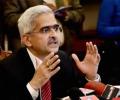
Heightened geopolitical uncertainties will lead the Reserve Bank's rate-setting panel to opt for a status quo at the next week's meeting, Axis Bank's chief economist Saugata Bhattacharya said on Monday. Bhattacharya said he had earlier expected a tightening action at the policy meet scheduled for April 6-8 but the increased uncertainties on the geopolitical front due to the Russian invasion of Ukraine and its impact on commodity prices makes him now think that RBI will defer such an action. He said the central bank's Monetary Policy Committee (MPC) may hike rates in the second half of FY23 by up to 0.50 per cent.

Thomas Isaac has been in and out of the national news in his role as Kerala's finance minister since 2018 for various path-breaking tax initiatives. But it is 2020 that he has become more prominent, principally in the GST council.

'Pump prices of petrol and diesel have reached historical highs. An unwinding of taxes on petroleum products by both the Centre and the states could ease the cost-push pressures,' the Monetary Policy Committee (MPC) has said.

The stalemate over compensating states for the shortfall in GST collections continued on Monday with a meeting of the GST Council ending without reaching any consensus. The panel, which is the highest decision-making body on indirect taxes, for the second time in a week failed to reach a consensus on the Centre's proposal of states borrowing against future GST collections to make up for the shortfall.

The government has decided to spend big on infrastructure across a wide variety of sectors to give a greater impetus to the economy which is recovering from the impact of Covid-19, Finance Minister Nirmala Sitharaman said on Monday.

The price of petrol is expected to come down to Rs 84.71 a litre and diesel to Rs 77.98

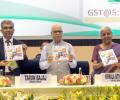
The government on Monday projected a 16.67 per cent growth in gross tax revenue in the next fiscal beginning April 1, at over Rs 22.17 lakh crore. The revised estimates of gross tax revenue for the current fiscal has been pegged at Rs 19 lakh crore, lower than the Rs 24.23 lakh crore budgeted earlier. Economic Affairs secretary Tarun Bajaj said, "Our revenue figure is under-stated not overstated.

Additionally, road cess on petrol was raised by Re 1 per litre each on petrol and diesel to Rs 10.

The government on Wednesday extended the existing foreign trade policy (FTP) for six more months up to September 30 this year due to the Covid-19 pandemic, according to a notification. FTP provides guidelines for enhancing exports to push economic growth and create jobs. On March 31, 2020, the government had extended the Foreign Trade Policy 2015-20 for one year till March 31, 2021, amid the coronavirus outbreak and the lockdown.

Flagging higher fuel prices in many opposition-ruled states, Prime Minister Narendra Modi on Wednesday called it "injustice" to people living there and urged the governments there to reduce VAT in "national interest" to benefit the common man. Modi raised the issue of many states not adhering to the Centre's call for reducing the Value Added Tax (VAT) on petrol and diesel after his government slashed excise duties on them in November last, and asked them to work in the spirit of cooperative federalism in this time of global crisis. Higher prices in some states were also harmful for neighbouring states, he added.
A road map could be laid out for a gradual reduction in the tax rates from the current incidence of about 62-94 per cent without causing a major blow to the revenues of the Centre and the states. The opportunity arising out of higher GST collections should not be squandered, says A K Bhattacharya.

The BJP would want that by March 2022, when UP votes, the economy starts looking up and it heads into the polls with no other issue distracting from its main poll plank of the construction of the Ram temple in Ayodhya.

The Union Budget on Monday evoked contrasting responses in the political arena with the ruling Bharatiya Janata Party hailing it as a vision for an 'Aatmanirbhar Bharat' and the Opposition describing it as a 'let down like never before' that was meant to 'deceive' people.

The finance ministry on Monday said it will transfer Rs 6,000 crore as the second tranche of GST compensation shortfall to 16 states and 3 Union Territories -- including Maharashtra, Bihar, Assam, Puducherry and Delhi. The Centre had on October 23 transferred Rs 6,000 crore to 16 states and 2 UTs of Delhi and Jammu and Kashmir. In the second tranche of transfer, Union Territory of Puducherry has been included.

The GST Council last year imposed a cess of 15 per cent on hybrid vehicles, in addition to the 28 per cent GST, leading to a total tax burden of 43 per cent against a previous tax rate of 28 per cent.

GST collections for January touched an all-time high of about Rs 1.20 lakh crore, the finance ministry said on Sunday. The ministry said in line with the trend of recovery in the GST revenues over past five months, the revenues for the month of January 2021 are 8 per cent higher than that in the same month last year.

The revenues for August are 88 per cent of the GST collected in the same month last year.

States are planning to pass resolutions in their legislative assemblies; however, such tactics will be used as the last resort if the Centre continues to stall allocations.

If the shares are purchased for investment, then it would be treated as a capital asset and taxed as capital gains.
But if the shares are bought and sold in a short duration repeatedly, then it would be taxed as business income, explains Amit Gupta.
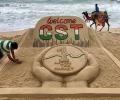
The finance ministry has set up two committees of state finance ministers which would rework rate slabs, review GST exempt items and identify potential evasion sources. Four years after the roll out of the national Goods and Services Tax (GST), which replaced the complex indirect tax structure, the centre and states have started work on moving towards a "simpler rate structure in GST" by reviewing the current rate slabs, including special rates and merger of rate slabs. The Group of Ministers (GoM) on rate rationalisation would also review items under inverted duty structure to help minimise refund payout, and review the supply of goods and services exempt under GST with an objective to expand the tax base and eliminate breaking of input tax credit (ITC) chain.
 © 2026 Rediff.com - Investor Information - Advertise with us - Disclaimer - Privacy Policy - Sitemap - Feedback - About us - Terms of use - Grievances