
In Professor Sulochana Gadgil's passing, India has lost a scientific giant, a fierce intellect, and a compassionate soul, remembers Dr Madhavan Nair Rajeevan.


Dr Shreekant Sambrani pays tribute to M S Swaminathan, renowned agricultural scientist and a lifelong crusader against hunger who passed away in Chennai recently.

I suggest we build a Vigyan Mandir (Temple of Science) with the ambience of a place of worship, so that it becomes a destination for pilgrims. We should embed on its walls bronze plaques describing each scientist mentioned here along with about a dozen of our ancient mathematicians, recommends Professor Kalyan Singhal, historian of science and technology.
"As I was working on agriculture, my family wanted me to take over the management of our plantations. But my aim was to master the art of developing new varieties, that is genetics and breeding. As the proverb has it, we reap what we sow. Consequently, sowing the right things is very important," M S Swaminathan had once said.
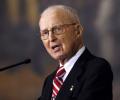
Nobel Peace Prize winner US scientist and one of the main architects of India's first green revolution Norman Borlaug died in Texas on Saturday. He was 95.
Dr M S Swaminathan, friends with Dr Norman Borlaug for 56 years, recalls how the Nobel Laureate transformed Indian agriculture.
The Green Revolution owes a debt to Norman Borlaug, whose birth centenary falls this year.

India-born Mexican scientist Sanjaya Rajaram has been presented with the prestigious World Food Prize 2014 for his agricultural research that led to a remarkable increase in world wheat production building on the successes of the Green Revolution.
The US Congress has invited Dr C S Swaminathan, who worked along with Borlaug during the days of India's Green Revolution, to introduce him.
Dr Amit Roy, president and chief executive officer, International Fertilizer Development Center, could very well be the next Dr Norman Borlaug.
Prime Minister Manmohan Singh on Monday paid glowing tributes to Nobel laureate Norman Borlaug, recalling that his Green Revolution techniques helped India achieve self-sufficiency in foodgrains, overcoming severe shortage. At a time in the 1960s, when India was facing the specter of severe food shortage, the introduction of Borlaug's high yielding varieties of seeds set in motion a technological revolution in agriculture, leading to India achieving self-sufficiency, he said.

India-born plant scientist Sanjaya Rajaram has been named the winner of the $250,000 World Food Prize for his breakthrough achievement in increasing global wheat production by more than 200 million tonnes following the Green Revolution.

The work of Norman Borlaug, who helped save billions from starvation, is worth recalling, especially as opposition to gene-modified crops mount, says Shreekant Sambrani.

'Respect nature, working with (it) rather than against it.'
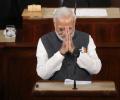
How do you rate PM Modi's speech at Capitol Hill?

It is largely due to his vision and efforts that we have almost quadrupled our per capita milk availability in the last 40 years, points out Shailesh Dobhal.

The media is celebrating Norman Borlaug as a great hunger-fighter, whose intervention with the 'Green Revolution' is supposed to have eradicated hunger in India. Obviously, the real starvation is of the mind, says Sadanand Menon.

'He spoke about 20 jawans in Ladakh, but he couldn't even name China.' 'He said the world had seen what had been achieved, even though we Indians don't know because Modi has himself said that nothing had happened and nobody had come,' points out Aakar Patel.

Prime Minister Narendra Modi delivered an impassioned speech to the United States Congress.
India is capable of developing GM crops, Randy Hautea, global coordinator for International Service for the Acquisition of Agri-Biotech Applications, tells Kanika Datta.

Praising the US for turning barriers into bridges of partnership, he said that America had stood with India when the support was needed the most, like when terrorists attacked Mumbai in November 2008 and in other economic endeavours as well

Here's the full text of Prime Minister Narendra Modi's address to the United States Congress.

'They don't always agree with our governments, their teachers or their parents, but it is the conviction of their ideas, and their determination to share them with the world that, I believe, is one of the greatest sources of hope for our planet.' 'The colonisation of space, understanding the very building blocks of matter and the universe, utilising our understanding of the human genome to conquer disease -- these are the tasks waiting for a fellowship of minds to realise new triumphs in our collective destiny.'
 © 2026 Rediff.com - Investor Information - Advertise with us - Disclaimer - Privacy Policy - Sitemap - Feedback - About us - Terms of use - Grievances