
The US on Monday decided to delay imposing its "Liberation Day" reciprocal tariffs until August 1, allowing more time to iron out issues between New Delhi and Washington before finalising an interim trade deal. On April 2, US President Donald Trump announced reciprocal tariffs against a number of countries including India (26 per cent), but paused the implementation of these duties for 90 days, giving all trading partners the deadline till July 9 to reach a deal.
Commerce Minister Piyush Goyal assures Parliament that India will take necessary steps to protect its national interests following the US announcement of tariffs on Indian goods. The government is assessing the implications and engaging with stakeholders.
United States President Donald Trump has said the trade deal with India is not finalised, as he stressed that India imposes more tariffs than almost any other country.
US President Donald Trump has announced a 25 per cent plus tariff on India from Aug 1. Trump, describing India as a "friend", said the US has done relatively "little business" with the country because of its high tariffs.
United States President Donald Trump said a 'very big' trade deal is on cards with India, hinting at significant progress in the negotiation process of a long-awaited bilateral trade agreement between the two countries.
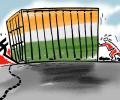
India has revised its proposal to impose retaliatory duties under the WTO (World Trade Organisation) norms against the US over American tariffs on steel and aluminium in view of the further hike in duty by the Trump administration. The US first imposed 25 per cent tariffs on imports of aluminium, steel and derivative articles on March 12.
An Indian commerce ministry team will soon visit Washington for another round of talks on the proposed trade agreement with the US to iron out differences in sectors, like agriculture and automobiles, a government official said on Thursday.
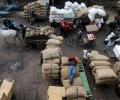
Deloitte on Thursday projected economic growth at 6.5-6.7 per cent for the current fiscal, as tax incentives provided in the Budget are expected to push domestic demand amid an uncertain global trade environment. Deloitte estimated India's GDP growth at 6.3-6.5 per cent for FY25 and said that the economic outlook for FY26 hinges on a delicate balance between evolving trade relations and government efforts to boost domestic consumer demand.
Indian and US officials will begin deliberations on the proposed bilateral trade agreement in Washington from Wednesday with an aim to iron out issues and give an impetus to the negotiations.

United States President Donald Trump on Wednesday (local time) hinted at reaching a new trade deal with India soon.
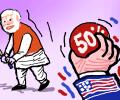
'Things may get much worse before they get better,' predicts Ajay Chhibber.
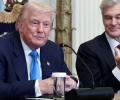
US President Donald Trump announced a deal with Pakistan to develop its oil reserves, suggesting Pakistan might sell oil to India in the future.
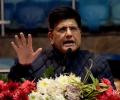
India and the US desire to give preferential market access to each other's businesses and teams of both the countries are working together on the proposed bilateral trade agreement, Commerce Minister Piyush Goyal has said. In February, US President Donald J Trump and Prime Minister of India Narendra Modi announced plans to negotiate the first tranche or phase of a mutually beneficial, multi-sector Bilateral Trade Agreement (BTA) by fall (September-October) of 2025.

Benchmark stock indices Sensex and Nifty declined on Monday, extending the losing run to the fourth day amid selling in IT shares and foreign fund outflows. The 30-share BSE Sensex dropped by 247.01 points or 0.30 per cent to settle at 82,253.46. During the day, it fell 490.09 points or 0.59 per cent to 82,010.38 but recovered some of the losses towards the close.

The Indian industry is paranoid about the USA's plan to impose reciprocal tariffs and wants early conclusion of a bilateral trade agreement, sources said on Wednesday. They said that the talks for the proposed bilateral trade agreement are going well.
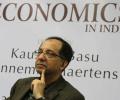
Former World Bank Chief Economist Kaushik Basu on Thursday said the US economic policy towards India has taken an unfortunate turn, noting that President Donald Trump's harsh stance against New Delhi appears baffling. US President Donald Trump on Wednesday announced a 25 per cent tariff on Indian goods from August 1, amid signs of a stalemate in the ongoing bilateral trade negotiations between the two countries.
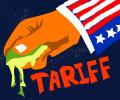
US President Donald Trump on Wednesday slapped an additional 25 per cent tariff on goods coming from India as penalty for New Delhi's continued buying of Russian oil.

Trading sentiment in the stock market this week will be guided by quarterly earning announcements from blue-chips such as Infosys and Bajaj Finance, the outcome of India-US trade talks and global cues, analysts said. Markets may on Monday react to the quarterly results of three heavyweights - Reliance Industries, HDFC Bank and ICICI Bank, an expert said.

The 25 per cent US tariffs, plus a penalty for Russian imports, could dent India's GDP growth by 30 basis points in the current fiscal, but the higher duty is unlikely to significantly affect India's domestic demand-driven economy, Barclays said on Thursday. If the 25 per cent tariff, announced by US President Donald Trump on Wednesday, is implemented from August 1, the effective average US import tariff on Indian goods will rise to 20.6 per cent in trade-weighted terms, as per Barclays estimates.
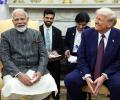
The lawmakers slammed opposition leaders over their remarks on the development, alleging that they were "happy" with the US government's move when "everyone" should be standing together in such a situation.

Amid uncertainty over trade talks with the US, Prime Minister Modi asserts India's commitment to protecting the interests of farmers and fishermen, vowing no compromise on their behalf.
A team of senior officials from India will again visit Washington this month to hold discussions with their US counterparts on the proposed bilateral trade agreement (BTA), government sources said on Thursday. To give impetus to the talks, India's chief negotiator Rajesh Agrawal, special secretary in the Department of Commerce, and Assistant US Trade Representative for South and Central Asia Brendan Lynch had last month held three-day talks in Washington.

Hectic parleys are underway between officials of India and the US in Washington on the proposed interim trade agreement between the two countries, an official said on Wednesday.

From labelling India the 'Tariff King' to slapping sweeping import duties, US President Donald Trump has steadily hardened his trade stance on India. These announcements are being seen as a pressure tactic to get New Delhi to agree to demands made by the US in the proposed Bilateral Trade Agreement (BTA).
India's decision to reserve its rights to impose retaliatory duties on the US over imposition of tariffs on auto parts is a procedural move under the WTO agreement on safeguards and it will not affect ongoing negotiations on the proposed trade pact between the two countries, an official said. India on Friday proposed imposing retaliatory duties under the WTO (World Trade Organisation) norms against the US over American tariffs on imports of the country's auto parts in the name of safeguard measures.
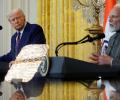
The deal fell through over unresolved disagreements over contentious issues, mainly on agriculture and automotive sector tariffs.
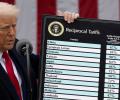
The impact of United States President Donald Trump's reciprocal tariffs is not yet known and New Delhi's strategy to deal with the situation is to firm up a bilateral trade pact with Washington, DC by fall of this year, External Affairs Minister S Jaishankar said on Wednesday.
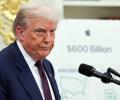
United States President Donald Trump has said India is 'very close' to China in terms of its purchases of Russian oil and will pay tariffs of 50 per cent as he indicated that 'you are going to see so much secondary sanctions'.
India and the US are likely to agree on an interim trade agreement before July 8 with New Delhi pushing for full exemption from the 26 per cent reciprocal tariff on domestic goods, an official said. The US on April 2 imposed an additional 26 per cent reciprocal tariff on Indian goods but suspended it for 90 days till July 9.
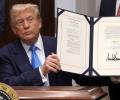
For India, the challenge is to strike a balance between tactical necessity and economic priorities, point out Pravin Krishna and Monil Sharma.
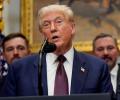
The United States announced a 25 per cent tariff on India as the White House released an expansive list of duties that Washington, DC will impose on exports from countries around the world.
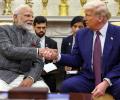
'India's farmers will be unable to compete with the US, given the subsidies that the latter provides its farmers.'
The US is expected to push for sweeping changes in India's policies, ranging from tariff reductions to regulatory overhauls, that could benefit American firms and exporters, under the proposed bilateral trade agreement with India, think tank GTRI said on Sunday.

A team of US officials is expected to visit India in the coming weeks for the next round of discussions on the proposed interim trade agreement between the two countries, sources said. The visit gains importance as India and the US are likely to agree on an interim trade agreement before July 9, with New Delhi pushing for full exemption from the 26 per cent reciprocal tariff on domestic goods.

'The logic every one of our neighbours must realise is that working with India will give you benefits, and not working with India has a cost.'
'We believe that in the new world order FTAs or bilateral trade agreements (BTAs) are the way forward.' 'They are enablers for our participation in global value chains. Today, around 70 per cent of global trade is tied to these chains.'
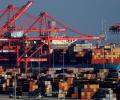
An Indian official team is likely to visit Washington next week to iron out differences on certain issues before formally launching negotiations for the proposed India-US bilateral trade agreement (BTA), an official said. The visit, which comes within weeks of a high-level US team visiting India, indicates that the talks for the BTA are gaining momentum.
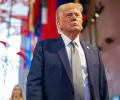
"India and everybody would think of them as an ally. I can say the same for others. But this is a group of wonderful nations that is countering other countries that look to hurt us on trade," he added.
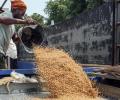
Very sensitive items -- such as apples, which carry political weight and are closely tied to farmer interests in states like Himachal Pradesh and Uttarakhand -- may face restricted concessions.
 © 2026 Rediff.com - Investor Information - Advertise with us - Disclaimer - Privacy Policy - Sitemap - Feedback - About us - Terms of use - Grievances