
Bangladesh holds its general election on Thursday, February 12, amid an intense political campaign across major cities. The Bangladesh Nationalist Party and student-led National Citizen Party mobilise supporters through rallies in Dhaka and Sylhet.

Sensitive issues remain. Water sharing of the Ganga and Teesta rivers. Treatment of minorities, particularly Hindus. Border management. Trade imbalances. Connectivity projects.What happens next will shape not just bilateral ties, but the balance of South Asia itself, points out Ramesh Menon.

Bangladesh is set to hold parliamentary elections with unprecedented security measures in place, following a period of interim governance and political changes.
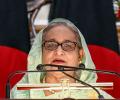
Bangladesh's International Crimes Tribunal is set to formally hear charges against deposed prime minister Sheikh Hasina on Sunday allowing state-run BTV to broadcast live the event, a first such instance in the country's history.

New Delhi -- which has had a disastrous neighbourhood policy that has alienated almost all the States with which it has a land or sea border -- seemed to be unwilling over the past years to even consider that its unquestioning support of Sheikh Hasina was painting it into a corner, points out Mihir S Sharma.

Alamgir said that even after the fall of the Hasina government following a people's uprising, the 'Indian establishment is yet to reach out to BNP, even though China, the US, the UK, and Pakistan have already done so.'

'Religion and extremism is going to be a big force, a very important force, in Bangladesh's politics.'
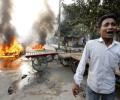
The death toll in violence across Bangladesh triggered by the execution of a top Jamaat-e-Islami leader on Saturday rose to 10, even as Islamists set afire the house of a federal minister in the country's northwest.
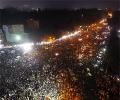
Bangladesh's Supreme Court on Tuesday handed down the death penalty for fundamentalist Jamaat-e-Islami leader Abdul Quader Mollah for his involvement in the 1971 war crimes, revising a special tribunal verdict which had sentenced him to life imprisonment.

Noting that the Indo-Pak ties "remain tense", the US intelligence chief said India's engagement with Pakistan hinges on Islamabad's willingness to act against those responsible for the Pathankot terror attack.
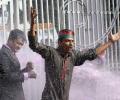
Bangladesh's decision to execute Jamaat-e-Islami chief Motiur Rahman Nizami for war crimes committed in 1971 has provoked anger across the Muslim world. Foreign Secretary S Jaishankar arrived in Dhaka hours after the execution, an important expression of India's support to Prime Minister Sheikh Hasina, explains Rajeev Sharma.
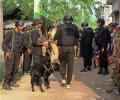
Prime Minister Narendra Modi's offer of central assistance in arresting the downward slide in West Bengal and National Security Advisor Ajit Doval's ongoing trip to the state and his asking for Mamata's cooperation in handling the situation and in dissolving the anti-national and inter-country network of jihad that has now chosen her state as one of its base, is perhaps Mamata's last best chance to salvage the situation, says Dr Anirban Ganguly.
 © 2026 Rediff.com - Investor Information - Advertise with us - Disclaimer - Privacy Policy - Sitemap - Feedback - About us - Terms of use - Grievances