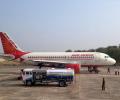
Jet fuel (ATF) price on Tuesday was hiked by 4.2 per cent but that of commercial LPG used in non-residential establishments such as hotels and restaurants was cut by Rs 115.5 per 19-kg cylinder reflecting global energy trends. Aviation turbine fuel (ATF) price was hiked by Rs 4,842.37 per kilolitre, or 4.19 per cent, to Rs 120,362.64 per kl in the national capital, according to a price notification of state-owned fuel retailers. This reverses a 4.5 per cent cut in jet fuel prices affected last month.

State-run oil companies on Wednesday raised prices of aviation turbine fuel, or ATF, for the third time in a month, this time by about 6.7 per cent, in step with international rates, which are firming up.
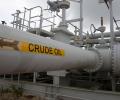
The government has reduced the windfall profit tax levied on domestically-produced crude oil as well as on the export of diesel and ATF, in line with softening international oil prices, according to an official order. The levy on crude oil produced by companies such as Oil and Natural Gas Corporation (ONGC) has been cut to Rs 1,900 per tonne from Rs 2,100 per tonne, the order dated January 16, said. Crude oil pumped out of the ground and from below the seabed is refined and converted into fuel like petrol, diesel and aviation turbine fuel (ATF).

Brokerages lowered their earnings estimates following muted results in Q1FY24. While analysts remain optimistic about the stock's medium-term prospects, they highlight near-term concerns stemming from lower realisations due to changes in the product mix and margin pressures resulting from new plane additions.

The government has brought back the windfall profit tax on domestically produced crude oil after international prices firmed up while the levy on export of diesel has been cut to nil, according to an official order. The levy on crude oil produced by companies such as Oil and Natural Gas Corporation (ONGC) is now Rs 6,400 per tonne with effect from Wednesday, the order dated April 18 said. At the last revision on April 4, windfall tax on domestically produced crude oil was cut to nil as international oil prices dipped below $75 per barrel.

The government has cut windfall gains tax on domestically-produced crude oil to nil while continuing the rate at zero on the export of diesel and ATF. The government has slashed the special additional excise duty (SAED) on crude oil produced by companies such as Oil and Natural Gas Corporation (ONGC) to nil from Rs 4,100 per tonne with effect from Tuesday, an official order dated May 15 said. This is the second time that the levy, which was introduced in July last year in the form of a cess to tax supernormal gains of oil producers and fuel exporters, has been cut to nil for domestically-produced oil.

Consumption-related stocks, such as hotels, and quick service restaurants (QSRs), have been hitting the ball out of the park ahead. On the other hand, the Miss World Pageant scheduled for later this year in New Delhi, too, could provide some tailwind to these stocks, especially hotels and aviation. However, analysts suggest investors put their best foot forward and buy these counters only on a decline given the recent rally and economic headwinds.
State oil firms on Wednesday raised jet fuel (aviation turbine fuel) price by 5 per cent in line with the spike in international oil prices, which have touched a record $71 US a barrel.

Lower crude oil costs and higher marketing margins are expected to raise the fortunes of oil marketing companies (OMCs) in the first quarter (Q1) of 2023-24 (FY24), while city gas distribution (CGD) companies could also benefit from lower spot prices of liquefied natural gas (LNG). However, in a break from the past, growth trends are expected to diverge for various segments within the broad energy sector. Analysts expect the earnings from gas production to go down for upstream national oil and gas companies such as Oil and Natural Gas Corporation (ONGC) and Oil India (OIL) due to the introduction of the new domestic gas pricing regime on April 1. After showing steep losses over the first half of 2022-23 (FY23), the marketing margins of OMCs have steadily recovered in four months.

Jet fuel prices on Saturday were hiked by a marginal 0.2 per cent -- the eighth straight increase this year -- to an all-time high, reflecting a surge in global energy prices. The price of aviation turbine fuel (ATF) -- the fuel that helps aeroplanes fly -- was hiked by Rs 277.5 per kilolitre, or 0.2 per cent, to Rs 113,202.33 per kl (Rs 113.2 per litre) in the national capital, according to a price notification of state-owned fuel retailers. Meanwhile, petrol and diesel prices remained unchanged for the 10th straight day after rising by a record Rs 10 per litre each.

Corporate margins and profits in India remain vulnerable to changes in crude oil prices in the international market. Historical quarterly data from listed companies (excluding banks, finance and insurance, oil and gas, and power sectors) indicate an adverse correlation between corporate margins and crude oil prices.
The Centre has garnered around Rs 2,500-3,000 crore in the first five weeks after it imposed a windfall tax on oil and gas companies for the export of fuel, Business Standard has learnt. It is likely that the government will continue with the one-time tax till the Indian crude basket is above $80 a barrel, sources said. The next review of the windfall tax on oil companies is early next week.
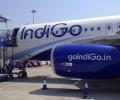
Despite the best ever quarterly net profit of Rs 3,091 crore during April-June of financial year 2023-24 (Q1FY24), challenges are mounting for InterGlobe Aviation-run IndiGo in the near term, said analysts. Given this, most brokerages have retained their ratings from 'buy to underperform', as well as their target price for the stock. For instance, Motilal Oswal Financial Services has retained its 'neutral' rating on the scrip as it believes the low-cost airline is facing teething issues at present.
Even flights on foreign routes pay more when they refill in India.

Rising crude oil prices and muted passenger traffic in the July-September quarter (second quarter, or Q2) of 2023-24 (FY24) have raised concerns about the profitability of listed aviation players. These two concerns have caused the stock of InterGlobe Aviation (IndiGo), the largest player in the sector, to slip by 11 per cent since its highs at the end of July. Nuvama Research expects yields to cool down in the near term due to seasonality, rising crude oil prices, and higher capacity.
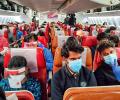
Domestic air passenger traffic jumped 57 per cent to around 49 lakh in July, reflecting a significant sequential as well as year-on-year growth amid a decline in coronavirus infections, according to a report. Recording continued recovery, traffic rose 56-57 per cent to 48-49 lakh in July compared to June this year when it was about 31.1 lakh. As against June 2020, the growth is 132 per cent, rating agency Icra said in the report on Thursday.
Domestic air passenger traffic plunged around 43 per cent month-on-month at 64 lakh in January 2022 as the third wave of the pandemic and the resultant restrictions by state governments kept flyers away from air travel, Icra said on Tuesday. The domestic passenger volume in December 2021 was recorded at 112 lakh. The rating agency said it is expecting the recovery process to remain subdued during March quarter and that the jet fuel prices continue to be a drag on the sector. The passenger traffic declined 17 per cent last month over 77 lakh passengers transported by domestic airlines on local routes in January 2021, Icra said.

Jet fuel prices on Thursday were hiked by the steepest ever 16 per cent to catapult rates to an all-time high in step with hardening international oil rates.
The Indian aviation sector is on the cusp of a change as airlines look to induct a record number of aircraft. This, analysts said, will put the sector on a growth runway, though keeping it viable for only long-term investors. According to Vinit Bolinjkar, head of research at Ventura Securities, expectations of strong air traffic, coupled with low penetration, is the prime reason for a solid long-term outlook.

ATF price in Delhi has been raised by Rs 272.77 to Rs 42,452.02 per kilolitre, an Indian Oil official said.
Experts say carriers will start making money on higher ticket prices, but jet fuel costs may act as a dampener
The price of non-subsidised LPG, which customers buy after using up their quota of 12 subsidised cylinders, was raised by Rs 16.50 per 14.2-kg cylinder, the first hike in six months.

Currently open access to ATF facilities exists at Delhi, Hyderabad and Bangalore airports, sources said on the sidelines of the Petrotech 2012 Conference in New Delhi.
Firm crude and weaker rupee mean more losses for oil marketing companies. Jet fuel also set to rise, stressing airline finances.

In the first reduction in rate in two months, jet fuel or ATF price on Thursday was cut by 3 per cent in line with softening international crude oil prices. Aviation turbine fuel (ATF) price was reduced by Rs 1,887 per kilolitre, or 3 per cent, to Rs 58,374.16 per kl in the national capital, according to a price notification of state-owned fuel retailers. This is the first reduction in rates after four rounds of increase since February. Rates were increased by Rs 3,246.75 per kl on February 1, followed by a 3.6 per cent hike on February 16, and a steep 6.5 per cent raise on March 1. On March 16, prices were again raised by Rs 860.25 per kl. On Thursday, a Rs 10 per cylinder reduction in price of domestic cooking gas LPG also came into effect.

Indian aviation has deep-rooted problems that need comprehensive and coordinated solutions, and high aviation turbine fuel pricing is certainly the most urgent.
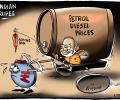
5 commodities namely crude oil, natural gas, petrol, diesel, and aviation turbine fuel (ATF) were kept out of GST's purview given the revenue dependence of state governments on these sectors.

Aviation turbine fuel accounts for 35-40 per cent of the total operating cost of an Indian airline.

Concerned over high service tax substantially raising air ticket prices, Civil Aviation Minister Ajit Singh has urged Finance Minister Pranab Mukherjee to revert to the earlier rates which were capped at Rs 100 and Rs 500 per domestic and international ticket.

Upbeat high-frequency indicators and consumer confidence show that Indian economy continues to forge ahead, emerging out of shackles of pandemic, said an article on the state of economy published in RBI Bulletin on Wednesday. The recovery is spearheaded by an uptick in private investment through November-December alongside a turnaround in bank credit offtake and high capex from the government sector (Centre and states). In conjunction, the employment situation has brightened, said the article written by RBI officials.
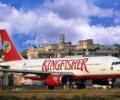
Mallya's airline is the second domestic carrier to have received DGFT approval for ATF import after budget carrier SpiceJet.
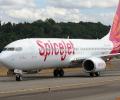
Reliance Industries Ltd is likely to import jet fuel for SpiceJet.

Aviation companies plan to join hands for importing aviation turbine fuel (ATF) in a bid to bring down their fuel bills.
Jet fuel prices on Wednesday were cut by 1.3 per cent -- the first reduction after 10 rounds of price hikes -- on softening international crude oil rates. Simultaneously, prices of commercial LPG - used by business establishments such as hotels and restaurants - were reduced by Rs 135 per 19-kg cylinder. The price of aviation turbine fuel (ATF) -- the fuel that helps aeroplanes fly -- has been reduced by Rs 1,563.97 per kilolitre, or 1.27 per cent, to Rs 1,21,475.74 per kl (Rs 121 per litre) in the national capital, according to a price notification of state-owned fuel retailers.

Stating that the Centre was planning construct 15 more airports under the Greenfield Airport Policy, Singh said the civil aviation ministry is in process of identifying the most suitable low cost viable model for development of small airports to increase regional connectivity.
Public sector oil firms on Thursday raised aviation turbine fuel (jet fuel) prices by up to 2 per cent, the second increase in three months.
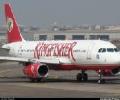
Seeking permission for direct import of jet fuel, Kingfisher Airlines has informed the government that steps are being taken to improve cash flow of the debt-ridden carrier by procuring ATF through suppliers' credit on lower interest rates.

In a bid to bring down the cost of air operations, Aviation and Petroleum ministries will meet FM to get ATF notified as 'declared good'.

Congress said ATF prices have been reduced by 31% while petrol only 16%.
 © 2026 Rediff.com - Investor Information - Advertise with us - Disclaimer - Privacy Policy - Sitemap - Feedback - About us - Terms of use - Grievances