
Former military secretary Lieutenant General Avadesh Prakash was on Saturday found guilty on three counts by an army court in Guwahati in the Sukna land scam involving transfer of 71 acres of land adjacent to the military station in West Bengal. He is the seniormost army officer to face court martial.

India has sought from Pakistan details about the charges against a 31-year-old Indian engineer who has been sentenced to three years in prison for espionage by a Pakistani military court.

The verdict was announced after the government submitted a 'new summary' to extend the service of 59-year-old Gen Bajwa.

Gen Rawat said, while addressing a gathering at a health summit, leaders emerge from crowds but are not those who lead people in 'inappropriate directions'.
Not willing to give up on the age issue, General V K Singh has filed a statutory complaint with the defence minister seeking a reexamination, in a first by an army chief.
Indian Army officer Lt Col Prasad Purohit, arrested for his alleged involvement in Malegaon blast, has moved the principal bench of the Armed Forces Tribunal in New Delhi to quash the court of inquiry ordered by the Army against him for violation of the Army Act and Rules. In his application, Purohit, who is currently lodged in Mumbai's Arthur Road jail, has charged the Army with denying him his right to remain present throughout the proceedings of the court of inquiry.

The former finance minister said that Pakistan "lost conclusively" before the world court and termed the sentencing by the military court to Jadhav as a "farcical processes".
Former Military Secretary Lieutenant General Avadesh Prakash, who is facing court martial for the Sukna land scam, on Thursday challenged the punitive action against him, saying Army rules were violated in the case. He approached the Armed Forces Tribunal, seeking quashing of the charges under the Army Act 123 and his attachment to the Western Command. Prakash alleged that the Court of Inquiry conducted by the Eastern Command in the case had violated the Army Rule 180.
For the first time in the Army's history, a former woman officer has been sentenced to a year's rigorous imprisonment and cashiered from service by a general court martial (GCM) which held her guilty of corruption.

Gen Rawat said exemplary punishment would be given to Maj Gogoi if he is found guilty.

Pakistan Defence Minister Khawaja Asif also dismissed Indian concerns that proper legal process was not observed in the trial. "There was nothing in the [legal] proceedings that was against the law," he said.
In the first-of-its-kind case, the Army on Friday decided to initiate court martial proceedings against a retired lieutenant general on corruption charges, for allegedly procuring poor quality food items for troops fighting insurgency in Jammu and Kashmir four years ago.Lieutenant General (retired) S K Sahni will be seniormost army officer, serving or retired, to face such disciplinary proceedings under the Army Act.
Lt Col R Mittal was tried on six charges under provisions of Sections 52 and 63 of the Army Act for intent to defraud and acts prejudicial to good order and military discipline, Army sources said on Wednesday.
Expressing concern over allegations by a woman army officer of physical and mental torture by her seniors, Defence Minister A K Antony on Wednesday ordered an inquiry into the incident.The minister intervened after the army described the allegations of Captain Poonam Kaur of the Kalka-based Army Service Corps battalion as 'baseless'.But nevertheless, army authorities instituted an inquiry as stipulated under the Army Act.

The petitioner argued that the people of Pakistan had a right of retribution.

A 31-year-old Indian engineer has been sentenced to three years in prison for espionage by a Pakistani military court over three years after he went missing when he illegally entered the country from Afghanistan reportedly to meet a girl he had befriended online.

The attested report of Court Martial General will also be included in the dossier.

Pakistan's military courts have gained a disrepute for not being transparent and violating all provisions of a fair trial.

Was the death sentence provoked by a retired Pakistani colonel going missing in Nepal, presumably abducted by Indian agents?

Jadhav was 'arrested' on March 3 last year by Pakistan security officials in Balochistan.

In a setback to embattled former Pakistani military ruler Pervez Musharraf, a special court in Islamabad on Friday dismissed his petition seeking treason trial under the Army Act and summoned him to appear before it on March 11.

'We have to hit Pakistan in such a manner where it hurts them the most.'

'Women were not allowed in the Territorial Army before January 5, 2018. Presently girls are not allowed in Sainik Schools and Rashtriya Military schools. Women are not allowed in the army education corps, in the engineering services (as permanent commission), they can't be religious preachers in the army. There's a need to change with the times.'

Rifleman Aurangzeb, who belonged to the 44 Rashtriya Rifles, was on way back home on June 14 to celebrate Eid when terrorists abducted him.
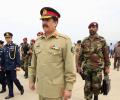
Nawaz Sharif may have permitted the trial of Jaish-e-Mohammed terrorists for the Pathankot attack. But this fell apart because of General Raheel Shareef's keenness to make Kulbhushan Jadhav the centerpiece of global attention. Ambassador G Parthasarthy, a former Indian high commissioner to Pakistan, reveals the Pakistan army chief's gambit against India.

More than 11 million Non-Residential Indians and 20 lakh defence and paramilitary personnel will soon be enrolled in electoral rolls with the government on Wednesday setting the ball rolling for exploring ways for facilitating electronic voting for them.

Gurbax Singh Dhindsa, father of Kargil war martyr GS Dhindsa, in a letter to the PM and defence minister underlining the fact that military personnel have little recourse to justice in higher courts.
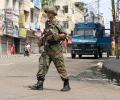
Unfortunately, by presuming guilt of the Army personnel in the Chattergam incident, for what is at worst an honest error, made in good faith, the ability of the military leadership to impose the fighting spirit necessary in their men to curb militancy stands seriously compromised.

Lifting the AFSPA can certainly be attempted but the provisions of the AFSPA, as an emergency law that empowers the army -- the nation's instrument of last resort -- must continue to remain on the statute books given the increasingly violent and uncertain times that the subcontinent is likely to face in coming years, says Nitin A Gokhale.
 © 2026 Rediff.com - Investor Information - Advertise with us - Disclaimer - Privacy Policy - Sitemap - Feedback - About us - Terms of use - Grievances