
The Central Bureau of Investigation on Saturday told a court that the Delhi police, acting in a pre-planned manner during the 1984 anti-Sikh riots, kept its "eyes closed" to the violence.

JNU student union president Kanhaiya Kumar came under strong criticism for his remarks that 1984 anti-Sikh riot was a "mob-led massacre" while 2002 Gujarat riots were a "state sponsored violence."
The BJP has demanded the death penalty for former Congress MP Sajjan Kumar, who was sentenced to life imprisonment for his role in the 1984 anti-Sikh riots. The party's leaders have called for the CBI to appeal the verdict, saying it was not an ordinary murder case but a genocide. The BJP has also said that the "wheels of justice" are starting to turn and that other Congress leaders involved in the riots will soon face consequences.
The accused had led a mob on November 1 and 2, and attacked the house of complainant Harminder Kaur.
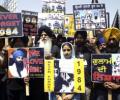
Protesting acquittal of Congress leader Sajjan Kumar in 1984 anti-Sikh riots case, around 150 riot victims today staged a march from Rajghat to Supreme Court but was prevented mid-way.
Congress leader Sajjan Kumar was on Tuesday acquitted of all charges by a Delhi court in the 1984 anti-Sikh riots case in which he and five others were accused.

The official said it was due to a technical glitch that the information could not be received by him and responded in time.
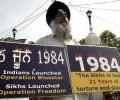
The double standards of Congress in following moral benchmarks stand exposed as it allegedly tried to shield its leaders who are involved in 1984 anti-Sikh riots, senior Bharatiya Janata Party leader M Venkaiah Naidu alleged.
The court was informed the Dispatch and Complaint register of 1984 have already been destroyed by a departmental order.
Prime Minister apologises for 1984 anti-Sikh riots

Singh said the Centre will provide whatever assistance required but the state governments should take stringent steps to curb such incidents.
Dr Singh made the remarks after paying obeisance at Gurudwara Bangla Sahib in New Delhi.
Toomey said he has personally witnessed the spirit of Sikhs and has come to better understand the Sikh tradition that is founded on equality, respect, and peace.
Home Minister Shivraj Patil says the Nanavati report will be tabled once the Union Cabinet okays it

A bench headed by Chief Justice Dipak Misra asked the Centre to suggest names on Wednesday itself for its consideration and appointment in the proposed SIT.
As a consequence of prominence given to the brutality during those few days, a very important aspect of that episode got almost glossed over. This was the intervention by a very significant section of people who restored faith in humanity, and conveyed the message that only a small section of Indians, that too politically backed, were consumed by anti-Sikh majoritarianism. The overlooked facet of the events of 1984 was the story of significant sections of the city's populace, public figures and nondescript ones, stepping out hand-in-hand, to first stand with little but bravery in hands, in the way of attackers, and thereafter to provide immediate relief to those who lives were uprooted and who lost family members in the violence, recalls Nilanjan Mukhopadhyay.
A Sikh group, campaigning for justice for the victims of the 1984 anti-Sikh riots, met US President Barack Obama, ahead of his visit to India in November.The group met Obama in Philadelphia on Monday, according to Sikhs For Justice, a New York-based group, which has initiated a case against Transport Minister Kamal Nath in New York for his alleged role in the riots.
An international human rights group has asked the Indian government to prosecute those involved in the 1984 Sikh riots, following the assassination of former prime minister Indira Gandhi.
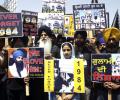
A SIT was set up for fresh investigation into the 1984 anti-Sikh riots cases in Delhi and some other states.
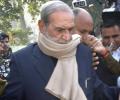
Kumar was convicted and sentenced to life for the remainder of his life by the high court on December 17 in the 1984 anti-Sikh riots in Raj Nagar area.

A Delhi court reserved its order on the quantum of sentence against Congress leader Sajjan Kumar in a murder case related to the 1984 anti-Sikh riots for February 25. The complainant, whose husband and son were killed, sought the maximum punishment of death penalty for Kumar. The court on February 12 convicted Kumar for the offence and sought a report from Tihar jail on his psychiatric and psychological evaluation.
The government has decided to give Rs five lakh each to the next of kin of victims of the 1984 anti-Sikh riots triggered after assassination of the then prime minister Indira Gandhi.
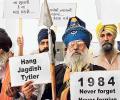
Justice R K Gauba dismissed their 22-year-old appeals against conviction by a trial court and asked all the convicts to surrender forthwith to undergo the prison term.

"Sorry. We are not inclined. Dismissed," a bench headed by Chief Justice S A Bobde said.

The Supreme Court has upheld the life sentence awarded to four persons for burning two men to death during 1984 anti-Sikh riots.
The central government decided to extend the rehabilitation package to the victims of the 1984 anti-Sikh riots in order to fulfil an assurance given to Parliament. A meeting of the Union Cabinet, chaired by Prime Minister Manmohan Singh, gave its nod to extend the package to the left out states and Union Territories for which an outlay of Rs 714.76 crore has been earmarked.
A Delhi court sentenced former Congress MP Sajjan Kumar to life imprisonment for his role in the murder of two Sikhs during the 1984 anti-Sikh riots. The court cited Kumar's age and illness as mitigating factors in its decision to impose a lesser sentence than the death penalty. Kumar was convicted for being part of a mob that set fire to the victims' home and killed them. This is the second life imprisonment sentence for Kumar in connection with the 1984 riots. He is also facing other charges related to the riots.
A United States judge has reserved his orders on submissions by the Congress party that the 1984 anti-Sikh riots case filed against it by a rights group in New York be dismissed as the Manhattan court does not have jurisdiction over the case.
The Supreme Court on Wednesday stayed the trial court proceedings against senior Congress leader Sajjan Kumar in a 1984 anti-Sikh riots case.
The agency said it had made efforts to contact Jasbir Singh, but neither his wife nor mother was willing to give the address of the prime witness against Tytler.
The witness, Jasbir Singh, in California, told TV news channels that the CBI had never contacted him before and that he was ready to testify before a court in Delhi if he was assured security.
A new book on the 1984 anti-Sikh riots in Delhi claims that the Ranganath Misra Commission which probed the carnage presented a "diluted" version of events and also blames the police for the mass killings.

The Delhi Police had closed this case in 1994 for want of evidence.

Kamal Nath said Sonia Gandhi spoke with him again after she received the letter and told him that 'well if this is your reason, fine'.
A United States court has issued summons to the Congress in connection with the 1984 anti-Sikh riots, acting on a Sikh rights group's petition charging the party with 'conspiring, aiding and abetting' organised attacks on the community. A federal district court in New York issued summons to India's ruling party in a class action lawsuit filed by the Sikh organisation 'Sikhs for Justice' which has offices in New York and India.
National Democratic Alliance convener George Fernandes said on Saturday that the post-Godhra violence in Gujarat and the 1984 anti-Sikh riots could not be compared.

Kumar, 73, surrendered before a trial court on December 31, 2018 to serve his sentence in accordance with the Delhi high court's December 17 judgment, which convicted and sent him to prison for the "remainder of his natural life".
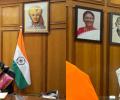
The election of Vijender Gupta, a three-time BJP MLA, as the speaker of the Delhi Assembly has sparked controversy, with AAP members accusing the BJP of being "anti-Dalit and anti-Sikh." The accusations stem from the removal of photographs of Babasaheb Bhimrao Ambedkar and Shaheed Bhagat Singh from the chief minister's office, a move condemned by AAP leaders as a display of the BJP's alleged anti-Dalit and anti-Sikh stance.

Senior lawyer H S Phoolka on Tuesday said he has decided to join the Aam Aadmi Party.
