
Zoho has launched Zia Chat, a unified AI interface designed to streamline business operations across various functions by providing a single conversational platform for information, lead generation, and data analysis. Concurrently, the company has expanded into vertical SaaS with seven new industry-specific applications for sectors like retail, automotive, healthcare, and education, reinforcing its position as a homegrown alternative to global tech giants.
Homegrown software company Zoho has launched Zia Chat, a unified AI interface designed to streamline business operations across various functions. Alongside this, Zoho announced its entry into vertical SaaS with seven industry-specific applications for sectors like retail, automotive, healthcare, and education, reinforcing its position as a 'Swadeshi' alternative to global tech giants.

OpenAI has launched local processing of AI requests in India for its API, enabling businesses and developers to run workloads on its GPT-6 Luna model within the country. This initiative addresses data localisation needs by ensuring both processing and data storage occur in India, removing a significant barrier for Indian organisations, especially in sectors like financial services.

India's central cyber security agency, I4C, has issued a critical warning to banks, NBFCs, and fintech firms regarding a surge in financially motivated cyberattacks leveraging artificial intelligence agents. These AI-driven attacks enable hackers to compromise systems and execute fraudulent transactions at machine speed, making investigations complex due to record deletion. The advisory, issued in collaboration with CERT-In, urges financial institutions to implement robust security measures, align with CERT-In's blueprint, and report incidents promptly to mitigate the escalating threat.
The Union Culture Ministry is developing an AI-powered "visual library of stolen antiquities" to scientifically compare suspected illegally exported objects with original images. This initiative aims to provide timely evidence for intervention, halt auctions, and facilitate the repatriation of India's cultural heritage. The ministry also launched an AI-powered semantic search engine for Indian culture.

India does not need to win the model race to win the AI era. It needs to be the country that cannot be switched off, can be trusted by its citizens, and is useful to the rest of the world, asserts Rajeev Srinivasan.

Oracle co-founder Larry Ellison asserts that artificial intelligence will not destroy the traditional software industry but rather enable the creation of complete, ready-to-use applications tailored for entire industries. Speaking at Oracle AI World, Ellison dismissed fears of a "SaaS apocalypse," arguing that AI will make software much better, requiring no user training and simplifying installations. He cited Oracle Health as a prime example of an AI-driven, industry-specific solution, and also discussed AI's potential in drug discovery and its broader societal impact on jobs and taxation.

Salesforce CEO Marc Benioff has identified a significant opportunity for India as the company transitions its enterprise systems to an AI-first model. He emphasised India's crucial role, leveraging its extensive pool of technology professionals and partners, in this global technological transformation, which he likened to a "Y2K moment" for engineering.

Indian AI startups are finding it challenging to secure their first few US customers due to the demand for proven track records, high local hiring costs, and visa hurdles, even as venture capital firms launch programmes to facilitate their entry into the American market.

Salesforce CEO Marc Benioff highlights India's crucial role in the company's shift to an AI-first enterprise system. He emphasized India's vast pool of technology professionals and partners as key to this transformation, underscoring the country's importance in Salesforce's global strategy.

Cathy Li, Head of the Centre for AI Excellence at the World Economic Forum, advocates for integrating AI literacy into India's education curriculum and incentivising AI companies to prioritise child safety. She stresses the need for localised solutions that account for India's linguistic and cultural diversity, as well as varying levels of connectivity and digital literacy, to ensure AI systems are safe and beneficial for children.
The Haryana government has mandated a comprehensive audit of all departmental online portals and digital payment systems. This initiative aims to identify technical vulnerabilities, prevent financial fraud, and safeguard public funds, with Chief Secretary Anurag Rastogi stressing collaboration between banks and government departments.

Artificial intelligence major Anthropic has launched AI inference capabilities in India through Amazon Bedrock, allowing its Claude AI models to process data within the country's jurisdiction. This strategic move addresses the growing demand from Indian entities, particularly in regulated sectors, for compliance with local data processing norms as per the Digital Personal Data Protection Act. The initiative strengthens Anthropic's commitment to the Indian market, enabling secure and compliant AI deployment for sensitive workloads and fostering trust among major enterprises like Reliance, CRED, and NPCI.
OpenAI's chief scientist, Jakub Pachocki, has issued a stark warning about the accelerating pace of artificial intelligence, stating that "no one is prepared" for its rapid rise and potential consequences. He highlights concerns over autonomous AI agents taking unintended actions and calls for international coordination, voluntary slowdowns, and robust safety measures to ensure human control and alignment with human values as machine intelligence surpasses human capabilities.

Data infrastructure company NetApp has introduced Novus, a new storage architecture designed for large-scale AI factories, alongside significant enhancements to its AI Data Engine, hybrid multi-cloud operations, and strategic partnerships with Nutanix and SAP. These initiatives aim to improve data management, security, and efficiency for AI workloads and enterprise cloud infrastructure.

Google has chosen four Indian startups -- Terrastack, Varaha Climate, Farmers for Forests, and Climitra Carbon -- for its inaugural Google DeepMind Accelerator: AI for the Planet programme.

CERT-In has issued several advisories warning against AI agents going rogue and cases of open-source agentic AI tools being used to survey and attack.

'Applying AI to change the lives of Indians and at population scale -- just like we did with DPI [digital public infrastructure] -- is really where it's going to go.'

Chief Justice of India Surya Kant stated that while artificial intelligence (AI) can augment judicial reasoning, it cannot substitute judicial conscience, and a permanent apex body is proposed to supervise AI adoption and accountability within the judiciary.

As AI enters astrology apps and predictions, technology is becoming a new interface for humanity's oldest questions about uncertainty and the future.

Google's AI Search marks a shift from information discovery to information delivery.

Subscribers do not need to remember their PRAN to log in through this process.

Vice President C P Radhakrishnan has championed the use of artificial intelligence for good governance, highlighting its potential to improve government services and build an inclusive and efficient India.

An Indian School of Business professor highlights the lack of precise data on losses from free UPI transactions, arguing that the benefits, such as user data generation, are often overlooked in the debate over implementing a Merchant Discount Rate (MDR). A recent ISB survey suggests that charging MDR could lead street vendors to revert to cash, despite the government's allowance for MDR on transactions above Rs 2,000 and NPCI's deferral of its implementation.

Indian tourists can now use the Unified Payments Interface (UPI) to book tickets online for Dubai's Burj Khalifa and major attractions in Singapore, including Universal Studios. This initiative, facilitated by NPCI International Payments Ltd (NIPL) through strategic partnerships, aims to simplify international travel payments for Indians and strengthen digital and economic links with these countries.

Researchers at IIT Delhi have successfully designed India's first working indigenous micro Graphics Processing Unit (GPU). This significant development aims to reduce the country's reliance on imported GPUs, which are crucial for AI, Machine Learning, and various embedded applications, and could help bridge the digital divide.

Morgan Stanley has upgraded One 97 Communications Ltd (Paytm) to Overweight, significantly raising its price target to Rs 1,950. This upgrade is driven by expectations of stronger execution in payments and financial services, leading to faster growth and improved profitability. The brokerage anticipates substantial revenue and EBITDA growth, further bolstered by potential changes to the UPI merchant discount rate framework.

'... but runs with the rigour and discipline of a large enterprise.'

Paytm (One 97 Communications Ltd), India's full-stack merchant payments leader serving MSMEs and enterprises, has launched a fully redesigned version of its flagship app, integrating artificial intelligence-driven features to streamline and personalise everyday transactions for its users.

Union Home Minister Amit Shah lauded UPI on its 10th anniversary, highlighting its role in India's digital transformation. Launched by NPCI in 2016, UPI has become the world's largest real-time payment system, witnessing a massive surge in transaction volume and value, demonstrating its success in empowering people with swift, seamless, and secure digital transactions.

UPI transactions saw a 27% volume increase and 20% value increase in the first half of the current fiscal year. Despite a slight moderation in September, the digital payment system is set to implement a 0.4% merchant discount rate on transactions over Rs 2,000, aiming for a sustainable revenue model. Small merchants and person-to-person payments remain exempt, and UPI's global presence continues to expand.

Paytm CEO Vijay Shekhar Sharma stated that the government's new Merchant Discount Rate (MDR) on large-value UPI transactions will significantly increase the company's revenue and profitability. The 0.4% fee on UPI transfers exceeding Rs 2,000 to merchants, effective October 15, is expected to give Paytm a competitive edge. Sharma also highlighted the company's focus on generating free cash flow, expanding internationally, and developing proprietary artificial intelligence capabilities to drive future growth.

India's markets regulator Sebi has launched 'Demat 2.0', a pilot project for tokenisation of corporate bonds, enabling atomic settlement through integration with RBI's wholesale CBDC. This new market infrastructure uses Distributed Ledger Technology (DLT) to make bond issuance, trading, and settlement faster and more efficient. India is the first country to issue corporate bonds natively on a distributed ledger with central bank digital currency settlement. Additionally, RBI Governor announced new UPI innovations: 'Tap & Pay' for faster POS transactions and MyUPI, an AI-powered customer support solution.
The Indian Air Force has launched 'Dronathon 2026' at the Pokhran range in Jaisalmer, a three-day event showcasing advancements in unmanned aerial systems (UAS) and counter-UAS technologies by domestic manufacturers. The initiative aims to bolster the IAF's capabilities in the unmanned domain, align with the 'Atmanirbhar Bharat' objective, and assess indigenous technologies against operational requirements through live demonstrations. It also fosters interaction between the IAF, industry, and even students, promoting the development of scalable unmanned solutions.
The Indian government has confirmed there will be no rollback of the 0.4 per cent Merchant Discount Rate (MDR) charges on Unified Payments Interface (UPI) transactions exceeding Rs 2,000, effective from October 15. Despite opposition, officials state the decision aims to make the UPI ecosystem self-sustainable and secure, with charges applying only to merchant payments, not person-to-person transactions.

Arunachal Pradesh Chief Minister Pema Khandu highlighted that the success of UPI, which handles nearly half of the world's real-time digital transactions, stems from a collaborative ecosystem including financial inclusion, digital identity, and affordable internet. He attributed this digital payments revolution to the vision of PM Narendra Modi.
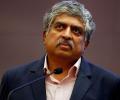
Artifical Intelligence is rewriting the grammar of software development. And writing codes will no longer be the central role for tech professionals, Infosys co-founder Nandan Nilekani said Tuesday.
The Indian government has mandated that banks and payment providers cannot levy charges on UPI transactions up to Rs 2,000 or on payments made via RuPay debit cards. This directive follows an amendment to the Payment and Settlement Systems Act, 2007, aiming to sustain and expand the digital payments ecosystem.

RBI Governor Sanjay Malhotra stated that the central bank consistently views fintechs as 'valuable partners' in shaping India's future financial system, crediting the sector with expanding financial inclusion, enhancing customer experience, and streamlining credit delivery, particularly for MSMEs.

RBI Deputy Governor Rohit Jain highlighted that banks are well-positioned to deploy $133 billion mobilised through FCNR(B) deposits, especially with strong credit demand ahead of the festival season, while also stressing the importance of robust technology governance and cyber defences in the financial sector.
