
The history of our nation may not always have charted a linear trajectory to greatness. But that must not distract us from recognising that we as a nation we continue to find new and innovative ways to reconcile contradictions, transcend fault-lines thus avoiding the pitfalls of so many of our neighbours, says Shashi Shekhar.

The government is attempting everything it can to make sure that this does not happen, observes Aakar Patel.

Events in America have strengthened the hand of those leaders there who wish India well, but think of India as being a collection of Indians.
If Indians are mistreated, they will object, asserts Aakar Patel.

'A decade ago, even though the sentiment might have been felt in large parts of the media, it was not expressed.' 'There was a reserve and there was a culture that adhered to the principles expressed in the Constitution,' observes Aakar Patel.
Years ago, as finance minister, Manmohan Singh popularised the term 'systemic failure.' Today he appears to believe it is a case of individuals being at fault rather than the system. I believe he was wrong then and is wrong now, says T V R Shenoy.
No one can deny that but for Parliament our unity as a country could never have been what it is today, says Suresh Prabhu, who has been elected to the Lok Sabha four times.

India needs to examine some way in which, assuming that there is either no vaccine or a delay in administering it to everyone, voting can be made safer, notes Aakar Patel.
Give this fact that the middle class is not responsible in India and cannot be trusted to lead, it is remarkable that our legislature, even given all of its vulgar traits, has performed as superbly as it has, notes Aakar Patel. The first column in a series as India celebrates the 60th anniversary of the first sitting of the Joint House of Parliament on May 13.

Police had sought an extension of Zubair's custody by five days.
Now we must first compete with Bangladesh. This is not what we had been promised, notes Aakar Patel.
The standard line that is used for anyone -- academics, minorities, farmers, dissident industrialists -- who points out that what the government is doing is wrong is being anti-national and separatists, reveals Aakar Patel.
For those who think India's democracy is just fine and there has been no change in the last few years, perhaps it would be instructive to see what has happened on a few issues, observes Aakar Patel.

'It is astonishing that such a serious issue be handled in so casual and cavalier a fashion, but this has become what is expected of this government,' observes Aakar Patel.
'Do the Muslims of India think that they are receiving justice from their nation and particularly from the Supreme Court?'

'India is the only large nation along with Argentina whose numbers have continuously and without a break risen from March,' observes Aakar Patel.

'I cannot remember a time in my life when we had such economic strife, such levels of unemployment, a national epidemic and the enemy inside our house and such little interest in these and a focus on Bollywood and temples and such things,' notes Aakar Patel.

'Money must be produced constantly.' 'This need is driving people to find work, and for many of them, it is working for a living for the first time in their lives,' observes Aakar Patel.
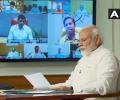
'The Union government does not have much of a governance function other than to send orders.' 'But even the sending down of orders it cannot do properly,' observes Aakar Patel.

'One hopes that it is for the better that this disaster alters our reality from the morning of May 4,' notes Aakar Patel.
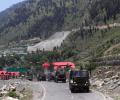
We have a full blown epidemic, an economic recession with the highest unemployment in Indian history, and a powerful enemy whose aggressive and offensive actions we did not anticipate, states Aakar Patel.

'Even those who do not like him will rally to his call if he says that the country's sovereignty is being threatened by China,' notes Aakar Patel.
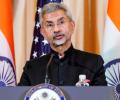
'What Jaishankar says is simplistic.' 'The past does not matter that much.' 'If we think that it does it is because we are not good enough at running the nation competently today and are searching for excuses why,' argues Aakar Patel.
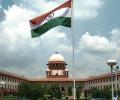
'What the long term repercussions of the Ayodhya judgment are will unfold in time.' 'And I hope the consequences are not going to be as damaging to us as they were to Pakistan,' says Aakar Patel.
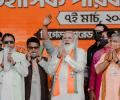
The prime minister says he will bring real change to Bengal. Perhaps he will. The interesting thing is that his party has never defined what this change is, observes Aakar Patel.

'"We have lost our jobs, we have lost our savings, we have been beaten up for being on the streets, we have walked for a thousand kilometres, we have seen our children starve or die because nobody came to help us".' 'For such people, the relationship with the government has gone,' notes Aakar Patel.

'He spoke about 20 jawans in Ladakh, but he couldn't even name China.' 'He said the world had seen what had been achieved, even though we Indians don't know because Modi has himself said that nothing had happened and nobody had come,' points out Aakar Patel.

'India is growing at the lowest rate in the last decade.' 'If it continues in that path then the jobs and prosperity that has been promised by this government and on the basis of which it was voted in, will continue to elude us,' says Aakar Patel.

'This is millions of Indians standing up for values rather than an individual gain.' 'This is why this protest is unique and this is why this protest has for the first time made this government uncertain and doubtful of what to do next,' says Aakar Patel.
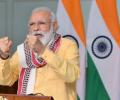
Aakar Patel looks forward to Prime Minister Modi's speech at the bhoomi pujan for the Ram temple in Ayodhya next week. It will be entertaining and stirring, predicts Aakar, and make lots of promises that he most likely won't be able to keep.

'When one has a lot of power, one can shut one's ears to the other side. This is what is common between the BJP of 2019 and the Congress of 1947,' says Aakar Patel.
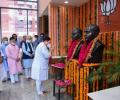
'The BJP's constitution promises allegiance to India's secularism and socialism.' 'This is the oath that it makes all its members sign,' observes Aakar Patel.

'Modi has not taken India into confidence over what is happening and what has happened.' 'We have not even officially been told what the position is with respect to the land lost between Fingers 4 to 8,' observes Aakar Patel.
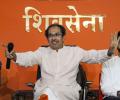
'The Sena can quickly reduce most solutions to violence.' 'When in power, it will revert to this gene which is coded into it and we will no doubt produce entertaining and frightening moments,' says Aakar Patel.

'There are no multiplexes, not a single cinema hall and no malls.' 'Because the government in Delhi constantly cuts off mobile services, there is no app-based economy in Srinagar.' 'There are 403 news channels in India, but there is none in Kashmir,' notes Aakar Patel after a journey to the Kashmir valley.

'Azim Premji has given away about one-and-a-half lakh crore rupees of his wealth.' 'Most of us will not even know what that sum actually means.' 'To put it into context, it can fund India's health budget and education budget,' points out Aakar Patel.
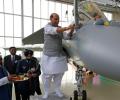
'We spent Rs 59,000 crore on acquiring 36 Rafales and we do not know if we will ever use them. The chances are that we never will,' argues Aakar Patel.

Why are the protesters still on their own and why are political parties abstaining from joining this mass movement? Aakar Patel explains.
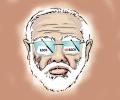
'It won't be easy to undo the damage that has been done to the economy by the lockdown and the solution will not come from two minute presentations,' observes Aakar Patel.

It is going to be a rough and brutal 2020 for India as its government pushes on with its ideological agenda, and the citizens do whatever they can to protect themselves, notes Aakar Patel.
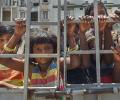
India is going into the longest lockdown in the world, with the least amount of notice given to its people and the least preparation by its government.
