
US President Donald Trump concluded his Beijing summit with Chinese President Xi Jinping, describing it as 'incredible' and highlighting 'fantastic trade deals' and a 'very strong' relationship between the two leaders.

United States President Donald Trump boards Air Force One for his return home following diplomatic engagements in Beijing.

The Beijing summit may have reduced immediate diplomatic uncertainty, but it did not resolve the deeper structural contest between the United States and China. That contest appears likely to define the coming decade, notes Varun Arya.

United States and China have agreed that "Iran can't have nuclear weapons," and that the Strait of Hormuz must be opened, according to US President Donald Trump.

Following his visit to China, US President Donald Trump has suggested a potential shift in Washington's approach to Taiwan, expressing reluctance to engage in military conflict over Taiwan's independence and cautioning against unilateral moves.

The Indian rupee plummeted to a new all-time closing low of 95.81 against the US dollar, driven by surging crude oil prices, persistent inflation concerns, and a strengthening dollar index.

Donald Trump says several issues were settled during the final day of talks with Xi Jinping covering trade, tariffs, and diplomacy.

India would confront a more entrenched China, a less dependable United States, and a regional order increasingly shaped by great-power bargaining over which it exercises limited influence, notes Amberish K Diwanji.

Delhi must now purge the delusional hopes of being a 'counterweight' to China in the US calculus, argues Ambassador M K Bhadrakumar.
'For the first time in a hundred years, the army has been taken out of the political equation. And for the first time ever, there is only one man who calls the shots. Not even Mao had this kind of power.'
On July 2 or July 6, the Dalai Lama will reveal his mind on his successor. This makes Beijing extremely nervous as the Communist regime fully realises the importance of controlling the next Dalai Lama, points out Claude Arpi.

Each time an Indian minister visits Arunachal Pradesh, the tinpot Communists in Beijing's Zhongnanhai get worked up and mutter threats.

On a surprise visit to Beijing amid speculation that he may unveil Tesla's autonomous driving technology in the burgeoning electric vehicle (EV) market in China, billionaire Elon Musk on Sunday met Chinese Premier Li Qiang and discussed future expansion plans for his automobile.

A participant holds the Tiranga during Tawang's first-ever motorcycle expedition from Holy Tree to the Holy Waterfalls organised by the Indian Army in Tawang, August 23, 2022.
Xi Jinping at a ceremony to mark Martyrs' Day at Tiananmen Square, September 30, 2022.
This past week, His Holiness has been in Leh, the capital of Ladakh, the Union Territory where Indian and Chinese soldiers have been in a standoff for two years, since April 2020.

He is due to call on Premier Li Keqiang later on Thursday and hold talks with China's Public Security Minister Guo Shengkun, who is also the State Councillor in the CPC, a rank above the minister.
'Which will not happen.' 'Foreign Minister S Jaishankar has expressly refuted Beijing's statement that normalcy was returning to Sino-Indian relations.'

Ahead of his visit to New Delhi, China's new Premier Li Keqiang on Wednesday said India and China "must shake hands" to make Asia an "engine of the world economy". Addressing the 100-member Indian youth delegation at Zhongnanhai, the imperial gardens housing the headquarters of China's ruling Communist Party and central government, Li spoke warmly about his visit to India 27 years ago as the leader of a youth delegation.
Xi's ascent to power and the quick consolidation of his leadership of the party with a shock anti-graft campaign securing the title of the "core leader" of the party bequeathed only to Mao has indeed forced his rivals in the party to submission and caught the attention of the world.

Wen, on his part, said that "a healthy, stable and dynamic China-India relationship is of far-reaching significance to the two nations, Asia and the whole world at large."

'The MEA, hopefully, made it clear that the Indian PM can't be seen in Xi Jinping's company when China has, for all intents and purposes, annexed over 1,000 sq kms of Indian territory in eastern Ladakh, and essentially that the Wuhan spirit and the Mamallapuram spirit have turned into vinegar.'

Congress president Sonia Gandhi on Friday met Chinese Premier Wen Jiabao with both leaders taking note of the steadily growing ties between the two countries.
In their first summit since Chinese President Hu Jintao assumed power last year, the two leaders discussed the nuclear crisis and Chinese aid for North Korea.
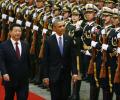
Chinese President Xi Jinping on Wednesday held formal talks with his US counterpart Barack Obama, a day after the two leaders pledged to push forward a new type of major-country relations between the world's two largest economies.

It will be interesting to see whether India-China border tensions figure during the deliberations of PLA deputies to the NPC and CPPCC, notes Jayadeva Ranade, the distinguished China expert and retired RA&W officer.
Gokhale's visit for bilateral consultations is taking place amid renewed optimism that the vexed issue of listing of Pakistan-based Jaish-e-Muhammed chief Masood Azhar as a global terrorist by the United Nations, which has been stalled by China, is headed for a resolution in the coming weeks
Jaishankar's talks with Yang and later in the Strategic Dialogue were expected to cover the key India-China differences like China blocking India's bid to join the NSG and UN ban on Azhar.

'Islamic State has declared that the liberation of Islamic Xinjiang from China is an objective. Beijing may well find that Pakistan is unable to assist in any meaningful way,' says China expert Jayadeva Ranade.

Modi, who is undertaking his first visit to China as prime minister, will reach the ancient city of Xi'an, the home town of President Xi Jinping, for a summit meeting, an unusual departure from normal protocol and seen as a reciprocal gesture by the Chinese leader who was hosted by Modi in Ahmedabad when he visited India in September last year.

What was the need for Xi Jinping, general secretary of the Chinese Communist Party, President of the People's Republic of China and Chairman, Central Military Commission, to don the new role of Commander in-Chief? Does this mean that the most powerful Chinese leader since Mao faces numerous threats from within the Communist Party?
