
Telecom service provider Reliance Communications is close to awarding a contract for implementation of mobile number portability (MNP) integration across its network to eight global telecom companies. The deal is estimated to be worth Rs 700-800 crore. The eight are Tekelec, HP, Intec, Huawei, ZTE, Ericsson, Lucent and Radio Telecom.

The move may prove a shot in arm for the Chinese firms such as Huawei and ZTE, who were not allowed to put in bids for the 5.5 million tender due to security concerns.

Telecom equipment vendor Nokia-Siemens filed a case in the Delhi High Court today against its disqualification on technical grounds as a bidder for state-owned Bharat Sanchar Nigam Ltd's tender for 94 million lines, one of the world's largest telecom contracts worth over Rs 50,000 crore.
Led by Huawei Technologies and ZTE, Chinese manufacturers are challenging the domination of European equipment-makers by grabbing contracts (some of which are in advanced stages of negotiations) worth over $2 billion in 2008 -- nearly one thirds of the Indian market of around $6 billion.

"I do not think there is any self-imposed deadline for action, but I think we are looking at weeks, not months," White House Chief of Staff Mark Meadows told reporters aboard Air Force One, flying with President Donald Trump form Atlanta.

Chinese equipment contracts had been given by many public sector undertakings and government companies for their networks, even in sensitive places such as the north east.
Ordyn bagged the contract after qualifying in a competitive bidding process in which global giants such as Huawei Technologies, ZTE, HFCL, IComm and Arasor took part.
Five global telecom equipment vendors -- Nokia, Motorola, Ericsson, Siemens and ZTE -- are in the fray for BSNL's 45.5 million GSM lines tender, bids for which were opened on Monday.
Apple, Research In Motion and ZTE Corp joined the ranks of the world's 10 largest mobile phone makers in 2007, underlining how technology advances and emerging markets are producing a new cast of winners and losers in the industry.
If BSNL were to take the minister's advice, the public sector company may have to reconsider disqualification of US equipment supplier Motorola and its Chinese partner ZTE from the tender -- a quarter of which was for rolling out 3G lines.

Govt likely to make security clearance mandatory for telcos irrespective of equity holding before giving licences; DoT members to meet today.
Decision against panel's suggestion.
A major Chinese telecom firm has won an over $5 million contract in post-war Iraq, despite facing "some resistance" from the US-led provincial authority, the state media reported on Tuesday.

The Tata group's tryst with mobile services, with either CDMA or GSM technology, did not really fly, forcing it to close operations and write off losses. Now the group is back in the big game, this time straddling the telecom equipment, network and technology space in India as well as the global market. To this end, it is leveraging the opportunities that flow from 5G technology through open radio access network, or O-RAN. Recently, the Tata Sons' subsidiary Panatone Finvest acquired 43.3 per cent in Bengaluru-based telecom equipment manufacturer Tejas Network for Rs 1,850 crore and announced it would buy another 26 per cent of the voting capital through an open offer.
In a move to capture a slice of the rapidly growing domestic mobile phone market, public sector telecom equipment major ITI Ltd on Tuesday said it was contemplating manufacturing GSM cellular phones, besides WLL-CDMA instruments in the country.

Huawei willing to place its software code with government.

"CCP's (Chinese Communist Party) territorial aggression is also apparent on its Indian border where China has attempted to seize control of the Line of Actual Control by force," US National Security Advisor Robert O'Brien said in a remark on China early this week in Utah.

The move is expected to help Nokia expand its presence in the key US market.

A hot sale of a Chinese product, whether assembled in India or anywhere else in the world, may make the country of origin rule fall by the wayside. Moreover, its execution is challenging for businesses as there are no clear guidelines or definitions from the authorities on what constitutes 'country of origin'.

According to software company Mavernir, the new virtualised networks would lead to a saving of 40 per cent in capex and 34 per cent in terms of lower operations cost for operators.
Several factors have held India back. One is DoT policy somersaults and lack of clarity on whether to or not to ban Chinese gear makers.

At first glance, it looks like a larger version of the iPhone 4s.
Reliance is leveraging the technological change of building a virtualised 5G network which would see the current hardware-dependent networks shift to software-centric platforms.

Ravi Shankar Prasad in a review meeting of MTNL earlier this month had pulled up officials for poor network quality and slow pace of network roll-out.

Experts say while the increasing demand for a ban on Chinese goods might make for good optics, the reality is that India is still heavily dependent on that country in a wide range of industries like electronics, mobile devices, auto, pharma, telecom equipment, and fertilisers.
Investment announcement for $100 bn over 5 years likely.

Patent fees will likely squeeze margins, and in turn the company's valuation.

All eyes this year, however, are on Nokia's latest launches.

Apple Inc may have disappointed many consumers by not putting sapphire glass covers on its new iPhone, but the scratch-resistant material is gradually making its way into mobile devices despite manufacturing challenges and high costs.

The Department of Commerce alleged that Huawei was engaged in activities that are contrary to US national security or foreign policy interest.

India was the second largest filer of international trademark applications among the BRICS nations in 2014.
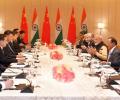
China had been trying hard to enter the Indian market, without opening its own to Indian products. There is an economic crisis in India-China relations that the Chennai Connect barely scratched the surface, points out Srikanth Kondapalli.

The Central Bureau of Investigation on Monday opposed in a Delhi court the bail plea of Congress leader Jagdish Tytler, who had been chargesheeted along with controversial businessman Abhishek Verma, in a case of alleged forgery of All India Congress Committee General Secretary Ajay Maken's letter which was sent to the prime minister.

Following the footsteps of Motorola, Chinese handset maker Xiaomi is also teaming up with e-Commerce major Flipkart to launch its handsets in India.

Mozilla showcased a smartphone prototype costing as little as $25 at the Mobile World Congress in Barcelona in February, targeting developing countries including India and China.
