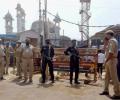
A plea was filed in the Supreme Court on Wednesday challenging the constitutional validity of certain sections of the Places of Worship (Special Provisions) Act 1991, saying that it "barefacedly violates" the principles of secularism and rule of law.
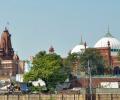
The plaintiffs had filed a suit in the lower court which had observed that they didn't have the right to sue.
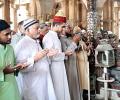
The Uttar Pradesh government has given the allotment letter to the Sunni Waqf board for the land in Dhannipur village in Sohawal tehsil in Ayodhya on the Lucknow highway, about 18 km from the district headquarters, state government spokesperson Shrikant Sharma told reporters on Wednesday.

The state government has also issued orders on celebration of Independence Day at state madrassas.

Deputy Chief Minister Manish Sisodia and Environment Minister Gopal Rai visited the Eidgah in Mustafabad and interacted with locals besides taking stock of facilities being provided by the government at relief camps.

The mosque is coming up in the Uttar Pradesh district pursuant to the Supreme Court verdict in the Ram Janmabhoomi case.

The administration started preparing for the demolition of two precariously standing hotels in subsidence-hit Joshimath in Uttarakhand on Tuesday, but faced protests from their owners and locals on the issue of compensation, while more families were evacuated from the danger zone as the number of affected houses rose to over 700.
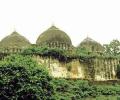
Sources said the parties have sought settlement under the provisions of The Places of Worship Act, 1991 which provides that no dispute with regard to any mosque or other religious places, which have been constructed after demolition of temples and are existing as in 1947, would be raised in a court of law.

The verdict by a special court in the Babri Masjid demolition case comes 28 years after kar sevaks razed the 16th century mosque and almost a year after the Supreme Court settled the land case in favour of a Ram temple at the disputed Ayodhya site.

'A time will come when the white structure in Mathura that hurts every Hindu will be removed with the help of the court'
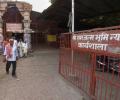
The move bears significance in the wake of November 9 judgement of the Supreme Court which allowed construction of a Ram Temple in the disputed site in Ayodha.
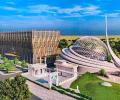
"The design of the mosque has been prepared using modern technology, and it will be egg-shaped without any dome. The two-storeyed mosque will not have any minaret. Solar power will be installed in the mosque, and around 2,000 people will be able to offer 'namaaz' at the same time," he said.
"The Trust chose January 26, 2021 for laying the foundation stone of the Ayodhya mosque as on this day our Constitution came into effect over seven decades ago. Our Constitution is based on pluralism, which is the leitmotif of our mosque project," said Athar Hussain, secretary of the Indo-Islamic Cultural Foundation (IICF).
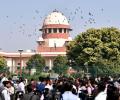
18 review pleas were filed against the November 9 verdict of the apex court. The SC found 'no ground to entertain' any of them.

Delhi environment minister Gopal Rai alleged in a press conference that Delhi police on the instruction of PMO put up banners carrying photos of PM Modi at venue of Van Mahotsav programme on Saturday night.

'The locals want a permanent solution to the perennial Mandir-Masjid issue. They have realised political parties will lose relevance if a temple is built.'

Samajwadi Party leader Tej Narayan Pandey on Sunday accused Shri Ram Janmbhoomi Teerth Kshetra Trust of committing corruption in a land deal and sought a Central Bureau of Investigation probe into the matter.

President Droupadi Murmu administered him the oath at a brief ceremony held at the Rashtrapati Bhavan.

Counted as a judge who enriched the 'verdict docket' of the apex court, Justice Chandrachud is viewed as sharp, articulate and forward looking.
With discussions on the UCC taking centrestage, he said the BJP government in the state will move towards implementing one law for all, "only after talking to all the parties".

Dhananjaya Y Chandrachud, however, had no qualms about overturning the judgements of father Y V Chandrachud on hot- button issues like adultery and the right to privacy.

He will take oath on November 9, a day after incumbent CJI Justice Uday Umesh Lalit demits office on attaining the age of 65.

In his letter, Khan stated that he has 'run out of patience' of issuing clarifications to the public pleading innocence over a number of allegations levelled against him and his family members.

The plea, filed by a religious guru based in Mathura, Devkinandan Thakur, has challenged the constitutional validity of Sections 2, 3, and 4 of the Places of Worship (Special Provisions) Act 1991, stating that it offends Articles 14, 15, 21, 25, 26, 29 of the Indian constitution and violates the principles of secularism and the rule of law, which is an integral part of the Preamble and basic structure of the Constitution.

In his second term in office, UP Chief Minister Yogi Adityanath has retained 34 portfolios.

After Azam Khan's demand of handing over the Taj Mahal to the Waqf Board, Uttar Pradesh Bharatiya Janata Party chief Laxmi Kant Bajpai has sought to drag the famed mausoleum into another row by claiming that it was a part of an ancient temple.

A plea claimed that Bhaskar had made "derogatory and scandalous" statements against the courts in the country and mentioned the Ayodhya case judgement.

'The fire burning on the streets because of BJP's hateful politics will not light up homes'
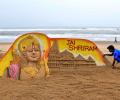
The following is the chronology of events related to the Ram Janmabhoomi-Babri Masjid land dispute in which, after the Supreme Court verdict, Prime Minister Narendra Modi on Wednesday conducted the 'Bhoomi Pujan' or ground breaking ceremony and laid the foundation stone for the temple's construction.
Iqbal Ansari, one of the main plaintiffs who fought for the right of the community over the disputed land, says Muslims in Ayodhya won't be satisfied if the Sunni Waqf Board accepts the five acres in Dhannipur.
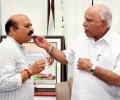
Success in Karnataka's assembly polls will hinge on two factors: Drop a large number of incumbent MLAs and project Modi and not the state leaders, least of all Bommai.

Sisodia also lashed out media for carrying news against AAP leaders without "checking facts".

The minority affairs ministry wanted use of the Public Premises Act, 1971, to remove unauthorised occupants from Waqf properties, but the law ministry, which is also under him, shot down the proposal on the ground that the Act is for summary evictions from "public premises" and not from the Waqf premises.

"This has to be deprecated. This is something which should not be happening," a five-judge Constitution bench headed by Chief Justice Ranjan Gogoi said.
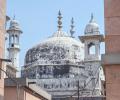
A bench of Justices D Y Chandrachud, Surya Kant, and P S Narasimha said that it is posting for October first week hearing on the appeal of Gyanvapi mosque committee's plea against the Allahabad high court order upholding the appointment of court commissioner to survey the site.
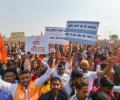
The litigants and their counsels -- altogether over 50 people -- met the three-member mediation panel on the Avadh University premises in Faizabad.
The Waqf Board declared Taj Mahal as its property on July 13.

From the kind of food to the art which will be displayed at the museum, historian Pushpesh Pant shares his vision.
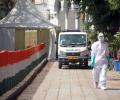
The court declined to increase the number of people or allow use of other floors of the mosque for offering prayers as sought by senior advocate Ramesh Gupta on behalf of the Delhi Waqf Board, but allowed them to move an application before the SHO for the same.
highlights of the Supreme Court judgment in which it unanimously granted the entire 2.77 acre of the disputed Ram Janambhoomi-Babri masjid land in Ayodhya to deity Ram Lalla.
