
Delhi has become the world's second most populous city in 2014 after Tokyo, more than doubling its population since 1990 to 25 million, according to a United Nations report.
Youth are at the centre of urbanisation. They add energy, vibrancy, creativity and digital age talent to cities.
Governments are increasingly putting pressure on industries to adopt best international practices to improve water management.

India is home to almost 1.3 billion people.
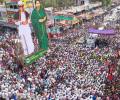
It looks as if competing political parties in Tamil Nadu have not grasped the full impact and import of a sizable section of voters possibly staying away from voting -- voters, supposedly with a predictable polling pattern -- owing to the Covid second wave and more so, how it could affect the outcome in individual constituencies and even booths, says N Sathiya Moorthy.
Cisco's CEO says India's urban planners urgently need to think innovatively to prepare for the unprecedented migration from villages that is expected over the next decade.

Creation of 115 million non-farm jobs over next decade critical to sustaining growth, says McKinsey

Modi govt pushed very hard the concept of smart cities in 2014.

Land pooling refers to amassing small land parcels for infra development and returning approximately 60% of the redeveloped land to the original owners
India is likely to be the third largest economy with a gross domestic product size of $15 trillion by 2030, says Standard Chartered's Super-Cycle Report.
Gujarat Chief Minister Narendra Modi on Thursday said that instead of viewing urbanisation as a challenge it should be converted into an opportunity.
Let's take a look at 14 infrastructure sectors that need immediate attention.
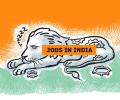
'You can't take jobs to people, you have to take people to jobs.'
The catastrophe in Uttarakhand may have been unprecedented, but it is not as if the state government wasn't unaware of the looming threat. Government reports had warned of the unchecked dangers of urbanisation, and from power projects, notes Shishir Prashant.

While the New Delhi Municipal Council area was given the 'Cleanest Small City' award, Uttarakhand's Gauchar was adjudged the 'Best Ganga Town' in the central government survey.
Mercer, the human-resources consulting firm, recently analysed living conditions in cities according to 39 factors, worked out basically to compensate employees of multinational companies when they are located in different cities of the world.

The going is not going to be easy for the DMK and its allies in Elections 2024. Despite the seats sweepstake in the 2021 assembly polls, the vote-share difference of 5.6% (DMK's 45.38% versus AIADMK-BJP's 39.72%) is not insurmountable on a bad day, points out N Sathiya Moorthy.

Indian coffee shops market over the next four-five years will grow between 6 and 18 per cent CAGR, all due to the growing coffee culture among the youth, increasing urbanisation, rising disposable income levels and changing eating and drinking preferences, says Atanu Biswas.

With its fleet of nearly 1,000 electric three-wheelers in Delhi-NCR, it moves around 100,000 commuters daily. The company will use the funding to rapidly increase its fleet size within Delhi-NCR as well as other key cities around the country.

'The reality is no one, including some of the names that have shown up in the last few weeks, have any unilateral decision-making power in this,' Facebook India MD Ajit Mohan tells Peerzada Abrar.
In a city where 45,000 people on average live on every square kilometre of space, making it one of the world's most congested, and it often takes two to three hours to negotiate a 20 km distance, even a railway overpass counts as a big urban milestone.
"FDI doesn't benefit any country; these investors are exploiting us," Says Madhav Gadgil.
The skyrocketing price of cemetery plots and funeral services has come has a shocker to millions of ordinary people.
Shift in economic balance toward the East and South is happening with unprecedented speed and scale.

From majestic forts to scenic lakes, choose between trips that offer the best of history and culture and tranquility.
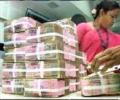
India's gross domestic product (GDP) can grow at seven per cent or more, provided the process of reforms is expedited, the World Bank has said.
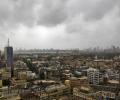
Smart cities must be very well equipped with technology and security systems alike.

As India gets increasingly urbanised, one man tries to minimise its silent casualty.
Even though its ranking slipped from the fourth spot in 2011, India has been placed ahead of the UAE, Saudi Arabia, Indonesia and Russia.

Banks now ride on what is defined as a "banking outlet". This is a fixed-point service unit, manned by either the bank's staff or its business correspondent (BC), where all kinds of services - acceptance of deposits, encashment of cheques, cash withdrawal or lending of money - are provided for a minimum of four hours per day, for at least five days a week. Banks are now turning to reposition the manner in which they acquire customers, report Abhijit Lele and Raghu Mohan.
The report, 'The roots of growth: Projecting EM infrastructure demand to 2030', produced jointly by Cambridge Judge Business School and the Royal Bank of Scotland, predicts that the emerging world will need to spend $20 trillion dollars on infrastructure over the next 20 years.
Following is the full text of Prime Minister Manmohan Singh's address at the inaugural ceremony of India Water Week, in New Delhi on Tuesday
McKinsey Global says these cities would generate about 47 per cent of expected global GDP by 2025.
Today is the day to mull and tomorrow the day to walk to your polling booth and decide what you want: a good city where there is a compliant corporator or a bad city with an arrogant politician ruling our civic destiny, says Mahesh Vijapurkar.
These states make India one of the fastest growing economies in the world.

Indian Media is witnessing buoyancy in the content, ad revenue and ad rates, thanks to heightened activity in terms of coverage on scams, budget and World Cup Cricket.
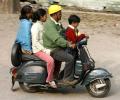
'That Modi and the BJP can continue to treat the rising and expanding middle class this way shows that they have gamed its mind quite perfectly,' argues Shekhar Gupta.
Indian cities need hard infrastructure but ultimately they are not about buildings, roads and sewage drains but about people and their varied social and economic interactions, says Sanjeev Sanyal.
Urban India accounted for 26 per cent of the poor in 2004-05.
Fast paced urbanisation has taken a toll on the environment.
