
'Actual implementation of the 14-point agreement is proving hard to achieve let alone striking and sustaining a long-term treaty or deal.'

Investors are keenly awaiting clarity on Reliance Jio Infocomm's IPO, the company's AI and data centre strategies, and next-generation leadership structure at Reliance Industries Ltd's (RIL's) 49th annual general meeting (AGM).

The Indian government has expressed its disagreement with the IMF staff's 'baseline' assumption that the 50 per cent US tariffs on its goods exports 'would remain in place indefinitely', based on which the staff pegged the country's GDP growth at 6.6 per cent this year, and pared its 2026-27 projection by 20 basis points to 6.2 per cent.

'The March correction was clearly due to the war and with prospects of that coming to a conclusion, there is a natural rally.'
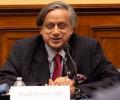
Senior Congress leader Shashi Tharoor says US tariffs are negatively impacting India, leading to job losses, and criticizes President Trump's diplomatic behavior.

'It was diminishing even before Trump came to power.' 'The US was at the centre of the global economy. That position is going to become less and less important and less central.'

'Just as we cannot surrender the interests of our farmers and dairy industry, Trump is also looking for markets for the produce of the farmers in the Midwest, which are his support base.'
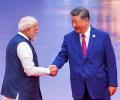
India's dual pursuit of a robust strategic partnership with Washington and a pragmatic, tension-management policy with Beijing represents the essence of modern multi-alignment. By embracing economic pragmatism, learning to compartmentalize political differences, and engaging in continuous dialogue, India can secure its borders, grow its economy, and contribute to a stable, multipolar Asian century, points out Ambassador Rajasekhar.

US president Donald Trump in recent weeks has renewed threats to make Canada the 51st US state, and said he might not renew the trilateral trade agreement between the US, Canada and Mexico -- the co-hosts of this year's World Cup.
The Trump administration has told the US Supreme Court that it imposed tariffs against India for purchasing Russian energy products as part of its strategy to address the war in Ukraine.

Ratings firm Crisil said on Wednesday that the uncertainties surrounding the US tariffs might be a new hindrance to capital expenditure decisions in the current financial year. The additional 25 per cent tariff imposed by US President Donald Trump on India for its purchases of Russian oil came into effect on Wednesday, bringing the total amount of levies imposed on New Delhi to 50 per cent.

Trump made the announcement in response to what he described as China taking "an extraordinarily aggressive position on trade" by sending "an extremely hostile letter to the world."

The imposition of a 100 per cent tariff by the US on imports of branded and patented pharmaceutical products starting October 1 may not significantly hurt Indian drug makers, with Sun Pharma being exposed to some headline risk but with limited earnings impact, according to analysts. Among Indian companies, only Sun Pharma has sizeable sales from patented drugs in the US (about 17 per cent of 2024-25 revenue), HSBC Global Investment Research said in a report.
No experts, clearly, were involved in the design of these new tariffs, which have been the subject of bemused wonderment across the world in how completely they ignore logic, rationality, fairness, and economic theory, observes Mihir S Sharma.

Reserve Bank Governor Sanjay Malhotra announced that India's foreign exchange reserves stand at a healthy $682.3 billion as of May 29, 2026, providing approximately 11 months of import cover and strong protection against external shocks.

Tata Motors' MD and CEO, Girish Wagh, has identified rising diesel prices as the most significant threat to India's commercial vehicle (CV) industry recovery, despite the sector recently surpassing its pre-FY19 wholesale peak. Diesel costs account for 25-50% of a truck operator's total cost of ownership, making any increase a critical concern for fleet economics.

The World Bank has increased India's economic growth projection for FY27 to 6.6 per cent, citing resilient domestic demand, while simultaneously cutting its global economic growth outlook due to the conflict in West Asia.
Describing the India-United States relationship as 'very complicated', US Treasury Secretary Scott Bessent on Wednesday hoped that 'at the end of the day, we will come together.'
In trade negotiations, as in chess, sometimes you need to accept a temporary disadvantage to secure a better long-term position, points out Sonal Varma, chief economist (India and Asia ex-Japan) at Nomura.

The Indian rupee plummeted to an all-time low of 95.80 against the US dollar, settling at 95.66, driven by elevated crude oil prices and escalating geopolitical tensions in West Asia, despite potential RBI intervention and import curbs on gold.
"I understood tariffs better than any human being in the world. And now with my tariffs, they were all dropping them. India was the most highly tariffed nation... And you know what, they've offered me no tariffs in India anymore. No tariffs," Trump said.

Communication channels between India and the US are open to resolve the ongoing tariff issues, and the glitch in trade ties is only temporary, given the long-term relationship between the two nations, government sources said on Wednesday. The US' 50 per cent tariffs on Indian exports to America came into effect from August 27, barring a few sectors.

'The Atomic Energy Commission has approved the FDI policy and it is going in for ministerial consultations.'

India and New Zealand are poised to sign a free trade agreement (FTA) on April 27 in New Delhi, aiming to provide tariff-free access for Indian goods to New Zealand's market and attract USD 20 billion in investment over the next 15 years.
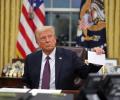
President Trump announces 100% tariffs on movies made outside the US, potentially impacting the Indian film industry. The move follows similar tariffs on pharmaceutical products.

State governments have requested the Centre for export incentives, lifting of import duty in the case of cotton for the textile sector and GST exemptions.

China's Foreign Ministry has refuted allegations of providing military support to Iran, warning the US against imposing tariffs based on these accusations. The statement follows reports of Iran acquiring a Chinese satellite for targeting US military bases. Meanwhile, a rescheduled meeting between Presidents Trump and Xi Jinping is set for May.
Industry leaders urge India to pursue diplomatic talks with the US, strengthen manufacturing, and consider China ties to gain leverage against tariff pressures.

The OECD projects India's GDP to grow at 7.6% in the current fiscal year and 6.1% in 2026-27, despite global economic challenges stemming from the Middle East conflict and energy price volatility.

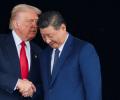
US President Donald Trump and Chinese President Xi Jinping met in Beijing to discuss a range of issues, including trade frictions and the war in Iran.
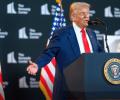
Trump said California has been particularly "hard hit" because of this, blaming democrat Gavin Newsom, the Governor of California, for this loss, calling him "weak and incompetent."

External Affairs Minister S Jaishankar raised India's concerns with US Secretary of State Marco Rubio regarding changes to US visa and immigration policies, emphasising that legal mobility should not be negatively affected. Rubio acknowledged potential 'bumps' during the transition as the US aims to improve its immigration system.

'The biggest point of contention is market access for US agricultural and dairy products.'

US President Donald Trump is set to visit China for talks with President Xi Jinping on trade, global issues, and the Gulf war. The visit aims to address trade frictions and other key issues, with high expectations for progress.
Former White House official John Bolton suggests that tariffs imposed on India by the US for purchasing Russian oil may have unintended consequences, potentially driving New Delhi closer to Beijing and Moscow.

The Indian government is set to accelerate reforms, including measures to enhance foreign direct investment, speed up divestment, and boost asset monetisation, to maintain economic growth despite rising fuel and fertiliser import costs driven by the West Asia crisis.

The US-China rapprochement, however tenuous, is not without implications for India. Both China and Pakistan have become closer to the US, notes Ambassador T P Sreenivasan.

High US tariffs are expected to affect close to 8 per cent of India's overall auto component production, ratings firm Icra said on Wednesday. Indian auto component exporters are at a relative disadvantage compared to most other Asian exporting nations, highlighting the importance of concluding an India-US bilateral trade agreement, it added.
Speaking to reporters aboard Air Force One, Trump stated, "We have a deal," referring to the trade pact which will be routinely extended. "Every year we'll renegotiate the deal, but I think the deal will go on for a long time, long beyond the year. We'll negotiate at the end of the year," he added.
