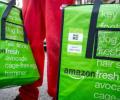
Amazon India has decided to shut down 'Amazon Distribution', according to sources. This follows its recent decision to shut its food delivery and edtech offerings. The moves are part of the annual operating planning review process amid global macroeconomic uncertainty. The e-commerce giant is looking to focus on its core businesses, sources said.

Tata Consultancy Services (TCS) is India's most-valuable brand in 2022 replacing HDFC Bank, which held the number one spot since 2014, according to Kantar BrandZ report on India's most-valuable brands. TCS was able to grab the top slot due to rising global demand for automation and digital transformation, following the pandemic. Indian brands have bounced back from the pandemic to increase their brand value by 35 per cent compound annual growth rate (CAGR) since 2020.

The BCCI on Friday said it will review IPL's sponsorship deals, including the one with Chinese mobile manufacturing company Vivo, in a meeting next week after 20 Indian soldiers were killed during a clash with Chinese troops in eastern Ladakh. The meeting of the IPL Governing Council will review the yearly Rs 440 crore title sponsorship deal with Vivo among others.

Food delivery platform Zomato has filed preliminary papers with capital market regulator Securities and Exchange Board of India (Sebi) to raise Rs 8,250 crore through an initial share-sale.

Readying its game plan, the Bengaluru-based e-commerce giant plans to renew talks of investments in various companies such as Swiggy, BookMyShow, Pepperfry, UrbanClap

Indian firms caught napping as private details of individuals were leaked

Gig workers are usually spoken of in the context of the sharing economy, like Uber, Ola drivers, delivery persons for Zomato and Swiggy and so on. This is the first time such workers will be covered under India's social security law.

As the deadly second wave of the Covid-19 pandemic rages on, startups and technology firms are realising the burnout effect it is having on employees. Many have shortened their work weeks to four days, while others have made provisions for more time off for employees to help them rejuvenate or care for loved ones.

According to experts, this will have major impact on new investments by Chinese players in companies, such as Paytm, Ola, BigBasket, Byju's, Dream11, MakeMyTrip, and Swiggy, when they go for follow-up funding. Chinese investors, such as Alibaba, Tencent, and Xiaomi, are active in the Indian start-up space, and have collectively invested billions of dollars.

Takes on UberEats, Swiggy; experts question cash burn.

Footfalls will invariably come down to a trickle even after lockdown restrictions go away, and the only way to prevent someone else from poaching your consumer is to go down to the consumer herself. Consumers will prefer products and services to be delivered to their doorstep, hygienically and safely.

Flipkart Supermart is already live in Bengaluru, Chennai, Hyderabad and Delhi

What India's top restaurants are doing to satisfy your food cravings.

Fresher hiring is expected to more than double compared to last year.

Uber on Tuesday said it is laying off about 600 employees in India -- about a quarter of its staff in the country -- as business has taken a major hit amid the COVID-19 pandemic. The development comes days after rival Ola had announced laying off 1,400 people from its rides, financial services and food business.

The duo spent almost $400 million in 2018 on rapid expansion as well as discounting to gain new customers, and Uber Eats has managed to edge out Foodpanda by 2 million orders.

After a recent fall in profit, Masayoshi Son of SoftBank announced that the Japanese tech investor will look at dramatic cost-cutting. Before he does that, investments in India for calendar year 2022 (CY22) will fall radically, observed sources in the know. Last year, the company had invested around $3.2-3.5 billion in the Indian start-up ecosystem - almost 10 per cent of the total investment the sector received. For CY22, the investments may not even touch $1 billion.

Uber's draft prospectus for the biggest IPO in the world since Alibaba's in 2014 has projected a major cash burn for Uber in trying to get a significant market share in India, reports Karan Choudhury.

Fintech unicorn Razorpay has raised $375 million in the Series F round of funding at a $7.5-billion valuation, making it India's second-most valuable start-up in this space, after Paytm. The company valuation has surged over seven times in 15 months, helping it push Walmart-owned digital payments firm PhonePe to the third spot on the country's most-valuable fintech list. Razorpay's latest round of fundraising was led by Lone Pine Capital, Alkeon Capital, and TCV.

Zomato said late on Friday that it was pushing the implementation of the new food quality policy to May 3 from April 18.

Food ordering platform Zomato, whose Rs 9,375 crore IPO opens on July 14, is planning to launch a grocery section on its app soon, a senior company official said. The company recently invested USD 100 million (around Rs 745 crore) for acquiring a minority stake in grocery delivery platform Grofers. "It (grocery) is a large opportunity. The online grocery is nascent right now but is growing rapidly not just in India but across the world... "We are actively experimenting in that space and recently invested $100 million for a minority stake in Grofers, with the idea of getting more exposure to that space and building our strategies and plan around that business," Zomato CFO Akshant Goyal said.

Keen to back start-ups while they are half-unicorns, SoftBank plans to invest $100 million in a firm with $500-million valuation.

After a recent spate of big-bang funding of food discovery and delivery apps, experts believe the sector's consolidation might be over and the remaining players are here to stay and thrive.

However, many of these firms were facing an uphill task of convincing the people on the ground to return to work, as many are apprehensive of their safety.

Photo-messaging app Snapchat on Wednesday said its monthly user base has reached 100 million in the country, and the company will continue to anchor its efforts towards growing and providing more resources to its community of Indian creators. Snap Inc, the parent company of Snapchat, virtually hosted the second edition of 'Snap in India'. At the event, Snap co-founder and CEO Evan Spiegel announced the milestone of reaching 100 million Snapchatters monthly in India.

Reliance Retail has bought a 25.8 per cent stake in Dunzo, India's leading quick commerce player, for $200 million (around Rs 1,488 crore) as it looks to expand its presence in online grocery delivery business. Dunzo has raised $240 million (about Rs 1,787 crore) in its latest funding round that was led by Reliance Retail Ventures Ltd (RRVL) - the retail arm of Reliance Industries, the two firms said in a statement. Existing investors Lightbox, Lightrock, 3L Capital and Alteria Capital also participated in the funding round.

$47.6 bn capital invested across 921 deals in India in 2020, despite pandemic.

'There was hardly any recruitment after the second wave.' 'Now, there is a huge demand for manpower.'

According to the law, the contribution "should not be more than 5 per cent of the amount paid to gig workers. The government is likely to start seeking contribution from gig companies towards the fund from April 1, 2021.

Projections suggest online food delivery market should grow to $22 billion by 2025.

It's high time we now turn the popular question on its head -- when there is no growth in jobs for several years, how can the real GDP grow at 7 per cent per annum, says Mahesh Vyas.

Help came from Sanjeev Bikchandani, founder and executive vice-chairman of Info Edge, the main investor in Zomato.

'The digital trust level has drastically gone up due to Covid, not only in tier-I and II cities, but also in tier-III, IV and V geographies,'

Over the last 12 months, thanks to bold bets by venture capital firms like Sequoia, SoftBank Vision Fund, and foreign strategic investors like Naspers, pipeline of start-ups with potential to achieve $1 bn in valuation is at an all-time high.

Flipkart has not been able to process with its plans of getting into the grocery vertical and is stuck on running pilots in select cities.

While there were concerns about the security aspect of drones, top government officials were of the view that restricting the drone industry would stifle a sunrise sector which holds significant promise for future, reports Arindam Majumder.

'We need people who can position a product digitally and craft the journey for customers, by improving user interface and user experience.'

Cab aggregator Ola is laying off 1,400 staff from rides, financial services and food business as revenues declined by 95 per cent in the last two months due to coronavirus pandemic, a note by CEO Bhavish Aggarwal said. In an email to employees, Aggarwal made it clear that the prognosis ahead for the business is "very unclear and uncertain" and the impact of this crisis is "definitely going to be long-drawn for us".

'Money must be produced constantly.' 'This need is driving people to find work, and for many of them, it is working for a living for the first time in their lives,' observes Aakar Patel.
The recent protests by employees of Urban Company and the case of a a Zomato delivery executive who died in a road accident point to the severely straitened condition of gig workers during the ongoing Covid-19 pandemic. Budget 2021 had promised several measures to help the cause of gig economy workers, but most of them are yet to see the light of day. Even after a year, the country's gig workers continue to be without any social security cover or a minimum wage guarantee. "In Budget 2021, finance minister Nirmala Sitharaman had announced that the government is looking toward including migrant and gig workers for social security benefits," says Srinivas Kotni, managing partner, Lexport, a consulting firm. Parliament had passed the Code on Wages in 2019 and Code on Industrial Relations, Social Security and Occupational Safety, Health and Working Conditions in 2020.
