
Carmakers Mercedes-Benz, Audi, Renault, Kia India and MG Motor on Wednesday announced plans to hike vehicle prices from January to partially offset the impact of rising input costs. They join the likes of market leader Maruti Suzuki India and Tata Motors, which have also made the year-end announcements to raise prices from next month. Audi India said it will increase prices of its entire model range by up to 1.7 per cent, while Mercedes-Benz India noted it will hike the prices by up to 5 per cent from January 1.
Passenger and commercial vehicle prices are expected to rise as automobile companies invest in upgrading vehicles to meet stricter emission norms that kick in from April next year. The Indian automobile industry is currently working to make their products meet the second phase of Bharat Stage VI, equivalent to Euro-VI emission norms, in real time driving conditions. Four-wheeler passenger and commercial vehicles will need more sophisticated equipment to be added to meet the next level of emission standards.
Automobile retail sales in India rose 11 per cent in September as better supplies from manufacturers enabled dealers to ramp up customer deliveries amid the ongoing festive period, Federation Of Automobile Dealers Associations said on Tuesday. Last month, total retail sales stood at 14,64,001 units as compared to 13,19,647 units in September 2021. FADA noted that October is expected to witness even better overall sales due to the festive season further gathering steam.

Innovation ranging from exterior designs of vehicles to EV charger locks grabbed eyeballs at the expo

Titan was the top gainer in the Sensex pack, rising 3.5 per cent, followed by Kotak Bank, SBI, Maruti Suzuki, Bajaj Finance, HUL, Axis Bank and Sun Pharma. On the other hand, NTPC, Tech Mahindra, PowerGrid and Infosys were the laggards.

Even as India overtakes Japan in automotive sales in 2022, moving to third place for the first time, oddly enough the country's biggest motor show is going to see some big hitters give it a clear miss. Some prominent automotive brands have cited high event costs, negligible returns on investment, poor event management, and unfavourable location as reasons for their reluctance to participate. Major pure-play electric two-wheelers, too, are riding past this year's edition of the Auto Expo.

'In FY23, PV sales are expected to end the year at a record 3.8 million units, up 26 per cent. In FY24, however, the industry is expecting 5-7 per cent volume growth'

Open order books in February breach 700,000; wait period for some models exceed a year.

Equity indices slipped in the negative territory on Wednesday after a two-day breather, with the BSE Sensex tumbling 709.54 points following weak trends in global markets. Unabated foreign fund outflows also played spoilsport for the bourses. The 30-share BSE Sensex tanked 709.54 points or 1.35 per cent to settle at 51,822.53. During the day, it declined 792.09 points or 1.50 per cent to 51,739.98.
Leading carmakers Maruti Suzuki and Hyundai witnessed a double-digit drop in sales in October on account of the global semiconductor shortage impacting production. Kia India, Honda Cars and MG Motor also saw a fall in dispatches last month as compared with October 2020. However, companies like Tata Motors, Mahindra, Nissan and Skoda managed to post positive numbers last month despite the supply chain challenges.

Market capitalisation of BSE-listed companies jumped to an all-time high of over Rs 280 lakh crore on Monday as benchmark indices bounced back after taking a breather in the previous trade. The 30-share BSE benchmark gained 85.88 points or 0.14 per cent to settle at 61,308.91. During the day, it jumped 162.45 points to 61,385.48.

Benchmark indices Sensex and Nifty gave up early gains to close lower for a fourth straight session on Thursday due to selling in IT and banking shares amid weak global equities. The 30-share BSE benchmark settled 98 points or 0.18 per cent lower at 53,416.15. During the day, it hit a high of 53,861.28 and a low of 53,163.77. The broader NSE Nifty also pared initial gains and ended 28 points or 0.18 per cent down to settle at 15,938.65.

At 12:25 PM, the barometer index, the S&P BSE Sensex was down 358 points or 1.3% at 26,368.

'Some of the launches may get deferred due to the semiconductor shortage, which is unlikely to get resolved before the second half of 2022.'

White is easy to maintain, looks brighter than other colours over a longer period, is the least commonly rejected colour among family members, has high resale value, provides better safety at night, absorbs less heat in the summer season, makes small cars look bigger, and is not considered inauspicious.

First off the block will be a new multi-purpose vehicle which is being co-developed with Toyota - Suzuki's alliance partner. The model will also wear a Toyota badge.

After a long delay, Thailand opened its twice-postponed Bangkok international motor show to the public as coronavirus restrictions eased, with nearly all attendees wearing masks and face shields.

The new year will see a line of hatchbacks (including compact SUVs) hit the Indian roads. Rajesh Karkera/Rediff.com offers a peek.

While commercial vehicles are expected to benefit from strong replacement demand, the two-wheeler and tractor segments are expected to gain from a recovery in the rural economy.

Companies in the micro, small and medium enterprises (MSME) sector may legally challenge the Haryana government's new law which mandates 75 per cent reservation of jobs in the private sector for locals. "We had earlier gone to the high court against this law, but the court said that it would hear the matter after the law was notified," said Manoj Tyagi, general secretary, IMT Industrial Association. Industries and associations feel that the law will not benefit the state and will hit MSMEs that are just coming out of the crippling effects of the lockdowns owing to the Covid-19 pandemic.

The list clearly shows the dominance of Maruti and Hyundai in the Indian passenger vehicle market.

Rajesh Alva brings you the details of the first maxi-scooter from the Suzuki stable.

Hyundai got two stars for Grand i10 Nios and Kia got three stars for Seltos.
India's passenger vehicle exports rose by 26 per cent in April-June 2022 aided by enhanced shipments to Latin America and Africa and a low base of the year-ago quarter that was hit by the second wave of COVID-19. As per the latest data released by the Society of Indian Automobile Manufacturers (SIAM), passenger vehicle shipments rose to 1,60,263 units in the April-June period of this fiscal as compared with 1,27,083 units in the same quarter of 2021-22. Passenger car shipments saw an 88 per cent year-on-year growth at 1,04,400 units while utility vehicle exports rose 18 per cent to 55,547 units during the period under review, SIAM data showed.

Recently, South Korean Foreign Minister, Chung Eui-yong, dialled his Indian counterpart, S Jaishankar, in New Delhi. His government, he said, "regretted the offence caused to the people of India". A day earlier, India had summoned the South Korean ambassador to express its "strong displeasure" over "an unacceptable social media post".

Continuing its decline for the third day on Friday, the BSE gauge plummeted 1,214.96 points or 2.20 per cent to 53,887.72 during the day. It settled at 54,333.81, a decline of 768.87 points or 1.40 per cent.

With 15 models and a market share of close to 50 per cent, it rules the Indian market, selling almost 1.5 million units every year, rolling out one model every ten seconds.

The figures are encouraging for the auto industry amid apprehension that due to higher cost and lack of fuel availability, cars with stricter emission standards may not be popular in initial stages. Automakers had even cited this confusion as one of the reasons for dwindling car sales in India, reports Arindam Majumder.

Apart from physical stores, the company operates 2,700 digital touch points in the form of web pages, which is gaining good traction from tier-II and III centres.

Automobile exports from India recovered in the first quarter with all vehicle segments, including passenger vehicles and two-wheelers, witnessing growth following an improvement in the pandemic situation across various international markets. As per the latest SIAM data, total vehicle exports during the April-June quarter this fiscal stood at 14,19,430 units as compared with 436,500 units in the same period of 2020-21 which saw massive disruptions due to the COVID lockdowns across the country, hampering sales as well overseas shipments. SIAM director general Rajesh Menon told PTI that while two-wheeler shipments were better than previous three years, passenger vehicles, three-wheelers and commercial vehicles export numbers were yet to catch up with numbers in the first quarter of 2018-19 fiscal.

After a turnaround in performance by Indian equity markets since July that has seen the S&P BSE Sensex and the Nifty50 wipe out the year-to-date losses, analysts suggest investors start nibbling into stocks that are focused on the domestic economy. While they say intermittent corrections, led by policies of global central banks and other economic data, cannot be ruled out, analysts expect India's relative outperformance among global equity markets to continue as it looks better placed with a healthy economic recovery, and remains one of the fastest growing major economies. In this backdrop, Neeraj Chadawar, head of quantitative equity strategy at Axis Securities, believes that amid global slowdown, aggressive tightening by the central banks, and preference for domestic interests first (by the local government), export-oriented themes are likely to be muted or will deliver conservative returns in the near-term.

'In terms of semiconductors, challenges do remain in the pan industry, but I think we are much better than where we were a year or so back.'
Passenger vehicle dispatches from factories to dealers in India fell 8 per cent in January, mainly due to semiconductor shortage, auto industry body SIAM said on Friday. The total passenger vehicle wholesales dropped to 254,287 units in January 2022 as compared to 276,554 units in the same month of last year. Last month, passenger car dispatches stood at 126,693 units as compared to 153,244 units in the year-ago period. Similarly, van dispatches declined to 10,632 units in the period under review from 11,816 units in January 2021.
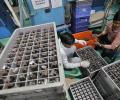
Auto component makers in India are bracing for a tough time. High absenteeism among workers owing to Covid-19, shortages of critical parts, and temporary closures of plants by automobile manufacturers have thrown a spanner in the works for the Rs 3.2-trillion sector, which derives 60 per cent of its revenues from automobile original equipment manufacturers (OEMs), with the balance split equally between replacement demand and exports. Car market leader Maruti Suzuki India on Saturday said it was extending the maintenance shutdown, which was from May 1 to 9, till May 16, "keeping in view the current pandemic situation". Some activities will continue in the plants.
As the second wave of the Covid-19 pandemic abates, India's automakers are hopeful of a quick recovery in sales volumes, led by better rural sentiment, low interest rates, improved availability of finance and a gradual uptick in business and economic activity. In fact, companies have started to ramp up production already, encouraged by high order books and the growing preference for private transport in both rural and urban areas as a means to avoid infections. In early April, the industry had been bullish as the sales trend for March showed that the effects of the Covid-19 pandemic had been left behind. The total vehicle sales had grown by 77 per cent, albeit on a lower base, and for the past few months, sales had consistently touched 300,000 units per month.

With rising petrol and diesel prices driving up demand for its CNG vehicles, the country's largest carmaker Maruti Suzuki India plans to widen its CNG portfolio by offering the fuel option in four more models 'very shortly', according to a senior company official. The company, which plans to launch an electric vehicle (EV) in the Indian market by 2025, is also currently keeping a close watch on the country's EV ecosystem "to find out what is the best way of evolution" to be able to offer affordable EVs with hassle free charging infrastructure in order to clock high volumes for a sustainable business.

The Tata group flagship has sold more sport utility vehicles (SUVs) in the domestic PV market in the past four months than any other automotive manufacturer, cementing its no.1 spot. It first grabbed pole position in the SUV segment in October 2021 after the launch of the Punch - a sub-compact SUV offering.

The new model, which is based on the company's fifth generation HEARTECT platform, comes with a BS-VI compliant one-litre petrol engine with a claimed fuel efficiency of 21.7 km per litre.

Tuesday's top gainers included SBI, UltraTech Cement, HDFC Bank, L&T, Bharti Airtel, Maruti Suzuki and Kotak Bank.

Tata Motors on Tuesday said it will increase prices of its passenger vehicles by an average of 0.9 per cent with effect from January 19, in order to partially offset the impact of rise in input costs. The Mumbai-based automaker sells various models like Tiago, Punch and Harrier, in the domestic market. Effective January 19, 2022, an average increase of 0.9 per cent will be implemented, depending on the variant and model, the automaker said in a statement.
