The Supreme Court has agreed to constitute a special bench to address the Centre's plea regarding the applicability of its March 11 judgment on OBC creamy-layer criteria to candidates of the Civil Services Examination (CSE) 2025. The Department of Personnel and Training (DoPT) seeks to proceed with service allocation for 958 recommended candidates based on the creamy-layer determination applied before the verdict, citing potential unequal treatment and disruption to training schedules.

The Supreme Court observed that Hinduism is a way of life, stating that mandatory temple visits or rituals are not necessary to be considered a Hindu; even lighting a lamp at home suffices.

A nine-judge Supreme Court bench has reserved its order on petitions related to discrimination against women at religious places, including the Sabarimala temple, and the scope of religious freedom.
The Supreme Court of India has observed that the practice of excommunicating Parsi women for entering into interfaith marriages is prima facie discriminatory, emphasising that the right of conscience is a birthright.

The Supreme Court of India has dismissed the use of information from 'WhatsApp University' as evidence in a case concerning religious freedom and discrimination against women at religious sites, including the Sabarimala Temple.
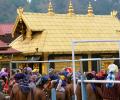
The Travancore Devaswom Board (TDB), managing the Sabarimala temple, argued in the Supreme Court that religious beliefs should be judged subjectively by the community, as the court hears petitions related to discrimination against women at religious places.
The Supreme Court of India has stated that religious institutions must have structure and norms for their functioning, emphasising that the right to manage a religious institution does not imply an absence of order.
The Supreme Court has stated that roads cannot be blocked for religious activities and that while religious denominations have autonomy in worship, the government can interfere if secular activities are affected.

The Supreme Court of India has voiced concerns about the potential consequences of individuals questioning religious practices in constitutional courts, warning it could lead to the fragmentation of religions and civilisation. A nine-judge Constitution bench is hearing petitions related to discrimination against women at religious places and the scope of religious freedom.
The Supreme Court has directed all states and Union territories to provide comprehensive information on acid attack cases, including case status, victim details, and rehabilitation measures.

The Centre has supported the restriction on women of menstruating age entering Kerala's Sabarimala temple, arguing that the Supreme Court's 2018 judgement assumes male superiority.
The Shabari story in the Ramayana found mention before a nine-judge constitution bench of the Supreme Court on Wednesday while hearing petitions related to discrimination against women at religious places, including the Sabarimala temple in Kerala.
The Supreme Court of India is hearing petitions related to discrimination against women at religious places, including the Sabarimala temple in Kerala, and the scope of religious freedom practised by multiple faiths.
The Supreme Court is hearing petitions related to discrimination against women at religious places, including the Sabarimala temple. A nine-judge bench is examining the scope of religious freedom and the exclusion of women based on age and menstrual status.

The Supreme Court questioned the chief priest of the Sabarimala Ayyappa Temple regarding the constitutionality of preventing believers from touching the deity, during hearings on discrimination against women at religious sites.
The Supreme Court of India has asserted its jurisdiction to determine what constitutes a superstitious practice within a religion, during a hearing on petitions related to discrimination against women at religious sites.
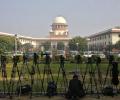
A nine-judge Supreme Court bench has commenced hearing on petitions related to discrimination against women at religious places, including the Sabarimala temple, and the scope of religious freedom across faiths.
The Supreme Court of India questioned the Centre regarding the eligibility of non-devotees to challenge the customs of the Sabarimala temple in Kerala, during a hearing on religious freedom and discrimination against women at religious sites.

The Centre has informed the Supreme Court that the restriction on women of menstruating age entering Kerala's Sabarimala temple is a matter of religious faith and denominational autonomy, falling outside the purview of judicial review. Solicitor General Tushar Mehta argued that courts should not apply 'secular standards of reason' to religious practices.
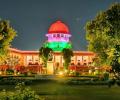
The Centre has asked the Supreme Court to reconsider its judgements decriminalising adultery and same-sex relationships, arguing they were based on a subjective application of 'constitutional morality'.

The Supreme Court of India has emphasised the importance of open access to all temples and 'maths' for everyone, warning that excluding any denomination would negatively impact Hinduism and divide society. This statement was made during hearings on petitions related to discrimination against women at religious sites and the scope of religious freedom.

The Supreme Court of India has stated that the time has come for a Uniform Civil Code (UCC), while hearing a plea challenging the Shariat law of 1937. The court suggested that the legislature should address the issue of discrimination against Muslim women.

The Supreme Court has directed the establishment of independent appellate tribunals, led by former high court judges, to address appeals related to voter list exclusions in West Bengal, while also cautioning against undermining judicial officers involved in the process.

Reader Ravindra Kshirsagar sends us a photograph.
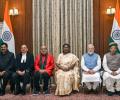
The Supreme Court's opinion on the presidential reference can impact on any number of cases if and when governors, if not the President, take a literary view of the Supreme Court's 'ppinion' on their 'discretionary powers' without reference to the rider on 'reasonable time', points out N Sathiya Moorthy.
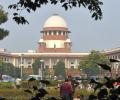
A Constitution bench comprising Chief Justice B R Gavai and Justices Surya Kant, Vikram Nath, P S Narasimha and A S Chandurkar, would fix the timelines on July 29 and commence hearing on the presidential reference in mid-August.
A five-judge Constitution bench of the Supreme Court is scheduled to consider the Presidential reference on whether timelines could be imposed by judicial orders for the exercise of discretion by the President while dealing with bills passed by state assemblies.
The Supreme Court of India has expressed concern over the protracted trials in heinous offences related to Maoist activities, stating that indefinite incarceration violates the right to liberty under Article 21 of the Constitution. Two separate benches of the court granted relief to two accused, citing the delayed trials. One bench expedited the trial of a man accused of transporting ammunition for a banned organization, while the other granted bail to a man accused of transporting materials for Naxal activities. The court emphasized the importance of speedy trials and suggested the establishment of special courts to handle Maoist-related cases, aiming to expedite proceedings. The court also criticized the practice of examining an excessive number of witnesses, which can lead to indefinite delays in the conclusion of trials.

Present a positive image by exuding enthusiasm and energy for work, says Surya Mahadevan.


Five-time world champion Viswanathan Anand continued to struggle in his first open tournament in 23 years as he suffered a shock defeat at the hands of French Grandmaster Adrien Demuth in the fifth round of the masters section of Gibraltar chess festival in Gibraltar on Sunday.

Former World champion Viswanathan Anand shrugged off his first round draw to score a resounding victory over Matthias Bach of Germany in the second round of the Masters section of Tradewise Gibraltar Chess festival, in Gibraltar, on Thursday.
Continuing his dream run, Grandmaster Abhijeet Gupta held higher-ranked compatriot Pentala Harikrishna to a draw, while Viswanathan Anand kept himself in contention with an easy victory, in the sixth round of the masters section of the Tradewise Gibraltar International Chess Festival in Gibraltar, on Monday.

Five-time World champion Viswanathan Anand continued to struggle with his form as he lost to 16-year old International Master Benjamin Gledura of Hungary in the seventh round of the Masters section of Gibraltar International Chess festival

Abhishek has been posting fond memories and interesting anecdotes on Instagram, recapping his #RoadTo20.
