
Sri Lankan Buddhist monk Galagoda Aththe Gnanasara, a prominent Sinhala-Buddhist nationalist figure, has been remanded after his arrest. This follows weeks in hiding since the Supreme Court overturned his 2019 presidential pardon, restoring his original six-year jail term for contempt of court and criminal intimidation. Gnanasara's organisation, Bodu Bala Sena, is known for its campaigns against the Muslim minority.

Sri Lankan opposition leaders are protesting the detention and alleged mistreatment of former state intelligence chief Suresh Sallay, who was hospitalised after a hunger strike. Sallay was arrested in connection with the 2019 Easter Sunday bombings investigation, and his wife has raised concerns about his treatment and restricted access.
A Sri Lankan court has imposed an overseas travel ban on former president Gotabaya Rajapaksa and two former military officers in connection with ongoing investigations into the 2019 Easter Sunday attacks. The ban was issued after the Criminal Investigation Department (CID) raised concerns that their flight could hamper the probe into the coordinated suicide bombings that killed 270 people. The current government reopened the investigation in late 2024, alleging political influence led to an earlier cover-up.

Sri Lanka's response to the Easter attacks has been slow and politically contested, unlike India's swift institutional reforms after the 2008 Mumbai terror attacks, observes Colonel R Hariharan (retd).
A Sri Lankan court on Friday named former president Maithripala Sirisena as a suspect in the 2019 Easter bombings in which 270 people, including 11 Indians, were killed.

Maithripala Sirisena was considered so meek and self-effacing that he appeared no threat to anyone. What a mistake his rivals made!

The president has agreed to call a parliamentary session on November 5, officials at Rajapaksa's office said.

The SC ordered a halt to preparations for snap elections on January 5.

Reacting to the apex court's ruling, sacked Prime Minister Wickremesinghe said, "We trust that the President will promptly respect the judgment of the courts.
Maithripala Sirisena, Sri Lanka's president-elect, was a low-profile cabinet colleague of longtime president Mahinda Rajapaksa until he switched sides to become joint opposition candidate and emerge as the proverbial dark horse in the presidential polls.
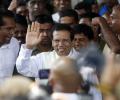
Maithripala Sirisena, who scored a stunning victory, was on Friday sworn-in as Sri Lankan president, bringing the curtains down on the 10-year rule of Mahinda Rajapaksa, marking a smooth transition of power.
Sirisena's sacking of Wickremesinghe was the culmination of an year of bitter relations between them on several policy matters. The president has been critical of the prime minister and his policies, especially on economy and security.

Sri Lanka's newly elected president Mithripala Sirisena waves at media as he leaves the election commission in Colombo. Photograph: Dinuka Liyanawatte/ Reuters
Sri Lanka's new president will embark on a 4-day visit to February 15.
Sri Lanka's new President Maithripala Sirisena on Monday unveiled his cabinet that included members from a cross-section of parties and announced fresh parliamentary polls in 100 days, two years ahead of schedule.

Dismissing opposition's claim that his government has given fishing rights to Indians, Sri Lankan President Maithripala Sirisena has said he has issued clear instructions to the navy to seize boats that violate the country's territorial waters.
Maithripala Sirisena, the Sri Lankan president-elect, will be sworn-in on Friday evening following his stunning victory in the tightest-ever presidential race that ended the 10-year-rule of Mahinda Rajapaksa.
They urged the government to be more careful about cybersecurity and advised the president to hold a snap election.
Reaching out to President-elect of Sri Lanka Maithripala Sirisena, Prime Minister Narendra Modi on Friday congratulated him on his electoral victory and said he looked forward to working with him to take the bilateral ties to a new level.
It was the first time in seven years Sri Lanka had imposed the measure. The country was under a state of emergency for nearly three decades when the government fought Tamil rebels Liberation Tigers of Tamil Eelam in the civil war that ended in 2009.
Sri Lankan President Maithripala Sirisena will visit India on his maiden foreign trip next month even as he ordered the release of all Indian fishermen in custody in Colombo as a goodwill gesture on the first day in office.

'Will President Dissanayake calibrate his foreign policy taking into account India's immediate security concerns? We need to watch.'

'If there is a push towards a Marxist oriented government it will be dangerous.' 'We have seen this in Nepal and Myanmar and it will be a concern for India if it is surrounded by countries with such political dispensations.'

For India to view the new Sri Lankan leadership only through the prism of the past or through their narrow view on China, is fraught with possibilities that should be avoided, asserts N Sathiya Moorthy.

The 73-year-old United National Party was appointed as the prime minister by President Gotabaya Rajapaksa after they held closed-door discussions on Wednesday.
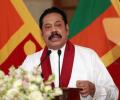
Rajapaksa's move signalled that he would contest the snap polls, to be held on January 5, under his own party banner and not that of Sirisena's SLFP.
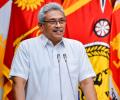
The dissidents, led by former president Sirisena's Sri Lanka Freedom Party, would leave the ruling Sri Lanka Podujana Peramuna coalition with its 14 Members of Parliament, party sources said after their meeting with the President on Monday.

Sirisena dissolved Parliament hours after a close aide of the President said that there will be no snap elections or a national referendum to end the current crises.
The parliament has approved a no-trust vote against Prime Minister Rajapaksa, speaker of parliament Karu Jayasuriya announced in the House.

Political analysts said Sirisena's move to install Rajapaksa as the prime minister could lead to a constitutional crisis as the 19th amendment to the Constitution would not allow the sacking of Wickremesinghe as the premier without a majority.

President Maithripala Sirisena's new Cabinet was also sworn in and Rajapaksa was named the new minister of finance and economic affairs.

Speaker Karu Jayasuriya questioned the president's decision to suspend parliament till November 16, saying it will have "serious and undesirable" consequences on the country.

Sri Lanka President Maithripala Sirisena sacked Prime Minister Ranil Wickremesinghe and appointed former strongman Mahinda Rajapaksa as the new premier. Sirisena's move has triggered a constitutional crisis in the country. Here are some points about the unfolding crisis and the role of key players:

The attorney general instructed the authorities to charge them for their failure to prevent the Easter terror attacks.
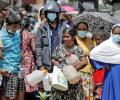
New Delhi has a chance to rid itself of its image as the bully in the subcontinent by helping a neighbour tackle problems that India, for once, has no role in creating. It should grab the opportunity with both hands, suggests Aditi Phadnis.

Meanwhile, a three-member committee appointed to probe the attacks that killed 258 people, including 11 Indians, on Monday submitted its final report to President Maithripala Sirisena.

Sri Lanka's new Finance Minister Ali Sabry on Tuesday resigned, a day after President Gotabaya Rajapaksa appointed him after sacking his brother Basil Rajapaksa amidst the island nation's worst economic crisis.
India said it will continue to extend its developmental assistance to the friendly people of Sri Lanka.
Lanka is witnessing a political crisis since October 26 when President Sirisena sacked Wickeremesinghe and replaced him with Rajapaksa.

Rulers in New Delhi and their political aides in sensitive states like Tamil Nadu have to be doubly careful not to provoke a situation whose consequences may be much more than visible now to the naked eye, notes N Sathiya Moorthy.
