
A bank manager in Ghaziabad was shot dead by a security guard following disputes over salary and leave, leading to the arrest of the guard and an accomplice.

The former beat South Central Railway while the bankmen accounted for Pakistan International Airlines.
They beat Indian Oil 4-1 in the final of the uru Tegh Bahadur hockey tournament.

Public sector banks in India are increasing their IT spending to bolster cybersecurity measures in response to concerns about Anthropic's Claude Mythos AI tool and its potential to exploit vulnerabilities in financial systems.
The bankmen came back from a goal down to beat Indian Oil 2-1 in the ONGC-Nehru hockey tournament.
Northern Railway won the women's crown in the Surjit hockey tournament.
A 3-1 victory over Delhi in the final gave the defending champions the title. Indian Oil finished third.

State-owned Punjab & Sind Bank is targeting salary accounts to boost the share of low-cost deposits. Swarup Saha, managing director and chief executive officer of the New Delhi-based lender, tells Manojit Saha that the bank may see gross non-performing assets (NPAs) fall below 8 per cent if there is resolution of the stressed assets.
Finance ministry backs chairman, may remove five govt-nominated independent directors
The Bankmen, reduced to ten men, beat Namdhari XI 2-0 in the quarter-finals of the Bombay Gold Cup hockey tournament.\n\n
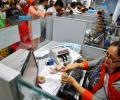
Led by the country's biggest lender State Bank of India (SBI), public sector banks logged a record cumulative profit of Rs 52,603 crore in the third quarter of the current fiscal, reflecting an 18 per cent year-on-year growth.
The Delhi-headquartered bank had favoured private placement over an initial public offer due to the stock market's volatility, a source familiar with the development said. "An initial public offer now is out of question," the source said. The private placement of shares is likely to be with public sector companies Life Insurance Corporation, UTI and Small Industries Development Bank of India but private sector participation is not completely ruled out.

A national rollout will take place after the pilot test in which SBI, PNB, Axis Bank, Bank of Maharashtra, Canara Bank, Kotak Mahindra Bank, IndusInd Bank, ICICI Bank, HDFC Bank, Indian Overseas Bank and Punjab & Sind Bank are participating.
State Bank of India-led public sector banks posted a record cumulative profit of Rs 49,456 crore in the second quarter of the current fiscal, reflecting a 9 per cent year-on-year growth despite two lenders reporting a decline. All 12 public sector banks (PSBs) together made a profit of Rs 45,547 crore in the September quarter of FY25.

Bad loans in the agriculture sector remain elevated, with several public-sector banks (PSBs) reporting higher slippages in the April-June quarter of FY26. For many banks, non-performing assets (NPAs) in farm lending were 5 per cent or more, with some nearing double digits.'

Public-sector lenders Indian Overseas Bank (IOB) and Uco Bank are likely to raise funds through qualified institutional placement (QIP) next month. Punjab & Sind Bank is likely to follow suit later this financial year to meet the public shareholding norm of 25 per cent. When a public-sector unit raises funds through QIP, the money goes to the company because it involves issuing new shares whereas in the case of offer for sale (OFS), the money raised goes to the government because its shares are sold.

Net NPAs increased to Rs 36,260 crore in the December quarter from Rs 34,843 crore in September and Rs 33,116 crore in December 2023, observes Tamal Bandyopadhyay.

After the merger of regional rural banks (RRBs) under the "One State, One RRB" policy to improve their efficiency and minimise competition among public-sector banks (PSBs) that sponsor them, the government is planning to list at least five RRBs by the end of financial year 2026-27 (FY27). After the latest amalgamation that came into effect on May 1, there are 28 RRBs in 26 states and two Union Territories (UTs), with more than 22,000 branches covering 700 districts.

Operations of public sector banks (PSBs) may be impacted as bank union AIBEA has given a strike call for Saturday to oppose incessant outsourcing of jobs. Although the officers are not part of the strike, there may be some impact on cash deposit and withdrawal, clearing of cheques etc. Several banks, including Bank of Baroda and Punjab & Sind Bank, have already informed their customers about the potential impact on services if November 19 strike materalises.

'We plan to launch new initiatives, including cash flow-based lending, to ensure borrowers are not burdened and can access funds more quickly.'
The finance ministry is in favour of extending the August deadline for public sector banks (PSBs) as well as insurance companies to increase their minimum public shareholding (MPS) to the mandated 25 per cent, said a senior government official. "The election results will determine the course of action. "Most likely, those who did not receive an extension to meet the minimum shareholding norm will be granted one," the senior government official said.

As the fight for deposits intensifies, the cost of money will rise and the margin will be under further pressure, points out Tamal Bandyopadhyay.

As banks' chase for customers to collect cheap deposits is not fructifying, they are forced to offer inflation-beating real interest rates on fixed deposits now, and state-run banks led by Punjab & Sind Bank tops the chart offering 8-8.50 per cent per annum deposit rate. Banks are forced to offer inflation-beating deposit rates for a tenor ranging from 200 to 800 days as credit growth has been far outpacing deposit mobilization throughout this fiscal, leading to a funding crunch.

The cost of deposits is on the rise, but banks can't raise interest rate on close to 60% of their loan books, points out Tamal Bandyopadhyay.

Union Finance Minister Nirmala Sitharaman will review the performance of regional rural banks (RRBs) after the Budget session of Parliament, according to two people familiar with the matter. The finance minister will review the performance of RRBs after August 13. The review will include discussions on enhancing the digital capabilities of RRBs, said a senior government official.

>It's not easy to predict the market. But there are at least two positive factors to back the PSU banks, explains Tamal Bandyopadhyay.

Punjab & Sind Bank plans to offer 5% each to top institutions

The cases pertain to State Bank of India, Punjab National Bank, Andhra Bank, Oriental Bank of Commerce, Indian Overseas Bank, Allahabad Bank, Canara Bank, Dena Bank, Punjab and Sind Bank, Central Bank of India, Union Bank of India, IDBI Bank, Bank of Baroda, Bank of Maharashtra and Bank of India.

With the addition of the seven banks - South Indian Bank, Karur Vysya, State Bank of Hyderabad, State Bank of Bikaner, State Bank of Travancore, State Bank of Mysore, and Punjab and Sind Bank - the number of banks allowed to import the precious metals now stands at 30.

PSB may get its first non-Sikh at the helm, vigilance clearances are awaited.
Public sector banks' cumulative profit crossed the Rs 1 lakh crore-mark in the financial year ended March 2023, with market leader State Bank of India (SBI) accounting for nearly half of the total earnings. From posting a total net loss of Rs 85,390 crore in 2017-18, the Public Sector Banks (PSBs) have come a long way as their profit touched Rs 1,04,649 crore in 2022-23, according to an analysis of their financial results. These 12 PSBs witnessed 57 per cent increase in total profit compared to Rs 66,539.98 crore earned in 2021-22.

Zero-coupon bonds don't give out interest but are issued at a deep discount to the face value, making it difficult to ascertain the net present value.
ICICI Bank plans to grow aggressively by opening 60 more branches this fiscal and aims to increase its retail assets to Rs 33,000 crore in 2004-05.

In the biggest consolidation exercise in the banking space, the government on Friday announced four major mergers of public sector banks, bringing down their total number to 12 from 27 in 2017, a move aimed at making state-owned lenders global sized banks.
A 71-year-old man, whose dream of starting a business with his life savings got shattered as a bank negligently transferred his money to a stranger, has now been provided relief with the National Consumer Commission asking the Punjab and Sind Bank to pay him Rs 15.5 lakh.

Not all public sector banks are back in the black, but their collective net profit for the year is Rs 32,346 crore against a Rs 9,013 crore loss in the previous year, points out Tamal Bandyopadhyay.
 © 2026 Rediff.com - Advertise with us - Disclaimer - Privacy Policy - Sitemap - Feedback - About us - Terms of use - Grievances