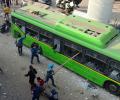
The Samyukt Kisan Morcha called off the tractor parade by farmers on Tuesday and appealed to participants to immediately return to their respective protest sites.

Farmer unions Monday announced a countrywide 'chakka jam' on February 6 when they would block national and state highways for three hours in protest against the internet ban in areas near their agitation sites, harassment allegedly meted out to them by authorities, and other issues.
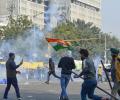
Not carrying weapons, following fixed routes and entering Delhi with tractors sans trolleys, were among the several conditions set by farmer leaders and police that were violated by participants of the tractor parade in New Delhi on Tuesday.
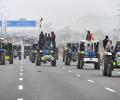
Farmers started the tractor march around 11 am and moved towards Kundli-Manesar-Palwal Expressway amid heavy deployment of Delhi Police and Haryana Police personnel.
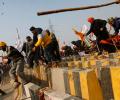
Farmers' union body the Samyukta Kisan Morcha on Tuesday disassociated itself from those who indulged in violence during the tractor parade, and alleged some "antisocial elements" infiltrated their otherwise peaceful movement.

A group of 200 farmers will travel to Jantar Mantar from the Singhu border in buses with a police escort and hold protests there from 11 am to 5 pm, sources in the Delhi Police said.
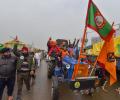
A day before the eighth round of talks, the government and the farmer unions stuck to their respective positions on Thursday -- the agitating farmers took out tractor rallies to press their demand for rollback of new agri laws and the Centre asserted it is ready to consider any proposal other than their repeal.

India's recently-enacted agri laws have the potential to increase farmers' income, but there is a need to provide a social safety net to the vulnerable cultivators, IMF's Chief Economist Gita Gopinath has said. Indian agriculture is in need of reforms, she said. There are multiple areas where the reforms are needed, including infrastructure, the chief economist of the Washington-based global financial institution said on Tuesday. The three agri laws, enacted in September last year, have been projected by the Indian government as major reforms in the agriculture sector that will remove middlemen and allow farmers to sell their produce anywhere in the country.

Addressing a press conference at Singhu Border in New Delhi, farmer leader Balbeer Singh Rajewal said that farmers never demanded the Supreme Court form a committee to resolve the impasse, alleging the central government was behind this development.

Thousands of farmers, mainly from Punjab and Haryana, are protesting at various borders of the national capital for more than a month against the laws and are demanding that these be repealed.

The government and the farm unions had reached some common ground on Wednesday to resolve the protesting farmers' concerns over rise in power tariff and penalties for stubble burning, but the two sides remained deadlocked over the main contentious issues of the repeal of three farm laws and a legal guarantee for MSP.

Addressing a press conference at the Singhu border protest site, farmer leaders warned of multiple actions if their main demands are not met. They said that only five per cent of the issues raised by them have so far been discussed in meetings with the government.

The Centre has sought five names from the Samkyukt Kisan Morcha (SKM) to be included in a committee for discussion on a host of issues, including MSP, and the umbrella body of farmer unions will decide those in its December 4 meeting, farmer leader Darshan Pal said on Tuesday.

Wearing garlands, the farmer leaders, who had called for observing 'Sadbhavana Diwas' (Harmony Day) on Saturday after the immense outrage over violence by protesters during their Republic Day tractor rally, sat on the dais during the fast, as crowds of supporters swelled, especially in Gazipur where the Bharatiya Kisan Union is leading the protest.
