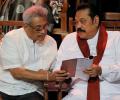
Gota has to decide if he could order elder brother Mahinda's arrest as the agent provocateur of Monday's violence. Then he has to prepare for an interim government, in which no one would now want to become a cabinet minister leave alone prime minister, explains N Sathiya Moorthy.

With six titles -- four more than Pakistan -- and unmatched consistency, Sri Lanka has quietly been the tournament's second-most dominant force.

'The fact that he hasn't resigned so far shows that he is going to do everything to hold onto power.'

Thousands of demonstrators have hit the streets since April 9, as the government ran out of money for vital imports; prices of essential commodities have skyrocketed and there are acute shortages in fuel, medicines and electricity supply.

The Government also defended the President's decision to enforce a state of emergency, that had given him sweeping authority to act in the interests of public security and preserving public order, including suspending any laws, authorising detentions and seizing property, saying it was declared after attempts were made to attack the President's Office and other public property.

Sri Lanka's former finance minister Basil Rajapaksa, who is the youngest brother of President Gotabaya Rajapaksa, was stopped from boarding a flight to Dubai on Monday evening, local media reported.
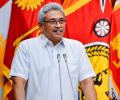
The dissidents, led by former president Sirisena's Sri Lanka Freedom Party, would leave the ruling Sri Lanka Podujana Peramuna coalition with its 14 Members of Parliament, party sources said after their meeting with the President on Monday.
'These efforts by Beijing can be weaponised one day with economic, security and political implications for India.'

'The Rajapaksas have been in active politics for decades and survived many challenges, but they seem to have misread this one.'

"President of Sri Lanka Gotabaya Rajapaksa is still in the country, I made a mistake in the (BBC) interview," Speaker Abeywardena told ANI in a telephone call.
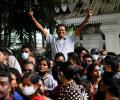
Sri Lanka on Wednesday declared a state of emergency after President Gotabaya Rajapaksa fled to the Maldives on a military jet in the face of a public revolt against his government for mishandling the country's economy.

Sri Lankan President Gotabaya Rajapaksa, who is under pressure to resign, was dealt a further blow on Wednesday when three more parliamentarians withdrew their support to the government.

In recent months people have been blocking roads across the country in a desperate bid to force the government to address the issue of acute gas shortages.

A video is being shared on social media showing the protesters counting the currency notes that were unearthed. The recovered money was said to be handed over to the security units, the Daily Mirror newspaper reported.

The President had been moved out of his residence on Friday, in anticipation of Saturday's protests.

'A fragile Sri Lanka will have a serious impact on the security of India.'

Prime Minister Narendra Modi congratulated Rajapaksa and said he looks forward to further deepen relations between the two nations.

The 74-year-old leader, who describe himself as "a rebel with a cause", earlier served as the country's president from 2005-2015, becoming South Asia's longest-serving leader. He was also prime minister for a brief period in 2018.

Despite mounting pressure, Gotabaya, and Prime Minister Mahinda have refused to quit office.
President Rajapaksa and Prime Minister Rajapaksa will transform Sri Lanka's political landscape after Thursday's electoral triumph, predicts N Sathiya Moorthy, veteran Colombo watcher.
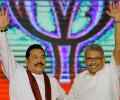
'Rajapaksa's victory poses a serious foreign policy challenge for the Modi government,' notes Ambassador M K Bhadrakumar.
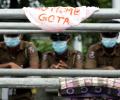
Sri Lankan police on Saturday fired tear gas and water cannons to disperse anti-government protestors here as the ongoing agitation demanding the resignation of President Gotabaya Rajapaksa over the worst economic crisis intensified as it entered its 50th day.

'While parliament has elected him, the people are demanding that he goes home.'

Mahinda Rajapaksa completed 50 years of parliamentary politics in July this year. He was elected as a Member of Parliament at the young age of 24 in 1970. He has since been elected president twice and has been appointed prime minister thrice.
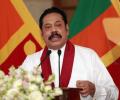
The parliament has approved a no-trust vote against Prime Minister Rajapaksa, speaker of parliament Karu Jayasuriya announced in the House.

Unofficial results indicate that the SLPP would comfortably win at least 17 out of the 22 districts on offer.
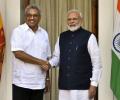
New Delhi is approaching Gota with an open mind, observes N Sathiya Moorthy.
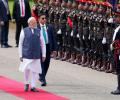
'Granting the country's highest civilian honour to Prime Minister Modi was surprising as it indicated the government was going out of its way to have India as a close partner.'
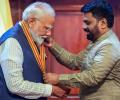
Sri Lanka has bestowed its highest civilian award, the Mithra Vibhushana, on Prime Minister Narendra Modi in recognition of his role in strengthening ties between the two nations. The award was presented by President Anura Kumara Dissanayake at a ceremony in Colombo. PM Modi expressed gratitude, stating the award honors not just him but also the people of India. The Mithra Vibhushana, instituted in 2008, has previously been awarded to prominent figures such as former Maldivian president Maumoon Abdul Gayoom and the late Palestinian leader Yasser Arafat. India's Foreign Secretary Vikram Misri highlighted the award as a recognition of PM Modi's contribution to strengthening the India-Sri Lanka partnership, particularly during Sri Lanka's economic crisis. The award includes a citation and a silver medal adorned with Sri Lankan gems and symbolic motifs representing shared heritage and prosperity.
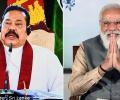
Mahinda Rajapaksa is a democratically elected leader who received a massive mandate of 71% of votes, and he owes nothing to Delhi or Washington for staging his political comeback, observes Ambassador M K Bhadrakumar.

Mahinda Rajapaksa recovered from his 2015 electoral losses, went to the people and campaigned about the injustice done to him. Without attempting to be subtle, he underscored his image of the Sinhala Buddhist warrior a la Dutugemunu, the king of Sri Lanka (164 BC to 140 BC) who led the military campaign against the invading warlord Elara.

Rajapaksa informed the lawmakers of United People's Freedom Alliance that he has resigned from the post.

Anti-government protesters in Sri Lanka on Tuesday set up a checkpoint on the road leading to the Bandaranaike International Airport in Colombo to prevent the Rajapaksa family loyalists from fleeing the country, as violence and widespread protest continued against the regime over the country's worst economic crisis in decades.

Rajapaksa's five-day visit to India assumes significance as his tenure as Sri Lanka's president from 2005 to 2016 saw expansion of China's footprints in the Indian Ocean island nation, triggering concerns in India.

Basil had negotiated the Indian economic relief package to help Sri Lanka tackle the current foreign exchange crisis.

The SLPP, led by prime minister Mahinda Rajapaksa, has won in 145 constituencies, bagging a total of 150 seats with its allies, a two-thirds majority in the 225-member Parliament, according to the results announced by the election commission.

In the endlessly entertaining and absorbing soap opera that is India-Sri Lanka relations, wait for the next episode, Aditi Phadnis reports.
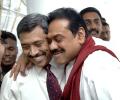
As the island heads for elections, two major factors worry Sri Lankan President Mahinda Rajapaksa. One is the division in the Sinhala vote and the other is the prospect of the Tamils and Muslims voting heavily against him.

Political analysts said Sirisena's move to install Rajapaksa as the prime minister could lead to a constitutional crisis as the 19th amendment to the Constitution would not allow the sacking of Wickremesinghe as the premier without a majority.

Sri Lanka fined 40 percent of match fee for slow-over rate in second T20 against Australia
