

The NSCN-IM is no longer the force it used to be. Once the 'de facto government' of Magaland, it gradually reduced to an extortion racket. But missteps by the Centre could give it a new lease of life.
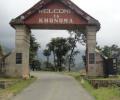
The locals of Khonoma, the village of legendary Naga leader Angami Zapo Phizo, hope the Naga peace accord satisfies the aspirations of the Naga people.

Eighteen years ago the government of India signed a truce with the NSCN-IM to facilitate prolonged peace negotiations, which culminated in the August 3 peace accord.
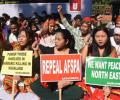
Exploiting the killings to ratchet up the tension in the region and harden negotiating positions with the central government serves nobody, least of all the people of Nagaland. The peace process must not be stalled because of this incident or distracted by calls to repeal the AFSPA, argues Vivek Gumaste.
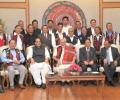
'NSCN-IM leader Muivah warns that the NSCN-IM has come very close to an honourable solution to the peace process with the Government of India, but if it does not materialise, then the Nagas will go away so far that it would be difficult to bring them back to the negotiating table easily,' note Sandeep Pandey and Meera Sanghamitra.
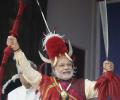
'If the NSCN-IM is cold shoulderd, the chances are that it will slip back into insurgency,' caution Sandeep Pandey, Meera Sanghamitra and Babloo Loitongbam.
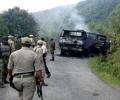
Nationalist Socialist Council of Nagaland-Issac-Munivah wanted to join the operations against NSCN-K militants.

Nationalist Socialist Council of Nagaland-K leader S S Khaplang, whose outfit carried out the June 4 attack on the Army in Manipur, is believed to be ill and convalescing in a Yangon hospital.

'The Congress, all these decades, worked on a slow Hindi-isation and Indianisation of Arunachal tribes. The RSS wants rapid Hinduisation,' says Shekhar Gupta.

'The creation of Pakistan was integral to Britain's grand strategy.' 'If they were to ever leave India, Britain's military planners had made it clear that they needed to retain a foothold in the NWFP and Baluchistan because that would provide the means to retain control of Iran, Iraq, Kuwait, the UAE, Bahrain and Qatar.'

'In the first meeting of this new year, we took a joint new year resolution that we will complete it this year. At the time things were not very clear, but the mood was clear that yes, we must resolve it.' 'Yes, details have to come out, but there are some sensitivities, there are some stake-holders not yet on board, especially other Naga undergrounds etc, we would like them to come on board... So at a proper time it has to be revealed to the country, and to the legislature. Perhaps, we may have to wait for some more time.' 'With better understanding of the Indian system, many of them have learnt, realised, appreciated that Naga nationalist aspirations can be accommodated in the Indian system. The Indian system is pretty comprehensive and flexible.' 'A Naga has as much stake, claim over India as any other Indian. There is no distinction. This, Nagas have realised, that yes, Naga nationalist aspirations and Indian nationalism are not mutually exclusive.' Ravindra Narayan Ravi, the Government of India's Special Interlocutor for the Naga talks, explains how the Naga Peace Accord was reached in an exclusive interview to Saisuresh Sivaswamy/Rediff.com

Indian intelligence agencies have often claimed that left-wing extremists are trying to make inroads in the militancy-hit regions of north-east to foment further unrest. But Jaideep Saikia, noted terrorism and conflict analyst, claims, "People who speak of Maoism taking roots in the north-east have not read history".

'... A youth movement which could really transform our politics in a way that the existing elites don't understand.' 'The more you suppress free expression, the more people will value it.' 'The State can't suppress a young society like India where there are so many interesting new ideas emerging,' says Sunil Khilnani, whose latest book Incarnations looks at Indian history through 50 lives.
