
'By pushing PSLV production to industry, the extra ISRO personnel available will be utilised to do projects like the human space mission.'

The 51-hour countdown for India's landmark 100th space mission began on Friday with Indian Space Research Organisation's old warhorse Polar Satellite Launch Vehicle rocket all set to soar into space on September 9 with two foreign satellites from the spaceport of Sriharikota in Andhra Pradesh.

The landing on the moon near the South Pole, an uncharted territory so far, would be on September 6 or 7, Sivan told reporters, as the Indian space agency is all set to embark on its most complex mission.
It was a historic day for the Indian Research Space Organisation on Sunday, says Vicky Nanjappa
ISRO plans to launch 720-kg SPOT-6 remote sensing satellite from France (built by ASTRIUM SAS) and a 15-kg Japanese spacecraft Protiers on board the home-grown Polar Satellite Launch Vehicle (PSLV-C21) in the second week of September, in a major milestone of sorts.

The 1,858 kg spacecraft, the country's first microwave remote sensing satellite, was injected into orbit by the Polar Satellite Launch Vehicle about 19 minutes after a perfect lift off at 5.47 am at the end of the 71-hour countdown from the Satish Dhawan Space Centre, around 90 km from Chennai.
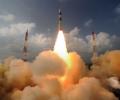
The second orbit raising manoeuvre of India's Mars Orbiter spacecraft was performed in the early hours of Friday, three days after its successful launch by PSLV C-25 into orbit around the Earth.

'We are looking at a joint venture between ISRO and a few companies to assemble the PSLV and launch it from Sriharikota.' 'In a month or two, the vehicle assembly building will be ready.' 'After that, we could see 13, 14 launches a year.'
India's Polar Satellite Launch vehicle-C16 rocket on Wednesday successfully launched into orbit the latest remote sensing satellite Resourcesat-2 that would study and help manage natural resources along with two nano satellites.
"The launch of Chandrayaan 2 will be in 2014. We are working towards it. It would be on a GSLV, after we launch two GSLVs within an interval of six months," ISRO chief K Radhakrishnan told reporters here soon after the launch of RISAT-1.

'ISRO is resilient enough to spring back and come with a solution quickly.'
'The goal seems to be that we do not invest further in our system to make our system more accurate and more reliable or more global in reach,' an ISRO source tells Shivanand Kanavi.

Ahead of his India visit on February 24-25, Trump said that India has not treated his country 'very well' on the trade front and indicated that a 'very big' bilateral deal with New Delhi may not be signed before the American presidential election in November.

Congratulate ISRO and its brilliant scientists for positioning the country in an elite group of nations exploring outer space.
The Indian Space Research Organisation, which had a recent setback with the failure of its latest communication satellite GSAT-5P, is planning three major satellite launches in the first quarter of this year.

India's launch preparations for the ambitious Rs 450 crore Mars orbiter mission achieved a major milestone with the successful thermo-vacuum test of the spacecraft with its payloads (scientific instruments).
Research and markets estimated in May that the global opportunity for small and mini satellites would grow nearly one and half times to $5.32 billion by 2021

A recap of events that occurred in India in the past week.
For the first time in the history of Indian space research, a satellite developed by a university in India will be launched by the Indian Space Research Institute (Isro) during the next flight of the Polar Satellite Launch Vehicle (PSLV). Tentatively scheduled for launch in March-April this year, the vehicle will carry a small remote-sensing satellite completely developed and fabricated by Chennai-based Anna University, sources in Isro said.
RISAT-2, India's spy satellite, was successfully placed into the 550 km orbit around Earth on Monday morning.Earlier, the PSLV-C12, carrying 300-kg Radar Imaging Satellite and 40-kg Micro Satellite ANUSAT, had lifted off from Indian Space Research Organisation's Satish Dhawan space Centre in Sriharikota today morning. The RISAT-2 has an all weather capability to take images of Earth.
On Thursday, scientists sent the 1,380 kg spacecraft to its next destination -- highly elliptical orbit of 300 km perigee and 1.6 lakh km apogee respectively. This will be followed by three more orbit-transfer exercises.
The agreement for cooperation in space technology was signed between Astrium and Antrix -- commercial arm of the ISRO -- entailes utilisation of the PSLV launch services. It enables Astrium to offer attractive solutions in international markets for in-orbit delivery of its earth observation satellites, using the PSLV launch services from Antrix/ISRO.

Here's a recap of the events from the past 24 hours.
Click here to watch the live broadcast of the historic launch!
The final 52-hour countdown for the October 22 launch of the country's first moon mission, Chandrayaan-I, began early on Monday morning at the Satish Dhawan Space Centre at Sriharikota in Andhra Pradesh.
India on Friday moved a step closer to launch its maiden unmanned moon session when the lunar spacecraft Chandrayaan-I was mated with the polar rocket which is set to blast off on October 22 from the Sriharikota spaceport. Gearing up for the final countdown, Space officials said all operations for the mission are progressing satisfactorily and barring a cyclone threat the PSLV-C11 will keep the date with the country's historic mission on October 22.
Former President A P J Abdul Kalam lauded ISRO scientists for successfully launching the PSLV-C9 to put 10 satellites in orbit. "Though I have envisioned India to become a superpower by 2020, the attitude and the confidence of the youth, to conquer everything in the right spirit, would make the country a global leader and superpower within five years," Kalam said.

Just over 22 minutes into the flight, the rocket put Astrosat into orbit at an altitude of 650 km above the earth

It also carries equipment for meteorological data relay and satellite based search and rescue services being provided by earlier INSAT satellites.
The Indian Space Research Organisation will launch ten satellites, including eight from abroad, which will be carried by PSLV-C9, on April 28.The cluster of satellites to be lifted includes the Indian satellite Cartosat-2A, weighing 690 kg. The vehicle would also carry eight nano satellites of 16 to 27 kg from Canada, Netherlands, Denmark and Germany. Of the eight nano satellites, six are form a cluster called NLS-4. These satellites were built to test nano technoloy.

Andhra Pradesh Chief Minister N Chandrababu Naidu on Monday met the victims of the building collapse incident in Chennai and promised to provide necessary medical care and relief on a "war-footing" for them.
Indian Space Research Organisation's immediate plan was the launch of two more PSLV flights this year and a GSLV launch early next year.

It is important for India to develop multiple launch sites and become capable of undertaking more launches in a year's time, says Ajey Lele.
The Indian Space Research Organisation is set to achieve a breakthrough on January 10 with the launch of four payloads, including the Cartosat-2 satellite and a recoverable space capsule
India on Monday successfully launched Israeli satellite 'Polaris' from the Satish Dhawan Space Centre in Sriharikota by a homegrown Polar Satellite Launch Vehicle, a spokesman of the Indian Space Research Organisation said. This is the second time that a 'core alone' PSLV configuration had put a satellite into orbit. In April 2007, an Italian satellite Agile was put into the orbit, the space agency spokesman said.
The T-52 hour countdown for the launch of the PSLV-C7 began at 0548 hours on Monday, and it was progessing smoothly.
With the development of GSLV Mark-III, India will be able to launch heavy satellites into the geosynchronous transfer orbit. This vehicle is billed as the technological successor to GSLV Mark-II.
After PLSV-C8, PLSV-C10 carrying Polaris satellite would also be launched either in June or July, officials added.
The third of the total of five orbit raising manoeuvres of the Mars Orbiter spacecraft was performed early on Saturday, raising its apogee, the farthest point from Earth, to over 71,000 km.

They made history for India and the world.
