
'The sales pressure on the ground, a board and CEO not fully aligned, and a senior team that isn't pulling together -- that's when these things surface.'

State-owned banks have received guidance from the government to close Jan Dhan accounts whose beneficiaries are unwilling to keep them active, amid rising instances of such accounts being misused by fraudsters as mule accounts to defraud people, people aware of the development said.
'Self-declaration from the customer in case of no change in KYC information or change only in the address details may be obtained.'

Concerned over the rise in mis-selling of products by banks and non-banking financial companies (NBFCs), the Reserve Bank of India (RBI) is examining whether to come up with norms to curb such practices. Observing that pushing financial products, such as insurance, indiscriminately to unaware consumers may be detrimental to their well-being, RBI Deputy Governor M Rajeshwar Rao said, "We are examining whether it necessitates framing of guidelines to address mis-selling of financial products and services by REs (regulated entities)."

While a giant, it's a nimble-footed one, and is growing at a speed that even some of its private sector peers find enviable.
Between FY18 and FY24, it doubled its balance sheet. Despite being a late entrant in some segments, it has been able to grab market share, observes Tamal Bandyopadhyay.
The Union Finance Ministry on Tuesday said that aggregate business of public sector banks (PSBs) has shown strong growth of 11 per cent in the first half of the financial year 2024-25 (H1FY25) to touch Rs 236 trillion. The operating and net profit were also robust. At Rs 1.5 trillion, operating profit grew by 14.4 per cent year-on-year (Y-o-Y) while the net profit saw an impressive 25.6 per cent jump at Rs 85,520 crore in the first half of FY25.

"The PMJDY has been the foundation stone for the Modi government's people-centric economic initiatives. "Whether it is direct benefit transfers, Covid-19 financial assistance, PM-KISAN, increased wages under MGNREGA, life and health insurance cover, the first step was to provide every adult with a bank account, which PMJDY has nearly completed," Nirmala Sitharaman said on the sixth anniversary of the scheme.
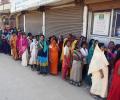
Finance Minister Nirmala Sitharaman on Wednesday said the National Rural Livelihood Mission has achieved remarkable success by mobilising rural women into 1 lakh SHGs (self help groups).
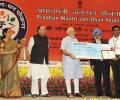
As per the latest finance ministry data, the total balance in over 36.06 crore Pradhan Mantri Jan Dhan Yojana (PMJDY) accounts was at Rs 1,00,495.94 crore as on July 3.

Debit card payments remained sluggish due to the surge in digital transactions after the pandemic, and the Unified Payments Interface (UPI) has emerged as the most popular mode of money transfer, particularly for small value transactions, according to RBI data. In July 2020, the total debit card spends stood at Rs 2.81 trillion, as compared to Rs 3.15 trillion in July 2023, reflecting a growth of 11.96 per cent. UPI spends have seen a whopping growth of 428 per cent, zooming from Rs 2.90 trillion to Rs 15.33 trillion during the same period, the data revealed.
The finance ministry on Friday said 5.52 crore (55.2 million) bank accounts have been opened till October 7 and deposit of Rs 4,268 crore (Rs 42.68 billion) have been mobilised under Pradhan Mantri Jan Dhan Yojana (PMJDY).

In view of the "runaway success" of the scheme, now it has been decided to make it open-ended with more incentives

The government scheme has a long way to go before its ultimate goals of universal financial inclusion and financial literacy are achieved.
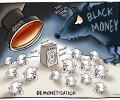
The CBDT has begun the process of matching the deposits in accounts opened under the Pradhan Mantri Jan-Dhan Yojana (PMJDY), or Jan-Dhan accounts, with the profile of the depositors.
The assessment of PMJDY should be done within the context of the programme.

Bill & Melinda Gates Foundation (BMGF) has offered to help in monitoring of the progress made with regard to Pradhan Mantri Jan Dhan Yojana (PMJDY), the flagship financial inclusion scheme of the government.

The government is working to provide healthcare schemes to poor people under the Jan Dhan initiative.

179 million debit cards were issued during December 2016 to June 2018. A mere 2,000 ATMs were opened in the same period.
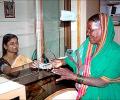
Prime Minister Narendra Modi announced the financial inclusion scheme in his first Independence Day speech last year.
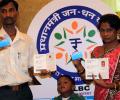
As many as 24.27 crore accounts have been opened under the scheme and the percentage of zero balance has come down to 24.43 per cent
The Jan Dhan scheme restricts the scope of life insurance cover to bring down burden on the exchequer.

Department of Financial Services is regularly emphasising the early issuance of RuPay Debit Cards, e-KYC based account opening, Aadhaar seeding, financial literacy and the progress in survey made.

The country's gross domestic product (GDP) is likely to grow at 5.8 per cent in the third quarter of fiscal 2022, according to an SBI's research report- Ecowrap. The country's economy expanded by 8.4 per cent in the second quarter of 2021-22, to cross pre-pandemic levels. However, the GDP growth in July-September period was slower than the 20.1 per cent expansion in the previous quarter.

The government plans a mega launch of the Pradhan Mantri Jan Dhan Yojana (PMJDY) by Prime Minister Narendra Modi on August 28, which is likely to see opening of one crore bank accounts on the first day itself.
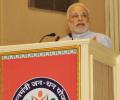
The Finance Minister said government's target was not villages only but cover every household of every village under the PMJDY.

The finance minister said easy access and efficiency in providing banking services will help in revival of businesses which are restarting operations after the lockdown.
Like Indira Gandhi, even Narendra Modi seems to be relying on directing public-sector banks through ministry of finance supported by party cadres, says Debashis Basu.

According to the latest report from Stranded Workers Action Network (SWAN), a voluntary effort started in March 2020 to mobilise relief for stranded migrant workers, almost 92 per cent workers, whom the group contacted between April 21 and May 31, had not received any money from their employer. This was after restrictions were imposed and work had stopped. The survey, which was conducted among 1,396 worker groups, adding up to 8,023 people that included 4,836 women and children, showed that 76 per cent of the workers had less than Rs 200 left with them.
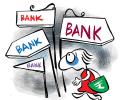
Banks now ride on what is defined as a "banking outlet". This is a fixed-point service unit, manned by either the bank's staff or its business correspondent (BC), where all kinds of services - acceptance of deposits, encashment of cheques, cash withdrawal or lending of money - are provided for a minimum of four hours per day, for at least five days a week. Banks are now turning to reposition the manner in which they acquire customers, report Abhijit Lele and Raghu Mohan.

The finance ministry on Sunday highlighted its achievements during the past six months, including the Jan-Dhan Yojana, Varishtha Pension Bima Yojana, and actions taken to curb black money.

India must remain an integral part of the global economy if it has to grow at 9-10 per cent over the next three decades, Niti Aayog CEO Amitabh Kant said on Tuesday. Speaking at the 15th India Digital Summit, Kant said India needs to become a major global exporting nation, without that it will not be possible to become richer and create wealth for its people over the next three decades.

Taking a dig at the system, Prime Minister Narendra Modi on Monday said things have started moving in India under him and the Jan Dhan scheme was being implemented at a rapid pace despite initial reluctance of RBI and bureaucracy.

Addressing a G20 Summit session, Modi also presented his '5-I' vision to maximise digital technology for social benefit.

The former RBI Governor also emphasised on the need to boost economic productivity and attract investments.
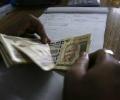
Around 10 crore bank accounts opened under the Jan Dhan scheme.

This will cost the government Rs 3.1 trillion, about 10 per cent of its annual expenditure, and higher than any other spending item in its Budget.

More than 127 million new bank accounts have been opened.
There were concerns that simply opening a bank account wouldn't constitute meaningful financial inclusion, as the poor would rarely use these accounts. However, recent data submitted to Parliament attests to increased account usage, says Ishan Bakshi.
Prime Minister Narendra Modi on Thursday launched his government's mega scheme ' Pradhan Mantri Jan Dhan Yojana', declaring that it was aimed at eradicating financial untouchability by providing bank accounts to the poor.

He advised banks to facilitate appropriate credit expansion.
