
Upbeat high-frequency indicators and consumer confidence show that Indian economy continues to forge ahead, emerging out of shackles of pandemic, said an article on the state of economy published in RBI Bulletin on Wednesday. The recovery is spearheaded by an uptick in private investment through November-December alongside a turnaround in bank credit offtake and high capex from the government sector (Centre and states). In conjunction, the employment situation has brightened, said the article written by RBI officials.

Foreign portfolio investors (FPIs) were net buyers to the tune of Rs 16,459 crore in Indian markets in August, with majority of investment coming in the debt segment. In equities, they invested just Rs 2,082.94 crore while debt segment saw inflow of Rs 14,376.2 crore between August 2-31, depositories data showed. The quantum of investment in the debt segment is highest in this calender year so far.

Firms hired additional hands to keep up with the production demand

The Nikkei India Services Purchasing Managers' Index (PMI), which tracks services sector firms on a monthly basis, stood at 48.7 in January, as against 46.8 in December 2016.

HSBC's services purchasing managers index, that maps the activity of around 400 firms, despite a 40 basis points dip, has kept above the 50 mark that signifies growth since November.

The IHS Markit India Services Business Activity Index improved from 52.7 in November to 53.3 in December, highlighting the second-strongest rate of increase in output in over a year, after July. However, the overall level of positive sentiment remained below its long-run average.

Indicators show green shoots in the economy with electricity and fuel consumption, inter and intra-state movement of goods, PMI data and retail financial transactions witnessing a pick-up, she said.

'One cannot take it that the economy has recovered, and the GST payment has increased because of that, or that production is back to January 2020 level.'

Reflecting a loss of "growth momentum", manufacturing activities in the country slowed down to a six-month low in March amid softer increases in new orders, production and employment, according to a survey.

India is facing no risk of recession or stagflation as macroeconomic fundamentals of the economy are strong, Finance Minister Nirmala Sitharaman said on Monday. Replying to a debate on price rise in the Lok Sabha, she said the GST collection and Purchasing Managers' Index (PMI) are indicating that the Indian economy is getting more robust. The GST collection rose 28 per cent to touch the second-highest level of Rs 1.49 lakh crore in July. GST, introduced in July 2017, touched a record high of Rs 1.68 lakh crore in April 2022.

The headline seasonally adjusted IHS Markit India Manufacturing Purchasing Managers' Index (PMI) fell to 27.4 in April, from 51.8 in March, reflecting the sharpest deterioration in business conditions across the sector since data collection began over 15 years ago. The index slipped into contraction mode, after remaining in the growth territory for 32 consecutive months. In PMI parlance, a print above 50 means expansion, while a score below that denotes contraction.

Currency scarcity weighed on manufacturing performance where growth of new work flows slowed

India's manufacturing PMI rose to 54.5 in December, 2014, while in the corresponding period a year ago it stood at 50.7, just above the crucial 50 mark which separates growth from contraction.

Axis Bank was the top loser in the Sensex pack, shedding over 4 per cent, followed by Tata Steel, SBI, NTPC, Bharti Airtel, ITC and ICICI Bank.

The Nikkei India Manufacturing Purchasing Managers' Index (PMI) stood at 47.9 in July, down from 50.9 in June, its lowest mark since February 2009, and highlighted the first deterioration in business conditions in 2017 so far.

Share markets will have only three trading days this week with Monday and Wednesday being holidays due to general elections in Mumbai and Maharashtra Day, respectively.

After contracting for 3 consecutive months, manufacturing activity saw an uptick in November, latest data from the HSBC Purchasing Managers' Index shows.

The upcoming corporate results season and the approaching Union Budget kept investors on their toes

The survey noted that advertising campaigns supported the increase in new work growth in the sector amid competitive pressures.
HDFC Bank, ICICI Bank, HDFC and SBI contributed the most to the gains in the Sensex up between 2-3% each.

The NCEAR has indicated some improvement in the fourth quarter of the current financial year.

Indian economy is expected to grow 10.5 per cent or more in the current fiscal, Niti Aayog Vice Chairman Rajiv Kumar said on Thursday. Speaking at a virtual conference organised by the Public Affairs Forum of India (PAFI), he also said that modernisation of the retail sector is very much on the cards. "India Purchasing Managers' Index (PMI) for both manufacturing and services has shown a very smart uptick last month. "This (Indian economy) will strengthen even further," he said. "I expect Indian economy to grow 10.5 per cent or higher in FY 22," he noted.

TCS was the top gainer in the Sensex pack, rising around 2 per cent, followed by ONGC, SBI, L&T, Infosys, HCL Tech, ICICI Bank and Axis Bank. The broader NSE Nifty surged hit a record high of 14,109.40.
The Nikkei India Services PMI posted above the critical 50.0 level, which separates growth from contraction, for the fourth month running in May.

The HSBC Emerging Markets Index, a monthly indicator derived from the PMI surveys stood at 52.6 in March, little unchanged from the February reading when it stood at 52.4, indicating a subdued rate of economic growth in global emerging markets.

It indicates that the economy has remained frail at the start of the new fiscal year.

'The real lifting of the economy will happen only if this momentum sustains in the coming months.'

Inflation in India probably edged up in October as food prices climbed while weak demand is expected to have hurt factory output growth.

The index has remained above the 50-mark, below which it indicates contraction, for more than three years now.

Earnings growth is unlikely to see much recovery and sales revenues are also likely to remain muted

ICICI Bank was the top loser in the Sensex pack, shedding around 2 per cent, followed by Bharti Airtel, Axis Bank, Kotak Bank and PowerGrid. NSE Nifty closed 7.55 points or 0.07 per cent down at 11,527.45.

Maintaining a rapid pace of the vaccination drive and quickly bridging healthcare infrastructure gaps across both urban and rural areas would emerge as the most sustainable stimulus for durable recovery of the Indian economy, says a report by the department of economic affairs.
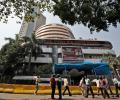
Sentiments turned somewhat weak towards the middle of the session as profit-booking emerged as investors turned cautious on disappointing quarterly earnings by some bluechip companies

Titan was the top gainer in the Sensex pack, rising over 3 per cent, followed by M&M, Reliance Industries, Axis Bank, TCS, Maruti and Infosys. NSE Nifty surged 122.10 points to 15,885.15.

'The question is, how soon we can expect to re-attain the pre-lockdown levels of output and income.'
The Chinese economy is headed for troubled waters, with its manufacturing sector shrinking in November for the first time in nearly three years, in a fresh sign of a further economic slowdown that may prompt it to loosen its monetary policy.

Forex traders said a stronger dollar also dragged the rupee down.

Leading indicators suggest economic activity has been disrupted after demonetisation.

Business confidence remained positive in August and was driven by upbeat forecasts of sales, an expected improvement in demand and promotional activities

Investments through participatory notes (P-notes) in the Indian capital market surged to a 27-month high of Rs 83,114 crore at November-end driven by continued liquidity and improvement in second quarter corporate earnings. P-notes are issued by registered foreign portfolio investors (FPIs) to overseas investors who wish to be part of the Indian stock market without registering themselves directly. They, however, need to go through a due diligence process. According to Securities and Exchange Board of India (Sebi) data, the value of P-note investments in Indian markets -- equity, debt and hybrid securities -- increased to Rs 83,114 crore at November-end from Rs 78,686 crore at October-end.
