
Areas in the National Capital Region -- Noida and Gurugram -- recorded an AQI of 529 and 478 respectively both in the highly toxic 'severe'.

The 24-metre-high air purifier recorded a PM2.5 concentration of 642 micrograms per cubic metre at the inlet and 453 micrograms per cubic metre at the outlet.

In India, air pollution is most severe in the Indo-Gangetic Plain (northern India), where topography and meteorology concentrate pollution from energy, mobility, industry, agriculture, and other activities, the researchers said.

According to the Graded Response Action Plan (GRAP), the air quality is considered to be in the emergency category if the PM2.5 and PM10 levels continue to be above 300 micrograms per cubic metre and 500 micrograms per cubic metre respectively for 48 hours or more.

Low temperature -- Delhi recorded a minimum of 13.5 degrees Celsius on Tuesday, the season's lowest so far -- allowed accumulation of pollutants, said Mahesh Palawat, vice president (meteorology and climate change), Skymet Weather.

The CPCB said reduction in PM10 and PM2.5 levels primarily indicate depletion in combustion and industrial sources of pollution which are common to both fractions of particulate matter.

The season will kickstart on 19th September in Abu Dhabi with a blockbuster clash between defending champions Mumbai Indians and Chennai Super Kings.

Chief Minister Arvind Kejriwal inaugurated the 'country's first smog tower' at Connaught Place in New Delhi on Monday and said it will prove to be a milestone and many such structures can be installed in the city if the pilot project yields results.

The city's 24-hour average AQI was recorded in the 'poor' category at 265 on Saturday as residents flouted the ban on firecrackers in parts of the national capital ahead of Diwali, according to Central Pollution Control Board's (CPCB) data.

Production, storage and sale of firecrackers in the capital will be punishable with a fine of up to Rs 5,000 and three years jail under Section 9B of the Explosives Act, the minister told a press conference in New Delhi.

Rohan and Madhav live at the PM's official residence.
The report, however, shows that Delhi's air quality improved by approximately 15 per cent from 2019 to 2020.

Green think tank Centre for Science and Environment (CSE) said the ongoing smog episode is a public health emergency.
The prime minister's office on Sunday dismissed suggestions that Prime Minister Manmohan Singh had sought to look the other way in issuance of controversial 2G spectrum licenses and said suggestions had been made informally to the Department of Telecom to ensure that there was level-playing field between the existing operators and new entrants.

Breathing polluted air for long periods of time can cause more serious problems. Avoid exercising outdoors on bad air days, suggests Dr Varun Gupta.

The central government's Air Quality Early Warning System for Delhi said a significant increase in the number of "fire points" was observed over Punjab (around 3,000), Haryana and Uttar Pradesh on Wednesday, which is likely to impact the air quality of Delhi-NCR and other parts of northwest India.

The central government's Air Quality Early Warning System for Delhi said a "significant improvement in air quality is not likely" owing to slow wind speed, particularly during night time, and contribution from farm fires.

Experts said while meteorological conditions were "moderately" favourable for dispersion of pollutants, a "very high" number of farm fires in Punjab was the primary reason for "severe" air quality.

The national capital on Friday recorded a 24-hour average air quality index of 239. On Thursday, it was 315, the worst since February 12 when the AQI was 320.

The air quality had turned 'severe' on Saturday evening with stubble burning accounting for 32 per cent of Delhi's PM2.5 pollution, but firecracker emissions and calm winds made the situation even worse.
It also asked the governments of Punjab and Haryana to take immediate stringent actions to curb stubble burning and authorities in Delhi-NCR to strictly check biomass burning.

Long-term exposure to chronically high PM2.5 levels weakens the ability of the lungs to fend off infections, therefore making people more susceptible to COVID-19, the scientists said.

No improvement in the air quality in Delhi-NCR is expected for another three days, authorities said on Monday, as the Supreme Court directed the Centre to call an emergency meeting to decide on measures like stopping non-essential constructions, transport and power plants by Tuesday evening.

The researchers discovered that just a 4.6 ppb reduction in long-term exposure to NO2 would have prevented 14,672 deaths among those who tested positive for the virus.

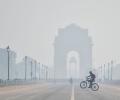
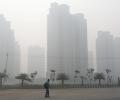
The smog reduced the visibility to merely 300 meters in the morning affecting traffic, an official of the India Meteorological Department said.

Omkeshwar Singh, Head, Rank MF, a mutual fund investment platform, answers your queries.

The results are based on epidemiological data collected up to third week in June 2020 and the researchers say a comprehensive evaluation will need to follow after the pandemic has subsided.

Omkeshwar Singh, Head, Rank MF, a mutual fund investment platform, answers your queries.

According to Central Pollution Control Board's (CPCB) Sameer app, the city's air quality index (AQI) stood at 449 in the severe category at 8 am on Saturday. It was 462 on Friday.
Pollution levels in Delhi during the Diwali period are likely to remain in the higher end of the 'very poor' category in the absence of emissions due to fireworks, the Ministry of Earth Sciences' air quality monitor, SAFAR said.

Less than six months ago, Delhi was gasping for breath. Authorities said air quality had reached "unbearable levels". Schools were shut, flights were diverted, and people were asked to wear masks, avoid polluted areas and keep doors and windows closed. But during the lockdown that began on Mar 22, the concentration of poisonous PM2.5 particles in a cubic metre of air averaged at 44.18, according to a Reuters analysis of government data, indicating a rare "good" rating, the safest level on the scale.

The dip in the air quality can be attributed to low wind speed and temperatures which allowed accumulation of pollutants.

Nikunj Saraf, Vice President Choice Wealth, answers your queries.

The green body's report said three of the world's largest nitrogen oxide air pollution emission hotspots that contribute to formation of PM2.5 and ozone are in India with one in the Delhi-NCR.

Given the rising levels of pollution, air purifiers have now become a necessity. Manavi Kapur and Veer Arjun Singh check out some of the options in the market.
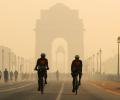
"The overall Delhi's Air Quality Index is in the very poor category with few Delhi locations entering at higher zone but that will be short lived. This is mainly because the extremely calm local surface winds which were prevailing yesterday are likely to increase slightly and may further pick-up by Oct 26," SAFAR said.

Pollution levels skyrocketed by the hour in Delhi on Sunday, turning the air quality hazardous, which agencies consider unfit for inhalation even by healthier people.

Rediff Labs has taken the exposure of air pollution, burden due to air pollution and then disease due to air pollution in order to explain how India is affected by it and comparing it to global numbers.

Omkeshwar Singh, Head, Rank MF, a mutual fund investment platform, answers your queries.
