
Investors' wealth eroded by a massive Rs 8,21,666.77 crore on Monday as the market saw a massive sell-off not seen in many months. The BSE benchmark Sensex plunged 1,170.12 points or 1.96 per cent to close at 58,465.89. This is the worst single-day drop for the gauge in over seven months. This was also the fourth straight session of decline for the Sensex.

Concerned over inflationary pressures in the economy, the Reserve Bank of India (RBI) is bringing down surplus liquidity in the system rapidly. It has fallen to pre-Covid levels and almost 2 per cent of banks' net demand and time liabilities (NDTL). NDTL shows the difference between the sum of demand and time liabilities (deposits) of a bank (with the public or the other bank) and the deposits in the form of assets held by the other bank.

Omkeshwar Singh, head, Rank MF, a mutual fund investment platform, answers your queries.

Mihir Tanna, Associate Director, S K Patodia & Associates, answers your tax queries.

Investor wealth slumped by a whopping Rs 5.3 lakh crore on Friday as the benchmark BSE Sensex crashed more than 1,900 points to post its biggest single-day fall in nearly ten months. At the close of trade, the total market capitalisation of BSE-listed companies eroded by Rs 5,37,375.94 crore to Rs 2,00,81,095.73 crore. The total market capitalisation of these companies stood at Rs 2,06,18,471.67 crore on February 25.

Omkeshwar Singh, Head, Rank MF, a mutual fund investment platform, answers your queries.

'Favourable product mix, sales recovery, and cost saving initiatives are expected to support margins going ahead while focus on debt reduction (target of debt free by FY24) will aid balance sheet strength'

Shares of Motilal Oswal Financial Services, Edelweiss Financial Services and IIFL Holdings have all doubled in the past one year against the Sensex's 23 per cent gain.

Macroeconomic data announcement, Omicron situation and global trends will be the major driving factors for the equity market in the first week of the new year 2022, according to analysts. In what turned out to be a historic year, the Indian stock indices went past multiple milestones and the 30-share Sensex made an annual gain of 10,502.49 points or 21.99 per cent in 2021. Religare Broking Vice-President (Research) Ajit Mishra said, "This week marks the beginning of a new month and participants will be closely eyeing some crucial high-frequency data like monthly auto sales, India manufacturing PMI and India services PMI. "Besides, updates on the COVID-19 situation and performance of global markets will also be critical."

'Valuations were depressed at 8,000 (Nifty 50 index) levels. It was a free ride to 12,000 levels.' 'What went down had to come up. Now fundamentals have to support further gains.'

The Fed interest rate decision, domestic macroeconomic data announcements and quarterly earnings will be the major sentiment drivers for the equity market in a holiday-shortened week ahead, analysts said. Investors will also take cues from the monthly auto sales numbers to be announced on Monday. Equity markets will remain closed on Thursday for Diwali Laxmi Pujan and on Friday for Diwali Balipratipada.
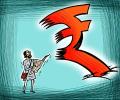
Equity investors became poorer by over Rs 8 lakh crore in five days of market plunge. The BSE benchmark has lost 2,062.99 points or 4 per cent in five trading sessions. On Thursday, the 30-share BSE benchmark tanked 585.10 points or 1.17 per cent to close at 49,216.52. Following the bearish trend, the market capitalisation of BSE-listed companies declined by Rs 804,216.71 crore to Rs 2,01,22,436.75 crore in five days.

Equity markets will look for directions from global trends, ongoing quarterly earnings and investment patterns of foreign institutional investors (FIIs) in a holiday-shortened week ahead and may encounter volatility amid the scheduled monthly derivatives expiry, according to analysts. Equity markets will remain closed on Wednesday on account of 'Republic Day'. "This week is a holiday-shortened one and it's going to be critical due to the list of events and data that are lined up.

While commercial vehicles are expected to benefit from strong replacement demand, the two-wheeler and tractor segments are expected to gain from a recovery in the rural economy.

Markets

Omkeshwar Singh, Head, Rank MF, a mutual fund investment platform, will answer your queries.

June was a memorable month for the 101-year-old Tamilnad Mercantile Bank (TMB). Last month, the Thoothukudi-based bank witnessed two new landmarks in a history in which the last three decades could easily qualify for a Kollywood blockbuster.

Omkeshwar Singh, head, Rank MF, a mutual fund investment platform, answers your queries.

Omkeshwar Singh, Head, Rank MF, a mutual fund investment platform, answers your queries.

India's rupee is likely to remain under pressure due to high prices of crude oil and other commodities, and may stabilise at around 79-80 against the US dollar in the near term, say experts amid limited headroom available with the Reserve Bank to check the weakening of the domestic currency. The currency has slumped over 5 per cent this year after Russia's invasion of Ukraine sent international crude oil prices soaring to a decade high. On Monday, rupee ended at a fresh all-time low of 78.34 (provisional) against the US dollar.

India reaffirmed their supremacy in the U-19 Asia Cup with a record eighth title

Omkeshwar Singh, Head, Rank MF, a mutual fund investment platform, answers your queries.

'The correction could take two to three months and traders need to be careful.' 'For investors, this could be a good time to nibble in.'

Omkeshwar Singh, head, Rank MF, a mutual fund investment platform, answers your queries.
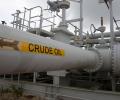
Retail inflation hit an eight-month high of 6.07 per cent in February, remaining above the RBI's comfort level for the second month in a row, while wholesale price-based inflation soared to 13.11 per cent on account of hardening of crude oil and non-food item prices, government data showed on Monday. The previous high for retail inflation was 6.26 per cent in June 2021. The consumer price index (CPI) based retail inflation, which is taken into account by the Reserve Bank of India (RBI) while deciding its monetary policy, rose mainly because of costlier food items, as per the data released by the National Statistical Office (NSO).

Tata Motors' UK-based subsidiary, Jaguar Land Rover or JLR, reported a muted operational performance in the December quarter of financial year 2021-22 (Q3FY22). The luxury carmaker saw a 33 per cent year-on-year (YoY) decline in wholesale volumes to just under 70,000 units in Q3, against estimates that were 16 per cent higher. The drop in despatches to dealers was on account of shortage in semiconductors.

The early bird results for the January-March 2022 quarter (Q4FY22) hint at a slowdown in corporate sector growth in the upcoming quarters. The combined net sales of the 81 early bird companies in the Business Standard sample were up 15.1 per cent year-on-year in Q4FY22; this was less than the 15.9 per cent YoY jump reported in Q3FY22. The slowdown could be much stronger for the domestic market-focused companies, including those in the banking, finance, and insurance (BFSI) space.

Shares of Zomato on Friday zoomed nearly 53 per cent in its debut trade against its issue price of Rs 76. The stock made its debut at Rs 115, reflecting a huge gain of 51.31 per cent against the issue price on the BSE. It then hit a high of Rs 138, a jump of 81.57 per cent.

Omkeshwar Singh, Head, Rank MF, a mutual fund investment platform, answers your queries.

Omkeshwar Singh, head, Rank MF, a mutual fund investment platform, answers your queries.

Commercial banks in the country continued with their improving asset quality trend in the October-December 2021 quarter with slippages remaining under control coupled with healthy recoveries and upgradation of asset classification. The 28-listed banks reported improvement in bottom line with net profits rising 64.1 per cent year-on-year (YoY) and 21.5 per cent sequentially. This is mostly on account of a fall in provisions and contingencies.
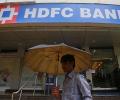
While HDFC Bank has vowed to recoup its lost market share in the credit card segment in three to four quarters by aggressively sourcing new cards, brokerages believe it is a little hard to come by, given how competitive the landscape has become, with other players in the market becoming equally aggressive to gain market share. Kotak Institutional Equities in its report on Monday said, "We would like to believe that the recovery in market share is likely to be gradual, if any. "All the key players, including Axis Bank, are now willing to expand their credit card portfolios as they have tested quite well against Covid-19."

Omkeshwar Singh, Head, Rank MF, a mutual fund investment platform, answers your queries.

Credit card spends jumped 57 per cent year-on-year (YoY) in September, aided by the festive season. According to the latest Reserve Bank of India (RBI) data, in September, credit card spends totalled Rs 80,477.18 crore compared to Rs 77,981 crore in August, thereby registering a 3.2 per cent growth sequentially, despite the high base. In the corresponding period last year, credit card spend was to the tune of Rs 51,356.68 crore.

Equity mutual funds attracted an all-time high net inflow of Rs 28,463 crore in March, on continued interest by retail and HNI investors, who used market correction as a good buying opportunity.

Omkeshwar Singh, Head, Rank MF, a mutual fund investment platform, answers your queries.

After a stellar run in 2021 that saw the S&P BSE Sensex and the Nifty50 clock gains of 20 per cent and 22 per cent respectively, global equity markets, including India, are gearing up to welcome 2022 on a cautious note. For one, new variants of the Covid -19 infection that make current vaccines less effective is one of the key risks worth flagging, analysts said. Inflation was also a risk for this asset class in 2021, although most market participants expect that the current elevated inflation levels will be transitory.

Omkeshwar Singh, Head, Rank MF, a mutual fund investment platform, answers your queries.

Private equity and venture capital investments more than halved to $3.6 billion in May 2021 when compared to the preceding April's $7.5 billion and a third lower than the year-ago period's $5.4 billion, a report said on Monday. However, on a year to date basis, the venture investments by these two categories of investors have doubled to $20 billion for the first five months of 2021, the report by industry lobby IVCA and consultancy firm EY said, stressing that investors continue to remain bullish. It can be noted that the country underwent the ravages of the second wave of the pandemic since April this year.

The top-100 wealth creators generated Rs 49 lakh crore during 2014-19, the highest-ever quantum of wealth added, according to Motilal Oswal's Annual Wealth Creation Study 2019. According to the study, Reliance Industries, Indiabulls Ventures and IndusInd Bank are the biggest, fastest and most-consistent wealth creators, respectively. The number of PSUs in the top-100 wealth creators is only nine, namely IOC, BPCL, HPCL, Power Grid Corporation, Petronet LNG, Indraprastha Gas, LIC Housing, Bharat Electronics and NBCC.
