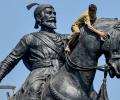
Oxford University Press India has issued an apology to Udayanraje Bhosale, a descendant of Chhatrapati Shivaji Maharaj, over 'unverified statements' made about the Maratha king in a book published over two decades ago. The apology addresses content in 'Shivaji: Hindu King in Islamic India' by James Laine, which sparked controversy and vandalism in 2004.

The top three contenders for 2025 were -- rage bait, aura farming and biohack.

Even though the NIA claims that more than 90 per cent of cases charge-sheeted have ended in conviction, the figure is likely misleading. To date, very few cases investigated by the NIA have resulted in a completed trial, points out former CBI joint director Navneet Rajan Wasan.

The Oxford University Press, which had first published the controversial book by US author James Laine on Chhatrapati Shivaji, told the Maharashtra government on Monday that it won't be publishing fresh copies of the book.

Quarantine, lockdown, pandemic, covidiot... Sabyasachi Dutta unravels how different nations arrived at their Word Of The Year 2020.

Union Minister of Commerce and Textiles Piyush Goyal has stirred up a hornet's nest by taking on India Inc, specifically the Tata group, which is among the companies that lobbied against the Modi government's pro-consumer draft e-commerce policies. While Goyal's comments, made at a Confederation of Indian Industry (CII) event, were streamed live on YouTube, the industry lobbying body later edited the video and subsequently withdrew the entire speech. Goyal had said the Tata group and other Indian companies often lobbied for their interest, while ignoring national interest.

Threats were often communicated to Pandit homes through notes tied to stones chucked through a window, or a notice pasted on a wall. Those sometimes came from neighbours eyeing that Pandit family's property. Those threats often worked in the atmosphere of terror during that awful season of vacuous exercise of State authority, writes David Devadas, longtime Kashmir watcher and author of two books on the Valley.

The transformative improvement promised in Jammu-Kashmir remains largely a mirage, observes David Devadas on the second anniversary of the Constitutional changes in the former state.

The days of a thousand cuts are over. These mini wars will remain under the threshold of undeniable war, but will escalate closer to that threshold when their big brother pushes in. Chinese aggression has changed the matrix, the strategies, and surely the objectives too, warns David Devadas.
Squashing erstwhile 'separatists', marginalising the 'mainstream', and squeezing funding channels have all evidently had an impact -- at least for the moment, notes David Devadas after a visit to Srinagar.

'Terrorists are killing ordinary citizens, huge crowds brave a pandemic to attend militant funerals, and artillery is booming on the LoC.' 'This April seems like a run-of-the-terror-mill Kashmiri spring: Violence is emerging like a prickly new bud,' warns David Devadas.

'Ambedkar's ideas have their own teeth -- if you don't have an appetite for them, you can't swallow them.'

With facts and figures, the CAG report has highlighted how Gujarat was far from a role model for states across India, and that the progress made in this province in western India in improving agriculture, education, healthcare and empowerment of women and children, was not exactly creditable, says Paranjoy Guha Thakurta.

'The Congress, all these decades, worked on a slow Hindi-isation and Indianisation of Arunachal tribes. The RSS wants rapid Hinduisation,' says Shekhar Gupta.

Nilanjana S Roy compiles a list of the most eagerly awaited books next year.

'The real test will be in defence-related deals, for instance the Javelin anti-tank missile: Is the US willing to co-develop something with India, on terms that will support the 'Make in India' initiative? Is there defence technology transfer? Or will it dump old junk on India?' asks Rajeev Srinivasan.
