
The Supreme Court has permitted the bursting of green firecrackers in Delhi-NCR for Diwali on November 7 and 8, 2026, with specific time restrictions. The court emphasized that the right to engage in practices with religious colour is qualified and cannot override constitutional restrictions on environmental pollution. It also issued detailed guidelines for manufacturers, traders, and authorities to ensure compliance and monitor air quality.

The Supreme Court stated it is not inclined to completely ban firecrackers but emphasised the need for authorities to implement existing orders on the ground to combat air pollution in Delhi-NCR. The court highlighted that annual orders become a "mockery" without proper enforcement and urged serious action, public awareness campaigns, and on-ground officer presence. It also noted ongoing consultations regarding the use of Barium in firecrackers and discussed measures taken by the Delhi government and CAQM to tackle pollution, including curbs on vehicles and construction. The court reiterated its stance of finding a middle ground rather than a complete ban or round-the-clock fireworks.

Delhi experienced its most polluted Diwali in five years with an average Air Quality Index (AQI) of 376, and the day after the festival saw only a marginal improvement, remaining in the 'very poor' category at 371, accompanied by a thick blanket of smog and fog.

The Supreme Court issued interim directions permitting the sale and bursting of green firecrackers in Delhi and the National Capital Region (NCR) during Diwali, outlining specific rules and restrictions.

The Supreme Court is considering relaxing the ban on firecrackers in Delhi-NCR ahead of Diwali, citing practical concerns and the need to balance environmental and livelihood interests.

The Supreme Court has permitted the sale and bursting of green crackers in Delhi-NCR for Diwali, relaxing the ban on green firecrackers as a temporary measure from October 18 to 21. The court has asked pollution control boards to monitor pollution levels and file reports. The order also includes measures to prevent the sale of non-compliant crackers.

Health ministry advisory urges rational use of cough syrups in children after 11 deaths in Madhya Pradesh and Rajasthan.

The Supreme Court has allowed certified manufacturers to produce green crackers, but restricted their sale in Delhi-NCR without approval. The court has asked the Centre to review the ban on firecracker manufacturing in the region.
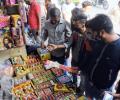
The Supreme Court on Thursday asked the Delhi police not to issue temporary licences for sale and storage of any kind of firecrackers, saying when the city government has banned all firecrackers no distinction can be made on the basis of whether it is green or not.

The Supreme Court on Wednesday refused to interfere with the Delhi government's order putting a comprehensive ban on manufacturing, storage, sale and bursting of firecrackers in the city, saying people's health is important.

A number of persons fainted after experiencing 'burning sensation' in their throat and chest. Many people who were asleep woke up in panic and scurried out of their homes and alerted neighbours and all of them soon reached the main roads unsure of what to do.

The changeover to green crackers after extensive experiments marks a revival of the industry which has over 1,000 manufacturing units around Sivakasi and used to clock an annual turnover of over Rs 6,000 crore.

A division bench of Chief Justice D K Upadhyaya and Justice G S Kulkarni said while it was not going to order a ban on bursting of firecrackers, a balance needs to be struck considering the deteriorating air quality index (AQI) in the metropolis.
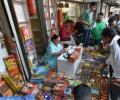
Some experts opine that green crackers are yet not practical and question government's move to promote them.

Pradhan also asserted that the fumes that were seen coming out was a 'technical' issue and there was no need to panic.

Delhi, which has gained infamy as one of the world's most polluted cities, has for some years now witnessed a sustained campaign from various quarters seeking a ban on firecrackers. While the Centre launched the newly approved, eco-friendly firecrackers earlier this month as a "safer and cheaper" alternative, the mood in the market is tepid, says Ritwik Sharma.

As of now, there is no restriction on the number of people entering the iconic monument complex at any point of time. The average footfall at the monument has increased at a rate of 10-15 per cent per annum.

Fresh smoke was witnessed on Monday at the Deonar dumping ground, where the fire which has been raging for three days now intensified last evening even as people living in the vicinity complained of discomfort due to the fumes emanating from the site.

A bench, headed by NGT Chairperson Justice Adarsh Kumar Goel, set up a five-member Committee to probe Thursday's gas leak incident in the chemical factory, in which 11 people were killed and 1,000 exposed, and submit a report before May 18.
The SC said, "You must tell us some way of preventing unemployment also. We cannot have people unemployed and hungry. There are areas where firecrackers can be used."
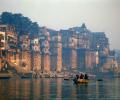
'There will always be hiccups given that the Namami Gange programme is spread over different sectors and involves several agencies.'

The Art of Living case will go down as a test for environment activism in the country, notes M Rajaque Rahman.

BJP, AIADMK oppose the project while DMK and CPI(M) support the Sethusamudram shipping project across the Palk Strait. T E Narasimhan reports

The environment ministry till May 2014 (still under UPA) ordered that cases like Vedanta's expansion plans need to consult people. But in December 2014, the NDA government reversed this position and in March 2015 the environment ministry extended Vedanta's environmental clearance till December 2018. This it did even while the question of the need for public hearing by projects in different kinds of industrial parks was being contested in the courts. This allowed the company to carry out construction.

A report submitted by the consortium of seven Indian Institutes of Technology on way to rejuvenate the Ganga river is at heart of Prime Minister Narendra Modi's ambitious plan to restore the glory of the river.
