
This was the one Budget that required radical departures on all these fronts, when it had none, asserts, Shreekant Sambrani.

The best course for the government at this time would be to tighten the seat belt a little more, without compromising on its investments in creating better infrastructure and giving a push to privatisation, points out A K Bhattacharya.

A tribal man in Odisha's Keonjhar district brought the skeleton of his dead sister to a bank to withdraw money deposited in her name after bank officials insisted on the account holder's presence.

A tribal man in Odisha was forced to carry his sister's exhumed skeleton to a bank to withdraw her money, sparking widespread condemnation. The bank claims it only requested valid documents, but the incident has raised questions about the treatment of vulnerable customers.
A tribal man in Odisha was forced to carry his sister's exhumed skeleton to a bank to prove her death and withdraw her money, sparking outrage and prompting government intervention.

The idea of back-loading the target of fiscal consolidation is perhaps guided by the government's desire to be prepared for any adverse developments in the coming year, points out A K Bhattacharya.

When it comes to running between the wickets -- which is exactly what an FM and a governor do -- Jadeja always defers to Dhoni's larger judgement of the situation and the needs of the team, observes T C A Srinivasa-Raghavan.

Few finance ministers announce any taxation measure that could upset the stock market. Ms Sitharaman decided to take that risk, observes A K Bhattacharya.

If the Budget makes no big announcements on new schemes, projects, or tax giveaways, the government would face a major political dilemma as it may have to reluctantly consider shunning the practice of unveiling pre-election sops to woo voters, notes A K Bhattacharya.

She has shown shrewdness, sensitivity, and courage. All of these will be needed in ample quantities for the real challenge that will emerge after the elections, notes Shreekant Sambrani.

With the fiscal deficit target staring at the government, the FY25 Budget has limited expenditure options, points out A K Bhattacharya.

The Union Budget will be debated from today.

'Ek baar aap GST dekh lo!' - Prime Minister Narendra Modi's gentle nudge to Finance Minister Nirmala Sitharaman in December last year sparked the beginning of a mammoth exercise to overhaul the tangled goods and services tax regime. And the final outcome is a significantly simplified system with lower tax rates and easier compliance for businesses.
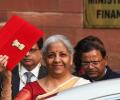
'... that it once again shies away from renewing its commitment to strategic divestment,' points out A K Bhattacharya.
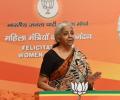
Nirmala Sitharaman is proving to be a better finance minister than her initial rookie status might have led people to expect, observes T N Ninan.

Feature for feature, bank FDs are indeed better than debt funds today, mainly thanks to Ms Sitharaman, notes Debashis Basu.

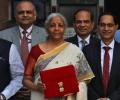
'The finance minister missed yet another opportunity to simplify the income tax structure in the Budget.' 'This was an opportune moment to get rid of the old tax system entirely and move fully to the new system,' asserts M Govinda Rao, member of the 14th Finance Commission.

Leading automakers Maruti Suzuki, Hyundai, Mahindra, and Tata Motors saw a dip in dispatches to dealers in August amid dip in demand with many prospective buyers postponing their buys anticipating a reduction in vehicle prices on account of the new GST framework. The country's largest carmaker Maruti Suzuki India reported an 8 per cent year-on-year dip in dispatches of passenger vehicles in the domestic market last month.

Finance Minister Nirmala Sitharaman on Tuesday met IMF managing director Kristalina Georgieva and discussed a range of issues, including impact of geopolitical situation on global growth.

Nirmala Sitharaman has a God given opportunity to orchestrate a transformation in India's defence capabilities. One hopes she has her own counsel and does not overly let the PMO run her ship, says Group Captain Murli Menon (retd).

'What is unusual about the current period of slow growth is that it has come without an external driver -- high oil prices and/or successive monsoon failures -- as was the case with all previous periods of slowdown, going back 50 years, notes T N Ninan.

'It would be reasonable to assume that Modi 3.0 would be more focused on projects and schemes which do not require any legislative change or which have the support of its coalition partners,' asserts A K Bhattacharya.

The finance minister could well be on her way to setting a record of achieving the biggest single-year reduction in the government's fiscal deficit, explains A K Bhattacharya.

If the finance minister's tax proposals have stimulated demand at all, it's for CAs, notes Kanika Datta.

Sri Annapoorna Hotel on Saturday appealed to the people to put to rest unnecessary assumptions and political misunderstanding after a video of its owner apologising to Union Finance Minister Nirmala Sitharaman over his remarks on Goods and Services Tax (GST) went viral on September 13.
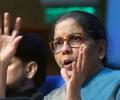
'The stimulus message was tagged on to what was meant to be an exhortation to self-reliance, glossing over the near impossibility of merging the immediate requirement of relief for a huge population and a questionable strategy for the future trajectory of a large economy aspiring to superstardom,' points out Shreekant Sambrani.

Startup founders need to sit up and think about how not to take stardom for granted and how not to disappoint their fans who have stood in long queues for those precious selfies with popular entrepreneurs, notes Nivedita Mookerji.
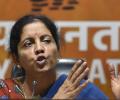
Chidambaram mocked her with a tongue-in-cheek tweet.

The Budget should use the extra RBI surplus to better effect, suggests A K Bhattacharya.

'Covid or no Covid, I knew I had made the right decision (calls from my bank to extend the much touted loans offered by Ms Sitharaman, notwithstanding),' says Keya Sarkar.

The finance minister's assertion that industry should not expect any spectacular announcements in the 2024 interim Budget suggest that the electoral imperatives of more tax concessions or higher expenditure on welfarist programmes could be far less pronounced than they were before the 2019 interim Budget, expects A K Bhattacharya.
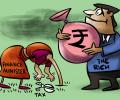
10 per cent for those who earn up to Rs 30 lakh a year and 25 per cent for those who earn more, suggests T C A Srinivasa-Raghavan.
Mr Modi has indicated he will carry on, and intensify, India's 'Look East' policy. But this start is hardly inspiring.

India's role as a leader of the global south may require it to give up its ambition to serve as a bridge between the warring halves of the international community, points out Mihir S Sharma.

'If such inflows materialise, what will be the effect on the rupee's value -- and therefore on exports growth, the only sustainable path to recovery?', asks Mihir S Sharma.

The government should have mentioned clearly the specific structural reforms that were responsible for the deviation from the fiscal deficit target by half a percentage point, says A K Bhattacharya.
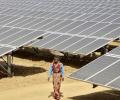
The push given to rooftop solar installation in the Interim Budget ties in with its high rate of adoption in Tier-II and -III cities of India. If original equipment manufacturers (OEMs) in the automobile industry, government, and the solar sector are to be believed, in cities of Rajasthan, Gujarat, and Kerala, 45-50 per cent of electric-vehicle (EV) users are employing rooftop power to charge their vehicles. This is compared to the national average of 25 per cent, say industry sources.

'She must first change the Rules of Business 1961 that makes the defence secretary and not the defence minister responsible for the defence of the country!' says Colonel Anil A Athale (retd.)

'Are we so ready to believe that in this country whose virtues we constantly shout from the rooftops, there is no single person -- other than Modi -- in a minimum of 272 elected MPs with the talent and ability to lead this country?' asks Prem Panicker.
