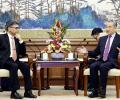
India and China have agreed to rebuild ties and resume people-to-people exchanges, including resuming direct flights and the Kailash Manasarovar Yatra this year. The two countries also discussed the resumption of dialogue mechanisms to address each other's concerns and move relations to a more stable path. The meeting comes after a period of strained relations following the Galwan Valley clashes in 2020.

'However, a lot of preparatory work would have to go in and China must be prepared to announce an end to the standoff by disengaging from the remaining areas along the LAC.'

Prime Minister Narendra Modi and Chinese President Xi Jinping were on Thursday seen having brief exchanges ahead of a media briefing by the BRICS (Brazil-Russia-India-China-South Africa) leaders in Johannesburg.
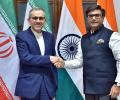
India's Foreign Secretary Vikram Misri will travel to Beijing for a two-day trip beginning Sunday, marking the second high-profile visit from India to China in less than one-and-a-half months. The visit comes amidst ongoing border tensions and follows a recent disengagement pact between the two countries in eastern Ladakh. The Foreign Secretary-Vice Minister mechanism meeting will focus on the next steps for India-China relations, including in the political, economic, and people-to-people domains. The decision to revive this bilateral mechanism was taken at a meeting between Prime Minister Narendra Modi and Chinese President Xi Jinping in Kazan in October.
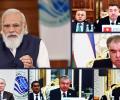
The Shanghai Cooperation Organisation (SCO) will hold its first in-person summit in Samarkand in Uzbekistan on Thursday after two years, shaking off Covid fears and providing a rare opportunity for all its eight heads of state to meet on the sidelines of the event to have face-to-face talks on pressing global and regional issues of common concern.
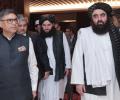
India's Foreign Secretary Vikram Misri has arrived in Beijing for a two-day visit during which he will hold talks with Chinese officials. The visit comes amid ongoing efforts to de-escalate tensions along the Line of Actual Control (LAC) in eastern Ladakh and to resume bilateral cooperation in various fields, including the Kailash Mansarovar Yatra.

India and China on Monday decided to resume the Kailash Mansarovar Yatra as the two sides agreed to take certain people-centric steps to 'stabilise and rebuild' ties.
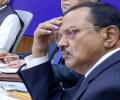
National Security Advisor Ajit Doval arrived in Beijing on Tuesday to take part in the India-China Special Representatives' talks to be held on Wednesday aimed at restoring the bilateral ties stalled for over four years' due to the military standoff in eastern Ladakh.

Prime Minister Narendra Modi's bilateral meetings on the sidelines of the BRICS summit in Johannesburg are being finalised, Foreign Secretary Vinay Kwatra said on Monday but did not give a direct reply on the possibility of a meeting between Modi and Chinese President Xi Jinping.
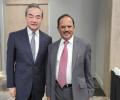
Doval is in Beijing for the 23rd round of the Special Representatives' talks being held after a gap of five years.

Chinese ambassador to India, Xu Feihong, on Wednesday expressed hope that the recently completed Indo-China border disengagement in Eastern Ladakh would smoothen relations and pave the way for a better understanding between the two neighbours in the days ahead.

'The impasse on the India-China border in the Sikkim sector persists, but the Hamburg meeting between the two leaders will certainly have its salutary effects on the relationship between the two countries,' says China scholar Rup Narayan Das.
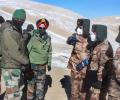
The talks are following up the outcome of the 19th round of Corps Commander-level talks held between the two sides on August 13-14 at the Chushul Moldo border meeting point.

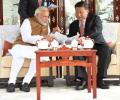
On Day 2 of the summit, Modi and Xi held a fresh round of one-on-one discussion at the Taj Fisherman's Cove Hotel.

'Tensions and dialogue are likely to go hand-in-hand with China.' 'The goal should be to cultivate power so that one can negotiate from a position of strength.'

'Disengagement is merely the first step in a lengthy process of arriving at a new normal along the LAC in Eastern Ladakh and the entire land boundary.' 'The Indian government should insist on the restoration of the status quo ante in Eastern Ladakh.'

Setting up Chinese Industrial Parks in India, increased access to Indian products to bridge the ballooning trade deficit besides border issues was expected to figure in Prime Minister Narendra Modi's first meeting with Chinese President Xi Jinping on the sidelines of the BRICS summit.

Modi was expected to arrive in Wuhan in the evening on April 26 and join Xi in the informal summit at a picturesque location the next day.

The summit is also being attended by Pakistan Prime Minister Shehbaz Sharif, Iranian President Ebrahim Raisi and leaders of several central Asian countries.
'To them, the day may not be far off when the state BJP starts claiming and propagating that Modi is next only to AIADMK's late boss Jayalalithaa,' says N Sathiya Moorthy.

Prime Minister Narendra Modi and Chinese President Xi Jinping shook hands on Tuesday at a side event at the G20 Summit in Bali, a gesture drawing some attention because of the strained relations between the two countries over a border clash two years back.
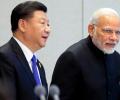
Modi is also expected to hold bilateral meetings on the sidelines of the summit, including with Putin, and Uzbek President Shavkat Mirziyoyev among other leaders.
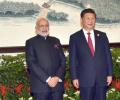
Prime Minister Narendra Modi and Chinese President Xi Jinping have agreed to make efforts to put India-China ties in the "right direction" and to "respect and accommodate" each other's concerns to avoid "impedance" relations, a top Chinese diplomat said on Tuesday.

The prime minister, accompanied by senior officials including National Security Advisor Ajit Doval and Foreign Secretary S Jaishankar, met the Chinese leader just before his travel to Myanmar from this port city.
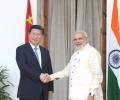
The Modi-Xi meeting assumes significance as India-China relations have followed a southward trajectory over contentious issues.
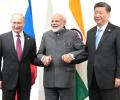
Asserting that both Prime Minister Narendra Modi and Chinese President Xi Jinping are 'responsible' leaders, Russian President Vladimir Putin on Saturday said they both are capable of solving issues between the two countries, and that it was important that no 'extra-regional power' should interfere in the process.

Surfing schools shut, roadside shops moved out, road being relaid, 10,000 police personnel expected... A Ganesh Nadar/Rediff.com finds a historical town getting ready to grab the headlines for 3 days.

Modi was seen drumming his fingers rhythmically while Xi keenly watched the show.

The focus of the talks will be to ensure mutual development and expanding overall ties, diplomatic sources said.

The meeting, which comes after the Doklam standoff, is aimed at a working a new paradigm for the bilateral relations for the next 15 years.

The historic coastal town is witnessing a flurry of activity, including infrastructure development in view of the high-level meet between Prime Minister Narendra Modi and Chinese President Xi Jinping next week.

All the three issues raised by China at the Modi-Xi meeting are either intractable or peripheral to the bilateral relations and suggest conventional methods to placate the other side without yielding much, says Srikanth Kondapalli.
'As the first leaders of their respective countries born after Indian Independence and the Chinese Liberation, Modi and Xi would be expected to have the ability to overcome the traditional mindsets and the hierarchical nature of their official/bureaucratic establishments,' say Alka Acharya and Jabin T Jacob.
'Since the bilateral deficit is a reality -- and a worry -- we need to find a way to deal with it,' says Ravi Bhoothalingam.

The Chinese delegation took stock of various aspects, including security and amenities and looked into the line-up of proposed events during the second edition of the informal summit between the Prime Minister Modi and the Chinese President, to be held from October 11 to 13.

'We should carefully handle issues concerning each other's core interests. We should properly manage and control problems that cannot be solved for the time being'

'From Doklam to Wuhan and the return of the India-China relationship to its previous equilibrium is indeed a major contribution of President Xi and PM Modi. Without any doubt they deserve the kudos for their sagacity and their wisdom,' says Ambassador Gautam Bambawale, India's envoy to China during the Wuhan summit.

'The need of the hour is to build on the positives and control the negatives,' says Colonel (Dr) Anil A Athale (retd).

India said a new mechanism will be set up for issues relating to trade and investment.

Bonhomie between Prime Minister Narendra Modi and Chinese President Xi Jinping in Ahmedabad, setting aside formalities to strike a friendly tone were highlighted by the state media on Thursday, with write ups and photos on front pages.
