
The BSE Sensex plummeted 1,236 points, wiping out nearly Rs 7 lakh crore in investor wealth, driven by escalating tensions between the US and Iran and subsequent market selloff.

Over 50 per cent, or 660 stocks, from the BSE 1000 index recorded negative returns during CY25.

Stock markets closed higher for the second straight session on Tuesday, driven by gains in bank, IT and capital goods shares.

The number of rights issues more than doubled and hit a 28-year high in 2025, even as qualified institutional placements (QIPs) shrank amid a broader market correction and the Securities and Exchange Board of India's (Sebi's) revised framework for rights issues.

Passive funds have resumed gaining ground in the mutual fund (MF) industry after a slowdown in 2024, with their share of assets under management (AUM) reaching an all-time high in 2025. The surge has been driven largely by robust inflows into gold and silver exchange-traded funds (ETFs).

'The problem is not just slower growth, but also the quality of growth.'

Ask rediffGURU Reetika Sharma your insurance, mutual fund and personal finance-related questions.

Even as net flows into smallcap funds in March turned negative, for the first time in 30 months, they remained a big draw for new investors. The smallcap fund category saw a net of 360,000 investment accounts, or folios, getting added last month, the second-most among all active equity categories. Smallcap funds' continued traction could be driven by their strong performance across timeframes, say experts.

Trade deals ease risks for Indian equities, but weak demand and stretched valuations raise questions over whether optimism -- especially in smallcaps -- can turn into a sustained bull run, points out Debashis Basu.
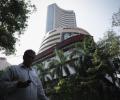
The BSE Smallcap index hit an over eight-month low of 47,627.96, falling 3 per cent in Tuesday's intraday trade amid selling pressure due to ongoing tariff-related concerns and rising geopolitical tensions.

Retail investors are moving away from a buy-and-hold approach and towards more informed short-term positioning, recent investment patterns show.

Trading pattern in the stock market this week will largely depend on the ongoing Q3 earnings announcement from corporates, global trends, and foreign fund movement, analysts said. Moreover, geopolitical developments and any update on trade negotiations would also be keenly tracked by investors, experts noted.

Mutual funds' largecap investment universe is expected to see seven changes in the upcoming stock reclassification exercise by the Association of Mutual Funds in India (Amfi). According to a report by IIFL Securities, Hero MotoCorp, Zydus Lifesciences, JSW Energy, NHPC, Bharat Heavy Electricals, Bosch and Samvardhana Motherson are expected to earn upgrades in the revised list of largecap, midcap and smallcap stocks set to be released in the first week of July. Amfi revises the list at the start of January and July every year based on the previous six-month performance of the stock.

Global risks include a potential delay in the US-India trade agreement, the possibility of a sharp correction in US equity markets, and renewed geopolitical tensions.

Retail investors now own a larger share of smallcap companies than they did a year ago, thanks to their conviction in mutual fund (MF) schemes focused on this segment. Data from Capitaline shows that MFs' average holding in the National Stock Exchange Nifty Smallcap 250 Index stood at 9 per cent at the end of the October-December quarter of 2023-24 (FY24), up from 7.76 per cent in the same quarter of 2022-23.

'The volatility in the stock markets since September 2024 has hurt the pace of accretion of new investors.'

Largecap equities are less volatile than mid- and smallcap stocks, making them suitable for risk-averse investors.

Flexicap fund performance depends heavily on the fund manager's decisions.

'Retail portfolios were going nowhere even as headline indices moved higher, prompting investors to sell holdings and shift money to IPOs, attracted by listing-day gains.'

2025 marked a shift in investor preference when it comes to MF schemes.
The post-Covid euphoria surrounding direct equity investing has ebbed in 2025. Individual investors have turned net sellers in the domestic equity market, pulling out about 8,461 crore so far this year - a sharp reversal from the record purchases seen in 2024, according to a report by the National Stock Exchange of India (NSE).

'Midcap and smallcap indices are trading in the expensive zone.'

Unless the primary market momentum slows, smallcap stocks will stay subdued.

Among Sensex firms, Tata Steel, Eternal, UltraTech Cement, Larsen & Toubro, Maruti and Bharti Airtel were the major gainers. However, Hindustan Unilever, Sun Pharma, ITC and Asian Paints were among the laggards.

Ask rediffGURU and PF expert Nitin Narkhede your mutual fund and personal finance-related questions.

The 2025 contraction marks the steepest decline in both the number of billionaire promoters and their aggregate wealth since 2012.

The rally in the equity markets in the second half of 2023 has led to a sharp surge in the cutoff for stocks to qualify as largecaps and midcaps. On the latest list put out by the Association of Mutual Funds in India (Amfi), the smallest largecap stock now has a market capitalisation (m-cap) of Rs 67,000 crore, 35 per cent higher than in July 2023. In the case of midcaps, the cutoff has surged 26 per cent to Rs 22,000 crore.

Net inflows into equity mutual funds (MFs) moderated for the second straight month in September, declining 9 per cent during the month to Rs 30,422 crore. The slowdown came as redemptions from active equity schemes rose 30 per cent month-on-month (M-o-M) to a one-year high of around Rs 36,000 crore.

Those who cannot bear significant downturns (as much as 40 per cent) or have a short horizon should exit entirely.

'While Indian markets are indeed not inexpensive, the valuations of largecap stocks are still a considerable distance from being overstretched.'

The rally in Indian mid-and smallcap indices thus far in calendar year 2024 (CY24) has been the best in class across the world, eclipsing the global FTSE benchmarks, and also out running peers from other leading world stock markets. This is despite the correction in the mid-and smallcap segments back home seen in the last few days, triggered by valuation concerns, geopolitical developments amid nervousness ahead of the July - September 2024 (Q2-FY25) corporate results season.

The milestone crowns a record year for the domestic primary market where IPO mobilisation is set to cross Rs 1.7 trillion.

From the Sensex pack, Eternal, Maruti Suzuki India, Kotak Mahindra Bank, Mahindra & Mahindra, Tech Mahindra, Titan, HDFC Bank, PowerGrid, Bajaj Finserv, HCL Technologies, Bajaj Finance and Larsen & Toubro were among the gainers. On the other hand, Tata Motors Passenger Vehicles, Asian Paints, UltraTech Cement, Bharat Electronics Ltd, Tata Steel, Adani Ports, Hindustan Unilever, ITC, Tata Consultancy Services and Reliance Industries were the only laggards.

Equity markets fell on Monday, with benchmark indices recording their worst session in over two months amid caution ahead of the US Federal Reserve's (Fed's) policy announcement and renewed uncertainty over the US-India trade deal. Sustained selling by foreign portfolio investors (FPIs) also weighed on sentiment.

'Defence, capital goods, engineering, capital market-related stocks, autos, and cement sectors are my bullish bets for Samvat 2082.'

'The first time India has seen two consecutive blockbuster IPO years.'

Small and midcap schemes may impose restrictions on redemptions, cap employee withdrawals, and increase the exit load, while ensuring a proportionate liquidation of the portfolio during market crises to safeguard the interests of all investors. These measures have been outlined in the investor protection policies recently put out by mutual fund (MF) trustees. The policies for small and midcap schemes were prepared by MF trustees following directives from the Securities and Exchange Board of India (Sebi) earlier this month.

Among the Sensex shares, Infosys, Tata Motors, Axis Bank, Adani Ports, Mahindra & Mahindra, HDFC Bank, Larsen & Toubro, Tata Steel, BEL and Power Grid were among the lead gainers. Kotak Mahindra Bank, ICICI Bank, Bharti Airtel, Asian Paints, Bajaj Finserv, and Titan were the among the laggards.

'We are cautious only on sub-sectors that have seen massive melt-up during the past six months.'
'What will matter in 2024 from the market standpoint is the direction of interest rates globally, as well as in India.' 'The results of the general elections will also be keenly watched.'
