
Hospital stocks have emerged as a strong theme in 2026, outperforming benchmark indices due to robust earnings growth, improved occupancy, higher average revenue per occupied bed, and aggressive expansion plans by major chains.

Net investments into equity mutual fund schemes in India remained elevated at approximately 38,440 crore in April, despite a slight dip from March's high and a 3% month-on-month decline in Systematic Investment Plan (SIP) inflows.

Investors now have 27 passive smallcap funds to choose from 17 index funds and 10 ETFs.

Amidst a sharp run-up in gold and silver prices, investors are advised to rebalance their portfolios by booking partial profits in precious metals and reallocating to domestic equities and debt, according to financial experts.

Life cycle funds may suit people who are starting their investing journey. They may suit those who do not want to monitor their investments frequently. Busy professionals, beginners and delegators, who lack the time, information or interest to manage asset allocation actively, may find these funds useful.

Indian IT stocks have seen a significant decline of up to 33 per cent year-to-date in 2026, largely due to artificial intelligence (AI) disrupting traditional outsourcing models, leading analysts to predict a challenging FY27 for the sector despite some cushion from rupee depreciation.

As the rupee weakens, wealthy families are accelerating investments in global assets.

Mutual funds (MFs) have significantly increased their ownership across market segments, but the midcap space stands out with comparatively higher growth. Data reveals that the number of midcap companies with over a fifth of MF ownership has doubled from nine in March 2022 to 18 by March 2025. In contrast, largecap stocks saw only a marginal rise, from three to four such companies during the same period.

Indian defence stocks have seen an average year-on-year gain of 67 per cent, driven by renewed interest following 'Operation Sindoor' and a broader increase in global geopolitical tensions, with the combined market capitalisation of 18 firms increasing by approximately 2.3 trillion.

Indian investors have seen their wealth erode by a staggering Rs 16.77 lakh crore over four trading sessions, as the markets faced deep losses driven by elevated crude oil prices, geopolitical tensions, persistent foreign fund outflows, and a record-low rupee.

Is the current rally telegraphing a durable peace plan in West Asia, boosted by United States (US) President Donald Trump's incoherent and contradictory posts on social media?

Net inflows into equity mutual fund schemes moderated in FY26, falling by 27 per cent to about 3 trillion till February, as choppy markets and global uncertainties prompted investors to shift towards safer options like hybrid funds and gold ETFs.

Fixed deposits from nationalised banks delivered higher returns than equities, outperforming both inflation and stock market benchmarks.

Indian equities are experiencing their sharpest rebound in years, with the BSE 500 index rallying 12.1 per cent so far this month, echoing Covid-era recoveries despite ongoing geopolitical uncertainty and earnings risks.
Indian benchmark indices Sensex and Nifty experienced declines due to a sharp rally in crude oil prices, continuous foreign fund outflows, and geopolitical uncertainties. Regulatory developments in the banking sector, particularly the implementation of the Expected Credit Loss (ECL) framework, also contributed to the selling pressure.

Ask rediffGURU and PF, MF and insurance expert Purshotam Lal your mutual fund, insurance and personal finance-related questions.

Small and midcaps are leading the charge in the latest market rebound. Since November 21, when the benchmark S&P BSE Sensex and the National Stock Exchange Nifty hit their recent lows and slipped into correction territory, the Nifty Smallcap 100 index has risen by 8 per cent, while the Nifty Midcap 100 has gained 5.7 per cent. Meanwhile, the Nifty 50 index has risen by 4.7 per cent during this period.

Indian IT services companies are set to significantly increase their acquisition spending to $6.5-7 billion this year, up from $5 billion last year, as they seek to boost revenue and capabilities in areas like Cloud, data, enterprise platforms, and AI amidst a challenging economic environment.

New demat account additions in India reached an 11-month low in March, with only 2.15 million new accounts opened, significantly below the 12-month average. This slowdown is attributed to a sharp decline in equity markets, escalating West Asia tensions, and increased crude oil prices impacting India's economic outlook.
Indian benchmark stock indices, Sensex and Nifty, closed nearly 1 per cent lower following the collapse of US-Iran negotiations, which heightened concerns of a prolonged conflict in West Asia and drove crude oil prices sharply higher.

Ask rediffGURU Reetika Sharma your insurance, mutual fund and personal finance-related questions.

Foreign brokerages have started to cut their year-end targets for the Nifty 50 index amid the ongoing West Asia conflict.

Ask rediffGURU and PF expert Nitin Narkhede your mutual fund and personal finance-related questions.

Indian investors have seen their wealth erode by a staggering Rs 48.29 lakh crore since the West Asia war began on February 28, leading to a significant downturn in the BSE Sensex and NSE Nifty, driven by geopolitical tensions and rising crude oil prices.

Indian markets on Dalal Street rallied sharply as easing tensions in the US-Iran conflict and stable oil prices boosted sentiment. Track Nifty 50 and BSE Sensex performance and key global triggers.

Ask rediffGURU Naveenn Kummar your insurance mutual fund and personal finance-related questions.

Benchmark BSE Sensex fell 558 points on Thursday amid heavy selling in IT shares, as concerns over AI-led disruptions and waning hopes of a Fed rate cut after firm US economic data weighed on investor sentiment.

Companies in the lower mcap deciles have recorded the fastest growth in median mcap.

The controlling shareholders of smaller and mid-sized companies are reducing their stakes at levels seldom seen since the 2008 global financial crisis. Over 20 per cent of companies listed on BSE MidCap and BSE SmallCap have seen a decline in promoter holdings for five consecutive quarters, reveals data from DSP Mutual Fund, shared with Business Standard. In the latest June quarter, the figure stood at 22.6 per cent.

After a strong run in the midcap and smallcap indices, which surged 46 per cent and 43 per cent, respectively, on the National Stock Exchange (NSE) during Samvat 2080, analysts suggest that the rally in these segments may pause to catch its breath in Samvat 2081.

Indian equity investors experienced a significant loss of 16.32 lakh crore due to a two-day stock market decline fueled by escalating geopolitical tensions involving the US, Israel, and Iran.

Retail investors' equity portfolios have significantly underperformed benchmark indices over the past 16 to 18 months.

The India-US trade deal has offered a much-needed breather for the Indian information technology (IT) industry, which has been grappling with global macroeconomic uncertainty and subdued client spending over the past few years.

The BSE Sensex and the Nifty 50 declined around 4.5 per cent each since the start of the West Asia conflict.

Investing in gold trumped most other asset classes in terms of compounded annualised returns over the long term, suggests a report by FundsIndia.

Indian equities on Dalal Street saw volatility as global market trends and fresh tariff concerns linked to Donald Trump impacted investor sentiment. Track Sensex, Nifty50 movement and key market drivers for Feb 24, 2026.
Equity benchmark indices Sensex and Nifty experienced a significant decline, primarily driven by a selloff in IT stocks due to concerns about AI disruption and renewed worries over global trade.

Market sentiment is likely to remain cautious as investors position themselves for the upcoming Union Budget and the US Fed's interest rate decision, where expectations are muted.

Stock markets rebounded on Friday with the benchmark Sensex closing higher by 316 points after heavy buying in banking and metal shares amid optimism over trade deal progresses and India's participation in Pax Silica.
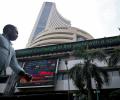
Benchmark stock indices Sensex and Nifty closed on a flat note in a choppy session on Wednesday as gains in PSU banks and auto shares were offset by losses in IT stocks.
