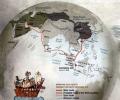
China's desire to have India as part of its ambitious Maritime Silk Route makes strategic sense for both nations. However, it would involve substantive assurances from Beijing, says Dr Rahul Mishra

It is time to throw an outer ring around India's national security by proactively engaging in areas immediately outside our neighbourhood. Such a ring will not only insulate India from emerging threats, but also create new leverage in securing our own neighbourhood, says Nitin Pai.

The defence ministry has signed off on a national security plan that it cannot fund. Ajai Shukla reports
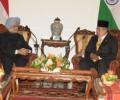
The two countries have decided to expedite trade related issues and signed six pacts to take forward their strategic partnership. Rediff.com's Sheela Bhatt, who is travelling with the prime minister on his visit to Indonesia, reports from Jakarta.

'Today the Chinese think they can slap India, and there will be no consequences.' 'They must be made to feel the consequences through any and all means,' says Rajeev Srinivasan.

'The creation of Pakistan was integral to Britain's grand strategy.' 'If they were to ever leave India, Britain's military planners had made it clear that they needed to retain a foothold in the NWFP and Baluchistan because that would provide the means to retain control of Iran, Iraq, Kuwait, the UAE, Bahrain and Qatar.'

'As in the Panchatantra tale of the cat and the monkeys, it is possible for the clever swing State to play off the two competing powers.'

Japan has the capital and needs to pull out of China, which has been its major destination. India, on the other hand, desperately needs capital especially for infrastructure, argues Rajeev Srinivasan.

'With the recent challenging of the notion of the Indian Ocean Region being India's strategic backyard, China is gradually upping the ante in the maritime realm around India.'

'The Modi government's lurch toward America has not brought it any dividends so far. The Western world is simply not in a position to make big investments in India... India needs to take a leap of faith vis-a-vis China.'
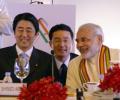
'Both nations have a common problem: A rampaging, jingoistic and hostile China which is making substantial territorial claims. In the long run, Japan and India are going to be the victims of Chinese aggression -- so they might as well hang together to contain China,' argues Rajeev Srinivasan.

Lieutenant General J F R Jacob, Chief of Staff, Eastern Army Command during the 1971 war, revealed how, armed with only a draft surrender document and an aide, he made the Pakistani army led by Lieutenant General A A K Niazi surrender.
Lieutenant General J F R Jacob, Chief of Staff, Eastern Army Command during the 1971 war, revealed how, armed with only a draft surrender document and an aide, he made the Pakistani army led by Lieutenant General A A K Niazi surrender.
Lieutenant General J F R Jacob, Chief of Staff, Eastern Army Command during the 1971 war, revealed how, armed with only a draft surrender document and an aide, he made the Pakistani army led by Lieutenant General A A K Niazi surrender.
Lieutenant General J F R Jacob, Chief of Staff, Eastern Army Command during the 1971 war, revealed how, armed with only a draft surrender document and an aide, he made the Pakistani army led by Lieutenant General A A K Niazi surrender.
Lieutenant General J F R Jacob, Chief of Staff, Eastern Army Command during the 1971 war, reveals how, armed with only a draft surrender document and an aide, he made the Pakistani army led by Lieutenant General A A K Niazi surrender.
