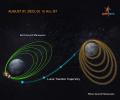
"The duration of manoeuvre was 1,738 seconds. With this, Chandrayaan-2 was successfully inserted into a Lunar orbit," Indian Space Research Organisation said.

Vikram (with rover 'Pragyan' housed inside) is expected to touch down on the lunar surface on September 7, between 1.30 am and 2.30 am.

The next operation - reduction of orbit- will be done at 11 PM on Sunday, ISRO added.

All spacecraft parameters are normal, the Bengaluru headquartered space agency said after the maneuver.

India's first unmanned spacecraft Chandrayaan-1 entered the lunar orbit on Saturday after Indian Space Research Organisation scientists successfully carried out a highly complex and tricky manoeuvre crossing another historic milestone in the country's space programme.

There will be two more orbit manoeuvres to make the spacecraft enter into its final orbit passing over the lunar poles at a distance of about 100 km from the Moon's surface.
India's first unmanned moon spacecraft, Chandrayaan-1 has entered the lunar transfer trajectory and is heading to an apogee of 3,80,000 KM as ISRO scientists on Tuesday carried the fifth and final orbit-raising manoeuvre.

The video showed the Moon in bluish green colour with many craters.
The ISRO had said it would attempt softlanding on the lunar surface on August 23.
All spacecraft parameters are normal, the Bengaluru headquartered space agency said after the maneuver on the spacecraft.

Here is a glimpse of the journey of India's third lunar exploration venture has taken so far.

Two de-orbit manoeuvres of Vikram Lander, to bring it further down, have been planned to prepare for its landing in the south polar region of the moon.

According to ISRO officials, Earth bound orbit is a phase during which the spacecraft will remain in the Earth's sphere of influence.
The nine-second de-orbiting or retro-orbiting manoeuvre was executed at 3.42 am using the onboard propulsion system.

The Chandrayaan-2 mission has made the first-ever observation of the effects of the Sun's Coronal Mass Ejection (CME) on the Moon using its onboard scientific instruments. This observation would help understand the lunar exosphere and the impact of space weather on its surface.

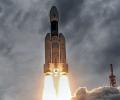
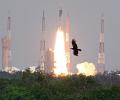
Weighing 320 tonne at lift-off, the vehicle used larger strap-on motors to achieve higher payload capability.
ISRO has said once the Lunar night falls, there would be no sunlight for the lander to generate power for its working and also it was not designed to operate in the heavy cold temperature of Moon during the phase.
The Vikram Moon Lander, named after the father of India's space mission Vikram Sarabhai on his birth centenary year, is scheduled to touch the lunar surface near its south pole on September 7 about 1.55 am.
The Chandrayaan-2 spacecraft is expected to reach the moon's orbit on August 20 and land on lunar surface on September 7.

Here is the timeline of the moon mission as undertaken by the Indian Space Research Organisation.

The Lagrange point 1 (L1) of the Sun-Earth system is about 1.5 million km from the Earth. It is about one per cent of the total distance between the Earth and the Sun.

Chandrayaan-2 was launched on July 22, 2019 and inserted into the lunar orbit on August 20, exactly one year ago.

Hours before Chandrayaan-2's 'Vikram' module's proposed soft landing on the Lunar surface, Indian Space Research Organisation chairman K Sivan said on Friday things are progressing as per plan for the much-awaited event.
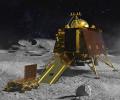
ISRO chairman K Sivan said the proposed soft-landing was going to be a 'terrifying' moment.
Most components of technology demonstration, including the launch, orbital critical maneuvers, lander separation, de-boost and rough braking phase were successfully accomplished.

'All possible efforts are being made to establish communication with (the) lander,' the ISRO further said in a tweet.

'Today onwards, the onboard thrusters will be fired and Chandryaan-3 will be taken away from Earth for an eventful landing on Moon's surface on August 23'

He noted that Chandrayaan-3 will be inserted into the lunar transfer trajectory after the orbit raising manoeuvres.

After the historic success of its Chandrayaan-3 lunar mission, Indian Space Research Organisation (ISRO) is going full throttle with its plans to send Indian astronauts for the first time to the Moon by 2040, ISRO Chairman S Somanath said.

The new year will witness two unmanned missions under the "Gaganyaan" project, deep ocean exploration project, "Samudrayaan" and many more.

A satellite placed in the halo orbit around the first Lagrangian point (L1) of the Sun-Earth system has the major advantage of continuously viewing the Sun without any occultation/eclipses, the IIA said.

The year ended with the launch of the PSLV's 50th mission.

Although Russia, United States and China have achieved a soft landing on the lunar surface, India is aiming at becoming the first one to explore the south pole of the Moon.

Indian Space and Research Organisation's Mars Orbiter Mission and American National Aeronautics and Space Administration's orbiter mission Mars Atmosphere and Volatile Evolution or MAVEN will share data concerning the upper atmosphere of Mars.
NASA said it is looking forward to explore the solar system with its Indian counterpart.

It has already tasted success with the moon mission and Mangalyaan. Is man in space the next frontier for ISRO?
