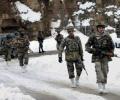
Experts have said the economic cost of China's misadventure in the last couple of months in eastern Ladakh and South China will be "massive" as it has "exposed" Beijing's "real face" when the entire world is fighting coronavirus.

This upgrade will allow air operations by military and civil aircraft even in poor visibility and adverse weather conditions.

Addressing a Defence Research and Development Organisation event in Leh, Singh asked how can India talk to Pakistan when it keeps trying to destabilise India using terror.

Readers share their travel pics across India. You can share yours too!
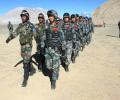
The last time the Chinese military had taken Indian soldiers captive was in July 1962 after a clash in Galwan Valley.
Chinese Foreign Ministry spokesman Zhao Lijian expressed this hope hours after India and China accused each other of firing in the air near the Pangong lake at the Line of Actual Control(LAC) in eastern Ladakh on Monday.

China remains in firm control of an estimated 600-800 square kilometres of Indian territory.

The prime minister also visited the Ram Manohar Lohia Hospital in New Delhi after the milestone was achieved and interacted with hospital officials.
Talking about dealing with the border issue faced by India, Jaishankar, without naming any country or going into details, said, "You know again we did what we had to do. There was a very active debate which still continues to this day. It is natural for people to offer advice, often on matters which they may not have particular knowledge of, that are a human trait. But again if there was what came through it was that we were resolute, we were strong about protecting our interests."
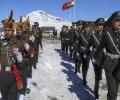
In a joint statement, the two armies said it was agreed to earnestly implement the important consensus reached by the leaders of the two countries and ensure that the frontline troops exercise restraint and avoid misunderstanding and miscalculation.
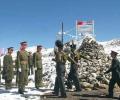
Since China began this buildup, the Indian side says Chinese troops will have to start the de-escalation. Only then will Indian troops go back. The June 6 meeting agreed to this roadmap.

The Indian Army on Friday strongly insisted on early disengagement of troops by China from all the friction points in eastern Ladakh at the eighth round of corps commander-level talks between the two sides that primarily focused on a roadmap for restoration of peace and tranquillity in the region, according to people familiar with the developments.

The onus today is on China, but it also requires a little diplomatic finesse from India, backed by a modernised armed force, argues BJP MP Subramanian Swamy in this excerpt from his new book, Himalayan Challenge: India, China And The Quest For Peace.

Packages for this season are 30-40% cheaper than peak season and are for value-conscious travellers.

Chinese foreign ministry spokesman Geng Shuang told a media briefing in Beijing that "at the moment the situation in the boundary region between China and India is overall stable and controllable".

Rediff labs analyses the number of visitors to centrally protected monuments in India and how much the revenue it generates for the government through the tickets to see these monuments.

The formal process of disengagement of troops began on July 6, a day after a nearly two-hour telephonic conversation between National Security Advisor Ajit Doval and Chinese Foreign Minister Wang Yi on ways to bring down tensions in the area.

He has driven into the Limca Book of Records twice. Tamanna Naseer finds out more about the battles Eric Paul fights despite being paraplegic.
Photos: Independence Day Special - We, the people of India
At the talks, the Indian side insisted on complete disengagement of Chinese troops at the earliest and immediate restoration of status quo ante in all areas of eastern Ladakh prior to May 5 when the standoff began following a clash between the two armies in Pangong Tso, they said.

Forget Munnar and Manali, these places in India are worth your time.

'.. if the cost is its own survival,' says Colonel Anil A Athale (retd).

We are today carrying out the reconstruction of New Delhi which will cost us Rs 20,000 crore and give the prime minister a new house while crores of people have no means and no money to buy vaccines for their children, observes Aakar Patel.

Sources indicated that during Saturday's talks, India will insist on a faster disengagement process in remaining areas to bring down tension in the region, which has witnessed a tense standoff between the two militaries for over nine months.

The sources also said both the Indian and Chinese troops are firmly holding on to their respective positions at the Line of Actual Control.

The visit is also aimed at boosting morale of the army personnel engaged in the seven-week bitter border faceoff with the Chinese troops in the region, sources added.

In a letter addressed to Prime Minister Narendra Modi, the Ladakh MP revealed his reason to quit the BJP and resign from the Lok Sabha ahead of the upcoming parliamentary elections.
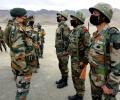
As per the sources, the discussions between the two sides include pulling back tanks and armoured vehicles from their present positions, and some development in this regard is likely to take place in the next few days.

Describing the order as a "matter most urgent", the director asked the oil marketing companies to make adequate stocks of LPG which can last up to two months both at bottling plants as well as godowns.

The two sides held diplomatic talks through video conference on the border standoff in midst of fresh details emerging that China has strengthened its position in several areas in eastern Ladakh including Galwan Valley where a violent clash on June 15 left 20 Indian soldiers dead.
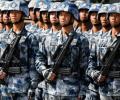
Chinese military has also deployed a sizeable number of its troops in Galwan Valley, the site of the violent clashes on June 15 that left 20 Indian soldiers dead.

'Chinese troops are not geared to fight Indian troops who are battle hardened and acclimatised and are far more hardy.'

India has already mobilised fighter jets and sent thousands of additional army troops to forward locations along the border with China after 20 Indian Army personnel were killed in a brutal attack by Chinese troops in eastern Ladakh's Galwan Valley on June 15.

It has also been decided to suspend the interstate bus services till March 31, the officials said. The decisions have been taken at a high-level meeting attended by chief secretaries of all states and the cabinet secretary and the principal secretary to the prime minister.

Delhi on Sunday recorded the lowest temperature of the season with the mercury dipping to 2.6 degrees Celsius, five notches below normal, with dense fog affecting 55 flights and about 70 trains.
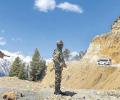
China and India have agreed to work to maintain peace along the Line of Actual Control and resolve the border standoff through talks while implementing the consensus reached between the two countries' leadership that 'differences' do not escalate into 'disputes', a top Chinese official said.
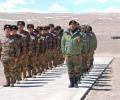
The sources said both sides held extensive deliberations on modalities for disengagement of troops from all the friction points in eastern Ladakh at the talks.
The Indian side is expected to present specific proposals at the talks to deescalate tension in Pangong Tso, Galwan Valley and Demchok -- the three areas in eastern Ladakh where the two sides have been on a bitter standoff for last one month, the sources said.

Reader Satyadeep Sarvaiya has sent us a photograph.
Hurried and ill-planned Summits like the Vajpayee-Musharraf Summit in Agra which preceded the attack on the Indian Parliament in December 2001 are best avoided for now, says G Parthasarathy
