The Indian government has dismissed the US Commission on International Religious Freedom's (USCIRF) report on religious freedom in India, stating that it does not recognise the commission's authority to comment on the rights of Indian citizens.
In its annual report on religious freedom, the USCIRF asked the US State Department to designate India as a "country of particular concern" on the status of religious freedom along with several other nations.

India has rejected a report by the US Commission on International Religious Freedom (USCIRF) that criticised India's record on religious freedom and called for linking US security assistance and trade to improvements in this area.
Coming on the heels of two successful bilateral meetings between Prime Minister Narendra Modi and President Joe Biden -- the Official State Visit of the Indian leader here in June and a bilateral meeting in New Delhi in September -- USCIRF in its announcement of the meeting said the Congressional hearing is on how the US government can work with the Indian government to address violations.

Religious freedom and related human rights in India are under ongoing threat, the US Commission for International Religious Freedom alleged on Tuesday in an unusual year-end update of the status of its assessment of religious freedom in the country.

The Chinese government is restricting individuals, in particular those of the minority community, from their religious practices, US Secretary of State Hillary Clinton said Tuesday.
External Affairs Ministry Spokesperson Arindam Bagchi said the observation on India in the report is based on 'motivated inputs and biased views'.
Taking note of the recent violence against the Christian community in India, the US has asked the Indian government to protect the religious freedom throughout the country. "We urge all parties to refrain from violence and urge government officials to protect religious freedom throughout India and thus preserve India's longstanding tradition of religious tolerance," said Ambassador for International Religious Freedom, John Hanford.

Religious freedom in India was on a "negative trajectory" in 2015 as religious tolerance "deteriorated" and religious freedom violations "increased", a United States report on international religious freedom said

"Our principled position remains that we see no locus standi for a foreign entity to pronounce on the state of our citizens' constitutionally protected rights," Spokesperson in the Ministry of External Affairs Anurag Srivastava said.
A US federal government commission has raised concerns about the state of religious freedom in India, recommending its designation as a 'Country of Particular Concern' and suggesting targeted sanctions.
In the 2020 edition of its annual report on International Religious Freedom, the US Commission for International Religious Freedom (USCIRF) alleged that religious freedom in India witnessed a drastic downward turn.
Putting India on the 'watch list' for the second year in succession, the US Commission for International Religious Freedom (USCIRF) in its report said the Indian government at various levels recognised the problem of communal violence and created some structures to address these issues.
India has rejected allegations of declining media freedom and erosion of religious and minority rights, asserting that the country is a vibrant democracy that guarantees free speech to all.
The report, released on June 21, alleged that some senior leaders of the BJP "made inflammatory speeches against minority communities".

The Centre has informed the Supreme Court that the restriction on women of menstruating age entering Kerala's Sabarimala temple is a matter of religious faith and denominational autonomy, falling outside the purview of judicial review. Solicitor General Tushar Mehta argued that courts should not apply 'secular standards of reason' to religious practices.
A US Congress-constituted quasi-judicial body on Monday recommended to the Biden Administration to designate India, China, Pakistan, Afghanistan and 11 other nations as "country of particular concern" in the context of status of religious freedom.
External affairs ministry spokesperson Vikas Swarup said the government does not see the locus standi of a foreign entity like US Commission on International Religious Freedom to pronounce on the state of Indian citizens' constitutionally protected rights.

The US Commission for International Religious Freedom (USCIRF) also recommended to the Congress to raise the issue of religious freedom during US-India bilateral meetings, and hold hearings on it.
In a missive to Bush, USCIRF chair Felice D Gaer urged him to 'ask Prime Minister Singh to ensure the immediate security of Indian citizens -- security that is undermined by recurrent attacks on religious minorities and communities.'

The announcement came as Secretary of State Rex Tillerson decided to re-designate about 10 countries as 'Countries of Particular Concern'.
India says the USCIRF has no locus standi to pass its comment on Indian citizens' constitutionally protected rights.
Accusing China of repressing dissent, the US commission on global religious freedom has appealed to President Barack Obama to take up the issues of human rights and religious freedom during his meeting with his visiting Chinese counterpart Hu Jintao at the White House.
"Whenever we do compromise those rights, the world is worse off," Pompeo said.

Thousands of Naga students and citizens rallied in Kohima, Nagaland, opposing the central government's directive to mandate the singing of Vande Mataram in official functions and educational institutions, citing concerns over secularism and religious freedom.
A US government report on Monday praised the religious freedom in India despite mentioning instances of attacks on religious minorities, and lauded the "independent" judiciary and a "vibrant" civil society for acting against violations whenever they occur.

A potential agreement between the United States and Iran, including a comprehensive ceasefire and gradual lifting of US sanctions, may be announced soon, according to reports. The agreement aims to de-escalate tensions and establish a framework for resolving disputes.
The funding comes after a 2016 report found an increase in violent incidents by cow vigilantes mostly against Muslims in India and authorities often 'failed' to prosecute them.

UN experts have voiced serious concerns regarding the ongoing abduction and forced religious conversion through marriage of women and girls from minority communities in Pakistan, highlighting that impunity is fuelling the practice.

'Your constant reiteration on the lack of religious freedom in India has sown doubts about the kind of information that you are being fed and based on which you seem to be making adverse references to India and its tradition of religious tolerance.'
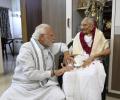
Who were the mothers who shaped Mahatma Gandhi, Sachin Tendulkar, Narendra Modi and other well-known Indians?
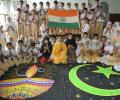
'In India, legal advocates and faith leaders from across the country's diverse religious communities condemned a case of extreme hate speech against Muslims in the city of Haridwar, calling for the country to uphold its historical traditions of pluralism and tolerance'
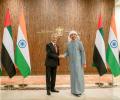
Frankly, was it really necessary in the middle of a fratricidal war for External Affairs Minister S Jaishankar to travel to Abu Dhabi for a one-on-one with the sheikh on April 12?Or, for National Security Advisor Ajit Doval to follow up on April 26? Or, for PM Narendra Modi to follow through today? There are no easy answers, notes Ambassador M K Bhadrakumar.

A United States court has ruled that Yoga classes in an elementary school do not endorse Hinduism or violate students' right to religious freedom and are "devoid of any religious, mystical, or spiritual trappings".
Authorities in Kashmir have initiated a profiling process of mosques, madrassas, and individuals associated with their management following the exposure of a 'white collar' terror module. The enumeration drive focuses on the finances of these institutions and the backgrounds of their personnel.

The three principles he taught in particular -- Ahimsa, Anekantavada and Aparigraha -- are as alive and necessary today as they were then. Perhaps more so.

'She was not a yes person. She would tell the truth and her feelings to Indira Gandhi, and Indira Gandhi would value her opinion. The same was the case with Rajiv Gandhi who would value her opinion.'

While the National Investigation Agency (NIA) sought a stay on the operation of the bail order so as to appeal before the Supreme Court, the HC refused the request, stating that Babu has been in jail for over five years.

A US federal government commission has flagged the alleged worsening of religious freedom in India and called for it to be designated as a "Country of Particular Concern".
 © 2026 Rediff.com - Advertise with us - Disclaimer - Privacy Policy - Sitemap - Feedback - About us - Terms of use - Grievances