
Retail inflation inched up to 0.71 per cent in November on rising prices of vegetables, protein-rich items, and fuel, government data showed on Friday. The consumer price index (CPI)-based retail inflation had fallen to a record low of 0.25 per cent in October, mainly due to lower prices helped by GST rate cuts and a favourable base.

Shares of gems and jewellery firm Rajesh Exports Ltd dropped 5 per cent to hit the lower circuit limit after capital markets regulator Sebi barred its promoter and CEO Rajesh Mehta from dealing in the company's securities, alleging large-scale misrepresentation of financial statements and diversion of funds.

RBI Governor Sanjay Malhotra stated that the central bank is closely monitoring whether the supply shock from the West Asia conflict will lead to a generalised price rise, potentially necessitating monetary policy action.

The Indian equity market is set for an event-heavy week, with analysts pointing to the Reserve Bank of India's (RBI) interest rate decision, developments in the US-Iran situation, and crude oil prices as the primary determinants of market trends.

The Indian rupee depreciated 16 paise to settle at a fresh lifetime low of 96.86 against the US dollar, marking its ninth consecutive session of decline, driven by elevated global crude prices and a strong dollar.

With Kylian Mbappe's depth and experience, economists predict France are tipped to edge Spain to lift World Cup.

Smallcap funds give investors access to businesses that can grow much faster than the broader economy.

India's manufacturing sector experienced a moderation in growth during June, with the HSBC India Manufacturing Purchasing Managers' Index (PMI) falling to 54.2 from 55.0 in May. This slowdown is attributed to softer increases in new business orders and international sales, leading to reduced expansions in buying levels, employment, and output.
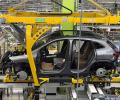
Automobile manufacturers are increasingly vocal about the mounting paperwork and delays associated with India's Production-Linked Incentive (PLI) scheme for the automotive sector, arguing that compliance requirements are becoming as challenging as meeting technical eligibility conditions. They are pushing for a simpler, faster, and more predictable certification and compliance framework.

Indian benchmark indices Sensex and Nifty climbed in early trade, driven by buying in blue-chip stocks like Reliance Industries and ICICI Bank, alongside a notable cooling in crude oil prices.
India Ratings and Research predicts the Reserve Bank of India (RBI) will maintain the repo rate at 5.25 per cent throughout FY27, despite potential inflationary pressures from higher fuel prices, with inflation expected to remain within the central bank's tolerance band.

The primary objective should be to figure out a way to grow at 7 to 7.5 per cent with inflation around 4 per cent. Any policy that can help us get there must be experimented with. Those that work should stay. Those that do not should go, suggests Karan Bhasin.

Indian stock market benchmark indices Sensex and Nifty closed nearly one per cent higher, extending their winning streak for a second day. This rally was driven by softening crude oil prices, positive geopolitical developments, and significant buying in blue-chip IT stocks, despite a broader global tech sell-off.

Tata Motors is set to acquire Italy's Iveco Group, a strategic move aimed at propelling the Indian automaker into the top four global commercial vehicle (CV) manufacturers, with projected annual revenues of $35 billion-$40 billion within five years.

Kerala is facing increased inflationary pressure due to recent hikes in petrol and diesel prices, according to Chief Minister V D Satheesan. The state's economy is also impacted by the decline in remittances from the Gulf and higher oil prices.

Chief Economic Advisor V Anantha Nageswaran stated that India's economy is projected to return to a 7 per cent-plus growth trajectory by 2027-28 (FY28), or sooner if external conditions improve, despite near-term challenges from the West Asia crisis.

Indian benchmark indices Sensex and Nifty rebounded in early trade, tracking a recovery in global equity markets and an easing of hostilities between Israel and Iran, after a sharp fall in the previous session.

US President Donald Trump has amplified a highly surreal, artificial intelligence-generated music video across his social media network, showcasing an array of fantastical digital avatars that depict him as a globally revered icon.

The live-action Moana faithfully recreates the original, but rarely captures its magic.

In an event-heavy week ahead, stock markets are expected to track Q3 corporate earnings from several blue-chip firms, including TCS and Infosys, while inflation data and global trends would also dictate investors' sentiment, analysts said.

Amidst a sharp run-up in gold and silver prices, investors are advised to rebalance their portfolios by booking partial profits in precious metals and reallocating to domestic equities and debt, according to financial experts.

India's services sector experienced its strongest growth in six months in May, with the HSBC India Services PMI Business Activity Index rising to 59.8. This expansion was driven by healthy demand, new client acquisitions, and improved new business intakes, alongside a softer rise in cost burdens.

A recently finalised peace deal between the US and Iran, set to be signed on June 19, is expected to significantly benefit India's economy by boosting exports to West Asia, stabilising the rupee, and easing inflationary pressures, according to exporters and experts.

Retail inflation rose to a three-month high of 1.33 per cent in December 2025 mainly due to higher prices of kitchen essentials, including vegetables and protein-rich items.

Behind the aesthetics of an entrepreneurial lifestyle lies a silent financial crisis that nobody is talking about: Freelancers are sprinting toward a retirement brick wall.

External Affairs Minister S Jaishankar has strongly defended India's decision to purchase Russian crude oil, stating that the country's energy choices are based on cost and availability, and highlighting the West's 'hypocrisy' in criticising India while historically supplying weapons used against it.

Indian benchmark indices Sensex and Nifty surged significantly in early trade, tracking a global rally fueled by US President Donald Trump's declaration of an end to the war with Iran and a subsequent drop in crude oil prices.

Gold prices in the national capital surged by Rs 600 to Rs 1.65 lakh per 10 grams, extending gains for the third consecutive day, while silver rebounded by Rs 5,000 to Rs 2.71 lakh per kilogram, driven by geopolitical tensions and inflation concerns.

The report notes that equities had faced pressure from elevated valuation premiums, subdued nominal gross domestic product (GDP) and earnings growth, sustained foreign portfolio investor (FPI) selling, artificial intelligence (AI) infrastructure euphoria, and external shocks including US tariffs and a spike in crude oil prices due to geopolitical tensions in West Asia. However, several of these factors are now reversing.

For members, the message is simple: don't be misled by headlines about '100% withdrawal'. The basic purpose of the EPF remains unchanged -- to help employees build a financial cushion for retirement while allowing limited access to savings for genuine needs during their working lives.

Analysts predict that the ongoing US-Iran conflict, fluctuations in crude oil prices, and foreign institutional investor (FII) flows will be the primary factors influencing Dalal Street this week, with inflation concerns adding to investor anxiety.

Non-banking financial companies (NBFCs) reported encouraging results for Q4FY26 with improved asset quality and earnings, but analysts maintain a cautious near-term outlook due to geopolitical tensions, monsoon risks, and specific portfolio concerns.

IT stocks had their worst first half fall in decades, with the Nifty IT index declining 31% in the January-June 2026 period, its biggest decline in the first six months of a calendar year since 2003.

A wellspring fuelling the CJP tsunami is the high levels of youth unemployment. Millions of youngsters, including extremely over-qualified people, apply in desperation for any job that is advertised. No government has been able to deliver on this front and things may get worse as artificial intelligence enters the workforce, points out Devangshu Datta.

Indian benchmark stock indices, Sensex and Nifty, experienced a significant decline for the third consecutive day, with the Sensex tumbling 1,092 points and Nifty closing below 24,550. This downturn was primarily driven by the India Meteorological Department's forecast of a below-normal southwest monsoon and ongoing geopolitical uncertainties surrounding the US-Iran ceasefire arrangement.


World Cup fever in Argentina, home of the defending champions, has boosted sales of counterfeit jerseys and soccer trading cards, sparking protests from retailers who are already under pressure from President Javier Milei's market-opening policies.

Indian benchmark indices Sensex and Nifty closed lower, snapping a two-day rally, as a spike in crude oil prices, triggered by reports of fresh US military operations in southern Iran, dampened investor sentiment and reignited fears of renewed energy supply disruptions.

Foreign Portfolio Investors (FPIs) have withdrawn Rs 14,231 crore from Indian equities so far in May, extending the total outflow for 2026 to over Rs 2 lakh crore, driven by persistent global macroeconomic uncertainties including inflation, interest rates, and geopolitical risks.

Almost a decade after India shifted to a formal inflation-targeting regime under the Monetary Policy Committee (MPC) framework of the Reserve Bank of India (RBI), a high-level panel of economists said that the flexible inflation targeting has largely worked in keeping it under control and no major revamp is required.
