
In 2025, India launched Operation Sindoor, a multi-domain combat mission against Pakistan in response to cross-border terrorism. The operation involved precision strikes, military retaliation, and diplomatic measures, marking a significant shift in India's security policy.

Juster said as democracies, the US and India are committed to a rules based order as well as to peace and diplomacy.

Jaishankar said such a description would be like putting the perpetrator and the victim of the Pahalgam attack at the same level.
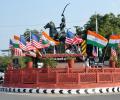
Indo-Pacific region. Senior officials from the ministries of External Affairs and Defence, and the US departments of Defence and State met here for the India-US 2+2 Inter-Sessional meeting.

Asserting that "maritime muscle flexing" by some countries and other factors have made the Indo-Pacific region "more contested and more volatile," naval chief Admiral Sunil Lanba on Tuesday said that the Indian Navy has its task cut out as it has been a major security provider in the region.
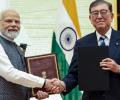
India and Japan have unveiled a comprehensive framework to boost their defence cooperation in response to security challenges, particularly concerning China's increasing military presence in the East and South China Seas.
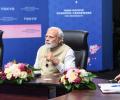
As US President Joe Biden launched a new trade deal with 12 Indo-Pacific nations, including India, to enhance trade, economic and investment opportunities, China, which sees the pact as a threat to its dominance in the region, went on the offensive against it, promising more opening up, while the official media here termed it as "economic Nato".
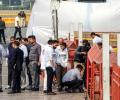
US Secretary of State Marco Rubio praises India's measured and professional investigation into the Red Fort car explosion, calling it a terrorist attack. The US has offered assistance, but acknowledges India's capabilities in handling the investigation.
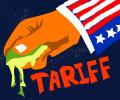
The US is "pretty close" to reaching a "fair trade deal" with India, President Donald Trump has said, adding that he will lower the tariffs imposed on Indian goods at "some point".
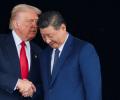
Speaking to reporters aboard Air Force One, Trump stated, "We have a deal," referring to the trade pact which will be routinely extended. "Every year we'll renegotiate the deal, but I think the deal will go on for a long time, long beyond the year. We'll negotiate at the end of the year," he added.
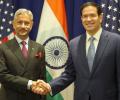
Rubio voiced "appreciation" for New Delhi's continued engagement on bilateral issues, including trade, defence and energy.

US lawmakers have urged President Donald Trump to reconsider his proclamation on H1-B visas, including the USD 100,000 fee, asserting that Indian nationals are central to American leadership in IT and AI, and the restrictions will negatively impact US-India ties.

Meeks, a ranking member of the House Foreign Affairs Committee Democrats, on Wednesday (local time) underscored "Congress' support for the US-India partnership," following his meeting with Indian Ambassador to the US Vinay Mohan Kwatra.
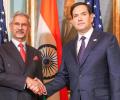
This will be the first face-to-face meeting between Rubio and Jaishankar following President Donald Trump's imposition of an additional 25 per cent tariff on India for Delhi's purchases of Russian oil, taking the total levies imposed on India by the Trump White House to 50 per cent.
The senior defence official, however, refrained from describing the kind of responses that the two countries would respond to their common challenges.

The 2025 US National Security Strategy marks a major pullback, with America turning backward and effectively allowing China greater dominance in Asia. while long-time partners like India are left to face an increasingly unstable global order largely on their own, observes Rajeev Srinivasan.
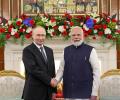
Luckily for us, a Russia that is desperate to stay relevant in an emerging multipolar world finds in India a reliable geostrategic partner. The Russian proximity to India also keeps China from exploiting its economic dominance vis a vis Russia, points out Colonel Anil A Athale (retd).

Gor, 38, was among 107 nominees confirmed by the Senate in a single en bloc vote on Tuesday, with 51 senators voting in favour and 47 against.
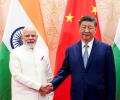
'What's currently underway is not a 'reset'.' 'What needs to be arrived at is a new balance.'

Zelenskyy, in a social media post, said Ukraine appreciates India's dedication to "peace and dialogue".
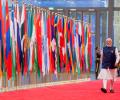
During a special briefing in Tianjin, Misri confirmed that the prime minister will first address the SCO plenary session before meeting President Putin.

The Fujian was launched at a brief ceremony held at the Shanghai shipyard, the official media reported from the eastern metropolis.

During the visit, the Prime Ministers will attend a community event in Sydney to celebrate Australia's dynamic and diverse Indian diaspora, "a core part of our multicultural community", the Australian government said in a statement.

India will be the most consequential partner for the US in the Indo-Pacific this century, US Defence Secretary Mark Esper said Tuesday ahead of the 2+2 ministerial dialogue between the two countries next week. Esper on Tuesday told a Washington audience that he and the Secretary of State Mike Pompeo would be travelling to New Delhi next week for the 2+2 ministerial with their respective Indian counterparts Defence Minister Rajnath Singh and External Affairs Minister S Jaishankar.

Prime Minister Narendra Modi and French President Emmanuel Macron discussed the Ukraine conflict and bilateral relations, reaffirming their commitment to global peace and stability.
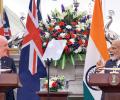
India and New Zealand have signed a pact to institutionalize their defence ties and vowed to boost cooperation in the Indo-Pacific. Prime Minister Narendra Modi raised concerns about anti-India activities by some illegal elements in New Zealand with his Kiwi counterpart Christopher Luxon. The two sides also signed six agreements to enhance cooperation in areas including education, sports, agriculture, and climate change. They also agreed to prepare a roadmap for cooperation in the defence industry sector and explore early implementation of cooperation in the digital payments sector.
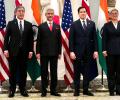
Soon after he was sworn in by Vice President J D Vance, US Secretary of State Marco Rubio hosted External Affairs Minister S Jaishankar, Penny Wong from Australia and Japan's Iwaya Takeshi for his first multilateral meeting as the top American diplomat.
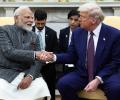
No one should make China an issue in their bilateral relations and their cooperation should not harm the interests of another country, the Chinese Foreign Ministry said on Friday reacting to queries on the meeting between Prime Minister Narendra Modi and United States President Trump.
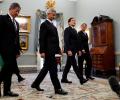
In a move sending a strong signal to China, foreign ministers from Quad countries -- India, Australia, Japan and the United States -- in a joint statement on Tuesday strongly opposed any unilateral actions that seek to change the status quo by force or coercion.
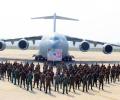
Dharma Guardian 2025 will primarily focus on urban warfare tactics and counter-terrorism operations and underscores the growing strategic partnership between India and Japan.
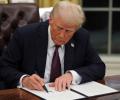
Dr Jaishankar is expected to discuss the dates for the fifth Quad leaders' summit in India later this year.

Prime Minister Narendra Modi has said that the Quad is not against anyone, but for a rules-based international order and respect for sovereignty, in a veiled reference to China.

The Bloomberg report suggests that this backchannel communication from President Xi has laid the groundwork for a broader thaw in relations. This overture has since translated into a series of tangible diplomatic actions leading up to the upcoming Shanghai Cooperation Organisation (SCO) summit.
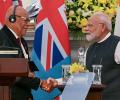
Fijian Prime Minister Sitiveni Rabuka discussed US tariffs on Indian goods with Prime Minister Narendra Modi, noting that "somebody is not very happy with you." The discussion occurred during Rabuka's visit to India to strengthen ties.

US Secretary of State Marco Rubio claims President Donald Trump was instrumental in bringing about the cessation of hostilities between India and Pakistan, a claim India has consistently denied.

'Pakistan is an ally who gives the US access.' 'If we have a presence there, it puts us that much closer to China and puts our assets closer to China and Iran.'
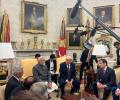
'Trump is not shy when he is frustrated with countries'
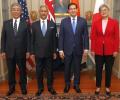
The Quad grouping has called for bringing the perpetrators, organisers and financiers of the Pahalgam terror attack to justice without any delay and urged UN member nations to extend cooperation for it.
'India is too important to the United States for there to be any kind of a permanent bump in the relationship.'
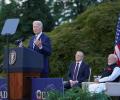
United States President Joe Biden was caught on a hot mic telling leaders of the Quad nations that China was testing them, thus reflecting upon the American seriousness of the emerging Chinese threat.
