
'China continues to perceive its relations with India through the prism of India-US relations, with the US using India to counter balance against China in the Indo-Pacific and beyond.'

This includes over $15 billion of proposed investment in the infrastructure sector in the Indo-Pacific and $9 billion for shoring up American defence in the region.
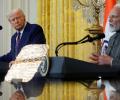
India and the US have entered a new phase in their relationship, marked by greater parity, point out Harsh V Pant and Vivek Mishra.

The agreement was to disengage from remaining standoff sites along the Line of Actual Control (LAC), two days before a meeting between Chinese President Xi Jinping and Prime Minister Narendra Modi on the sidelines of the BRICS Summit.

Four-nation grouping Quad on Tuesday launched a major new initiative for the Indo-Pacific that allows the partner countries to fully monitor the waters on their shores and help ensure peace and stability in the region, a move that comes amid China's increasingly intimidatory behaviour.
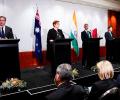
The meeting to be presided over by External Affairs Minister S Jaishankar will be attended by US Secretary of State Antony Blinken, Japanese Foreign Minister Yoshimasa Hayashi and Australia's Penny Wong.

According to the report, the Pentagon is deploying the USS Tripoli ARG, along with the 31st Marine Expeditionary Unit (MEU), part of its own strike group.

In their first summit, the leaders of Quad countries on Friday decided to launch a mega vaccine initiative under which coronavirus vaccines will be produced in India for the Indo-Pacific region with financial assistance from the United States and Japan while Australia will contribute in logistical aspects.

India's historical focus on its continental borders has overshadowed its maritime ambitions, but that is changing quickly, notes Ajai Shukla.

India and France have elevated their relationship to a 'special global strategic partnership,' with increased cooperation in defense, trade, and technology. The leaders also inaugurated a helicopter assembly line in Karnataka.

Prime Minister Narendra Modi has met his Australian counterpart Scott Morrison in Washington, DC, ahead of the first in-person Quad meeting to be hosted by US President Joe Biden and discussed a broad range of issues of bilateral, regional and global importance, including the Indo-Pacific.
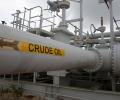
MEA spokesperson Randhir Jaiswal said India's energy decisions are guided by national interest.

The US "Indo-Pacific Strategy" is bound to be a failed strategy, Wang said in the comments posted by the Chinese foreign ministry on its website.

Morrison said ways to deepen bilateral trade and investment ties and harness new economic opportunities to support mutual economic recovery and growth will also be discussed at the summit.

External Affairs Minister S Jaishankar met United States Secretary of State Antony Blinken in Phnom Penh on Sunday and discussed bilateral ties, the raging Ukraine conflict, energy issues, G20 and the situation in the Indo-Pacific, days ahead of a possible meeting between Prime Minister Narendra Modi and President Joe Biden.

Ambassadors of the Quad nations, consisting of the United States, India, Australia and Japan, held a rare publicised meeting in Beijing.
The foreign ministers of the Quad grouping of India, the US, Australia and Japan on Friday held extensive talks in Melbourne amid escalating tension between Russia and NATO countries over Ukraine, the Afghan crisis and increasing concerns over China's "coercion" in the Indo-Pacific region.
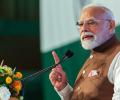
Prime Minister Narendra Modi on Friday said it is important for India and China to work together to bring stability to the world economic order as he asserted that New Delhi is ready to advance bilateral ties from a strategic and long-term perspective based on mutual respect, mutual interest and mutual sensitivity.

The latest announcement was made by the US Defence Secretary Jim Mattis during the change of guard ceremony at Joint Base Pearl Harbour wherein Admiral Phil Davidson replaced Admiral Harry Harris as Commander, US Indo-Pacific Command or IndoPacom.

US President Donald Trump greeted India on its 77th Republic Day, highlighting the historic bond between the two democracies amid ongoing trade tensions.

'Today, as I look at our satellite -- tested, finished and ready to ship -- represents 1,642 days of grit and belief.'

India and the US have signed a framework agreement for defence cooperation for the next 10 years, enhancing their partnership and aiming for regional stability.

The Quad has come of age and its agenda covering areas like vaccines, climate change and emerging technologies makes it a force for global good, Prime Minister Narendra Modi said at the first summit of the coalition. In his opening remarks, he also talked about shared values and promoting a secure, stable and prosperous Indo-Pacific.
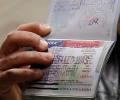
US lawmakers have expressed concerns that policies enacted by the Trump administration, such as the H1B visa fee and tariffs on India, are detrimental to American businesses and threaten the relationship between the United States and India.

External affairs minister S Jaishankar on Tuesday discussed issues relating to Afghanistan and the Indo-Pacific during his bilateral meetings with global counterparts on the sidelines of the annual high-level UN General Assembly session.
He said he will be visiting Tokyo at the invitation of his Japanese counterpart Fumio Kishida, and noted that in March 2022, he had hosted Kishida for the 14th India-Japan Annual Summit.

The coast guards of India, Japan, the US and Australia have launched the first-ever "Quad-at-sea" mission to boost operational coordination and interoperability in the Indo-Pacific.
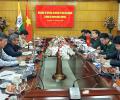
The 15th India-Vietnam Defence Dialogue signalled a move from routine talks to deeper cooperation, with new deals on submarine rescue and defence industry to support stability in the Indo-Pacific, notes Dr Rajaram Panda.

Jaishankar also met his Iranian counterpart H Amirabdollahian and held productive discussions on bilateral economic cooperation, Afghanistan and the joint comprehensive plan of action, also known as the Iran nuclear deal.
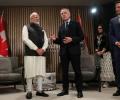
The statement suggests that Canadian authorities do not see ongoing foreign interference or violent activity tied to India at present.
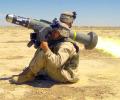
The US has approved the sale of Excalibur Projectiles, Javelin Missile System and related equipment totalling over 90 million dollars to India.

External Affairs Minister S Jaishankar and US Secretary of State Marco Rubio discussed cooperation in trade, critical minerals, nuclear energy, and defence, reaffirming commitment to a free and open Indo-Pacific.

The enduring relationship between the two countries have survived the disintegration of the erstwhile USSR in 1991, the end of the Cold War and the regime change in both countries, points out Rup Narayan Das.
United States Secretary of State Marco Rubio on Thursday (local time) hailed India as 'one of the top relationships that the US has in the world today' during the Senate confirmation hearing for Sergio Gor, US President Donald Trump's nominee for US Ambassador to India.
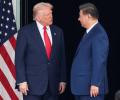
United States President Donald Trump said that China 'knows the consequences' if it attacks Taiwan, asserting that Chinese President Xi Jinping understands the situation 'very well'.

The United States has warned China against escalating tensions as Taiwan detected multiple Chinese naval vessels, official ships and balloons operating around the island amid Beijing's large-scale live-fire military drills.

Prime Minister Narendra Modi emphasized the strong partnership between India and the UK, highlighting its importance for global stability and economic progress amidst global uncertainty. Discussions covered trade, defense cooperation, and geopolitical issues.

Senior officials from India and the US engaged in virtual talks to discuss bilateral ties, focusing on trade, investment, critical minerals, and energy security, including civil nuclear cooperation.

India has joined the US-led 'Pax Silica' alliance, aimed at building a resilient supply chain for critical minerals and artificial intelligence, marking a significant step in strengthening bilateral ties and fostering economic security.
The US Representative criticised the administration's new USD 100,000 fee on H-1B visas, observing that Indians hold 70 per cent of these visas and saying the change directly harms workers who have long supported US innovation across technology, science and medicine.
