
Ask rediffGURU and PF expert Nitin Narkhede your mutual fund and personal finance-related questions.

Net flows from domestic institutional investors crossed Rs 5 trillion for the first time during a calendar year.

Oravel Stays Ltd, which operates travel tech firm and brand OYO, on Wednesday said it will refile its draft public listing application by the middle of next month. Earlier this month capital markets regulator Sebi had asked the company to refile the draft initial public offering (IPO) papers with certain updates. "We are working on updating all key sections simultaneously.

Zomato's mega initial public offering (IPO) ended with a bumper 38 times oversubscription on Friday as institutional investors poured money to get a pie of the hottest online food delivery platform. Zomato got bids for 2,751.25 crore shares against 71.92 crore shares on offer, stock exchange data showed. The IPO is India's biggest since March 2020. Institutional investors, who shied away in the first two days of the IPO, bid several times over the number of shares reserved for them.

Star Health and Allied Insurance's Rs 7,250-crore initial public offering (IPO), the third largest this year and eighth largest ever, just about managed to make it despite a poor response from investors, garnering just 79 per cent subscription, forcing the investment bankers to prune offer for sale (OFS) component. This is the second large offering after digital payments major Paytm this year to receive a lukewarm response from investors, a sign that despite the IPO frenzy investors are discerning when it comes to pricing. As Star Health didn't meet the profitability criteria, its IPO required a mandatory 75 per cent subscription from qualified institutional buyers (QIB).
'Entering India is exciting, but it's also challenging. You have to be prepared for long-term investment.'

After the merger of regional rural banks (RRBs) under the "One State, One RRB" policy to improve their efficiency and minimise competition among public-sector banks (PSBs) that sponsor them, the government is planning to list at least five RRBs by the end of financial year 2026-27 (FY27). After the latest amalgamation that came into effect on May 1, there are 28 RRBs in 26 states and two Union Territories (UTs), with more than 22,000 branches covering 700 districts.

Of the 59 IPOs for which the data is available, 36 IPOs received mega responses of more than 10x (of which, six IPOs more than 100x), while eight IPOs were oversubscribed more than 3x.
With the Russia-Ukraine war roiling financial markets globally, the government may defer the mega IPO of LIC and wait for an opportune time to get the maximum value of its holding in the state-owned insurance behemoth, sources said. "It's a full blown war now so we will have to assess the situation for going ahead with the LIC IPO," a government source said. Finance Minister Nirmala Sitharaman, too, had indicated review of the IPO in view of the evolving geopolitical situation.
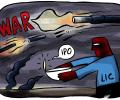
'It will be a cat and mouse game between investors and the government.' 'The issue will be launched only if there is sufficient demand from investors and the government is in agreement with the bankers on the valuations.'

Oravel Stays - which operates hospitality tech firm OYO - on Friday pre-filed its Draft Red Herring Prospectus with stock market regulator Sebi, sources said. Sources close to the company told PTI, OYO may launch its initial public offering (IPO) around Diwali this year. Unlike the traditional route where companies have to launch the IPO within 12 months from the Sebi approval, or final observation; in the pre-filing route, an IPO can be floated within 18 months from the date of Sebi's final comments.
LIC's public offer, the country's biggest-ever IPO, was fully subscribed on the second day of bidding on Thursday. Against 16,20,78,067 shares on offer, 16,68,60,765 bids were received -- translating into a subscription of 1.03 times, as per data on stock exchanges as of 7 pm. However, the Qualified Institutional Buyer (QIB) and Non-Institutional Investor (NII) portions have received a tepid response so far.

There have been more instances of a management team buying out the owners of a company after the pandemic. There are eight such transactions, called management buyouts (MBOs), in the five years ending 2024, according to data from tracker LSEG shared with Business Standard.

'For 40 years, India valued only technical skills. IITs, coding -- that became everything.' 'Soft skills were sidelined. But those are the skills that will keep you employable now, not technical skills.'
'BSE has facilitated nearly Rs 35 trillion in capital raising across multiple segments.'
The move might delay the Gurugram-based hospitality unicorn's initial public offering (IPO). OYO filed preliminary documents with the Securities and Exchange Board of India (Sebi) in September 2021 for a Rs 8,430 crore IPO.

IPO market hopes to come out of slump in festive season, reports Sundar Sethuraman.
The initial public offering of the country's largest insurer LIC will open on May 4 and close on May 9, sources said. The IPO, through which the government will sell 3.5 per cent stake in state-owned Life Insurance Corporation (LIC), will fetch Rs 21,000 crore to the exchequer. The IPO values LIC at Rs 6 lakh crore.
Zaggle Prepaid, Cyient DLM, Healthvista India, Rashi Peripherals and Vishwaraj Sugar Industries have obtained the green signal to launch their initial public offerings (IPOs). The approvals come at a time when capital raising by way of IPOs has slowed to a crawl, with only four issues hitting the market so far this calendar year. Recently, the Securities and Exchange Board of India (Sebi) issued final observation letters on their draft red herring prospectuses (DRHPs), which is akin to getting approval to hit the markets.

India and the US are expected to have smooth trade negotiations after US President Donald Trump and Indian Prime Minister Narendra Modi had a productive meeting during Modi's visit to the White House last month, Stephen A Schwarzman, chairman, chief executive officer, and co-founder of one of the world's largest alternative investment firms, Blackstone Group, said in Mumbai on Wednesday.
The government will launch the mega public offer of LIC by March and file draft papers with market regulator Sebi by the end of this month, an official said. Finance Minister Nirmala Sitharaman had last week reviewed the progress of the initial public offering (IPO) of Life Insurance Corporation (LIC) in a meeting with top officials of the ministry. The official said the September 2021 quarter financials of LIC are getting finalised as well as fund bifurcation is in progress.

Markets regulator Sebi is actively working with the Ministry of Finance and other financial regulators on setting up a centralised KYC (Know Your Customer) system, chairman Tuhin Kanta Pandey has said. The Central KYC is an online database that maintains KYC records of customers in a centralised manner, aiming to streamline compliance across financial institutions.

When Gensol Engineering made its public market debut through a small and medium enterprises (SME) initial public offering (IPO) in September 2019, its promoters held a commanding 96 per cent stake. Now, that figure has shrunk to a "negligible" fraction.

Dining today isn't just about food -- it's about the experience and the story.

To help you ride the growth trajectory of India's equity markets, we have curated the top five fastest-growing stocks that hold an impressive upside. If you're planning to build a sound portfolio and capitalize on the growth of these leading institutions, it's time you watch these stocks.

FOMO-driven investing is reshaping India's stock market. Swati Saxena explains how social media hype fuels risky bets and how to protect your wealth.

'I advise people to stay away from secondary IPOs. There is a big conflict of interest between the exiting and incoming investors'
Three companies -- FirstMeridian Business Services Ltd, IRM Energy Ltd and Lohia Corp -- have received capital markets regulator Sebi's go-ahead to raise funds through initial public offerings (IPOs). These firms, which filed their preliminary IPO papers with the markets regulator between September 2022 and January 2023, obtained the observation letters during February 21-24, an update with the Securities and Exchange Board of India (Sebi) showed on Tuesday. In Sebi parlance, observation implies go-ahead to the company to float the initial share-sale.

From the 30-share Sensex blue-chip pack, Titan, Adani Ports, UltraTech Cement, Tata Consultancy Services, NTPC, Bharti Airtel, Tech Mahindra, Infosys, Hindustan Unilever and JSW Steel were the biggest laggards.

Investors attribute the revival to the country's strong public markets, which are boosting confidence in initial public offering (IPO)-bound startups offering viable exit opportunities.

Logistics services provider Delhivery is likely to launch its downsized initial public offering (IPO) this week, said people in the know. The Softbank-backed firm may trim its issue size from Rs 7,460 crore to Rs 5,500 crore to align with the volatile market conditions, sources said. Sources added the fresh issue component of the IPO could be reduced to Rs 4,500 crore and the OFS component to Rs 1,000 crore.

Bessemer Venture Partners has closed $350 million in capital for its second dedicated India fund to back founders in the region, who build enduring companies.
Ever since the Life Insurance Corporation (LIC) announced launching the initial public offering (IPO), 6.48 crore LIC policyholders have shown interest to get the much-touted share of the largest insurance company in the country, an official said. "The response to our IPO launch is wonderful. We have some figures: 6.48 crore policy holders have linked their PAN number with the policy details up to the cut-off date (February 28, 2022)," Rahul Jain, director of the Department of Investment and Public Asset Management (DIPAM) in the Ministry of Finance, told reporters. The LIC has set a price band of Rs 902-Rs 949 per equity share. The government intends to raise Rs 21,000 crore through the issue.


Shares of Le Travenues, which operates online travel booking platform ixigo, soared 78 per cent on their market debut (June 18) and surged 80.4 per cent in the three days over their issue price. Ixigo has joined competitors EaseMyTrip and Yatra on the bourses. Analysts believe the blockbuster response to ixigo may lead to greater scrutiny of the financial performance of other online travel aggregators (OTAs) like Easy Trip Planners, and Yatra Online.
India is likely to see over 100 mature, large-scale profitable or on the path to profitability startups in the next five years, of which 80 have the potential to go for public listing, market research and consultancy firm Redseer said on Tuesday. Redseer Strategy Consultants, in a report on IPOs, said 20 of the mature startups have gone public so far. "India may see over 100 matured, large-scale profitable/path-to-profitability start-ups in the next five years.

The total number of demat accounts in the country stood at 171.1 million as of August 31.

Food delivery platform Zomato's initial public offering was oversubscribed on the opening day on Wednesday with retail investors bidding for 2.7 times the number of shares reserved for them. The offer received bids for 75.60 crore equity shares against an IPO size of 71.92 crore, stock exchange data showed. Retail investors sought 2.69 times the portion reserved for them. Against 12.95 crore shares reserved for retail individual investors, 34.88 crore shares were bid by 1700 hours.

Initial public offerings (IPOs) have attracted droves of retail investors to the stock market in CY22. But these applicants have lost money on 40 per cent of the fresh issues this year - a trend that may impact sentiment towards maiden share sales during the remaining part of the year. Of the 14 companies that have listed this year, five have closed below their issue price.

FSN E-Commerce Ventures Ltd, which operates online beauty e-commerce platform Nykaa, on Monday said it has fixed a price band of Rs 1,085-1,125 per share for its initial public offer (IPO) that opens for subscription later this week. The IPO will open for subscription on October 28 and conclude on November 1. IPO comprises a fresh issue of equity shares aggregating up to Rs 630 crore (fresh issue) and an offer for sale of up to 41,972,660 equity shares being offered by the selling shareholders (offer for sale or OFS), a statement said.
