
A severe cold wave brought the minimum temperature down to a numbing 1.5 degrees Celsius at the Ridge weather station in central Delhi.

Kerala has been receiving rainfall since Saturday and 10 out of the 14 weather monitoring stations in the state have received more than 2.5 mm rains.

The southwest monsoon has started on a weak note and this has delayed the sowing of kharif crops. Though a cause for concern, the situation hasn't reached a stage where it warrants any panic response. Moreover, according to meteorologists and industry players, monsoon rains will witness a revival in the coming few weeks.

The India Meteorological Department has issued an 'orange' alert.

Rains will continue to batter Tamil Nadu for the next seven days and the next 48 hours are "very crucial", the IMD has said.

Cyclone Biparjoy has left a trail of destruction in Gujarat's Kutch and Saurashtra regions as some 1,000 villages are still without power with hundreds of electric poles getting damaged, while several coastal villages were flooded due to heavy rains and incoming seawater, officials said on Friday, a day after the storm made landfall.

Less-than-expected rainfall and a poor spatial distribution, experts say, can rekindle fears of a rise in food and fuel inflation that can have an impact on the RBI's monetary policy. The fear of less than optimal rainfall due to El Nino this year, analysts believe, is the biggest short-term risk for the markets, which they said has not been fully priced in yet by them. Monsoon set over Kerala on June 08, a week later than its scheduled date.

The government declared Monday (Dec 4) a public holiday and urged private companies to encourage 'work from home' option for its employees in Chennai, Tiruvallur, Kancheepuram and Chengalpattu districts.
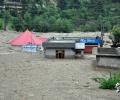
As the weather improved in parts of north India, which was pummelled by heavy rains for days, authorities on Wednesday worked on a war footing to rescue stranded tourists, restore vehicular traffic on arterial roads and prevent floodwaters from entering new areas.

The cyclone will make a landfall at around 9:00 pm to 10:00 pm on Thursday

Any long dry spell could cause moisture stress in the standing crop during the crucial maturing stage and also make it prone to pest and disease attacks.

In Delhi, Safdarjung, the base station for the national capital, recorded 44.2 degrees Celsius, while Mungeshpur observatory in northwest Delhi, reported 47.3 degrees Celsius.

The maximum temperature at the Safdarjung Observatory, Delhi's base station, is likely to rise to 45 degrees Celsius.

Palghar, Thane, Raigad and Ratnagiri could witness thunderstorm activity, lightning, moderate rain and gusty storm over the next two days.

LIVE! Incessant rains: Red Alert in 5 Kerala districts

An unspecified number of people were evacuated from coastal areas of Odisha where Jagatsinghpur, Kendrapara, Bhadrak and Balasore were likely to experience heavy rainfall accompanied by high-velocity winds, particularly on May 19 and 20, IMD Director General Mrutyunjay Mohapatra said.

As rains continue to lash across Kerala days ahead of the expected onset of Southwest monsoon, the India Meteorological Department (IMD) on Sunday issued a red alert in five districts of the state for Sunday and Monday indicating extremely heavy rainfall.

The India Meteorological Department has issued a 'Red Alert' and predicted 'very heavy' to 'extremely heavy' rainfall across several districts of Assam over the next five days.

The Met Department has predicted light to moderate rainfall across parts of West Bengal, Andhra Pradesh and Odisha with the probability of the severe cyclonic storm 'Asani' recurving.

The India Meteorological Department (IMD) predicted that cold wave to severe cold wave conditions are very likely to continue in northwest India over the next three days and abate thereafter.

Hundreds of people are being evacuated from coastal villages in Kutch district in view of cyclone Biparjoy, but authorities are facing a challenge as many villagers are reluctant to leave their livestock and belongings behind.

Heavy rains over a span of few hours flooded many parts of Nagpur city, following which more than 400 people, including 70 students from a school for the speech and hearing-impaired, were rescued, said Maharashtra Deputy Chief Minister Devendra Fadnavis on Saturday.

Waterlogging was reported in Andheri, Kurla, Ghatkopar, Chembur and some other places.

Incessant showers lashed Mumbai and its neighbouring areas on Wednesday morning, leading to flooding in many low-lying areas and traffic snarls on roads, officials said.
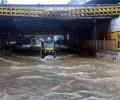
The India Meteorological Department (IMD) has forecast heavy rainfall in Mumbai and suburbs with very heavy to extremely heavy rains very likely at isolated places.
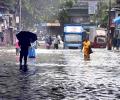
Some low-lying places like Hindmata, and areas in Dadar and Sion, including the Gandhi Market and road number 24 in Sion, were inundated, forcing pedestrians to wade through the water and making it difficult for motorists to commute.

An improvement in the wind speed November 21 onwards might bring air pollution levels down.

The mercury breached the 46-degree Celsius mark in several places such as Allahabad (46.8 degrees Celsius) and Jhansi (46.2 degrees Celsius) in Uttar Pradesh; Sports Complex (46.4 degrees Celsius) in Delhi; Ganganagar (46.4 degrees Celsius) in Rajasthan; Nowgong (46.2 degrees Celsius) in Madhya Pradesh; and Maharashtra's Chandrapur (46.4 degrees Celsius).

After lagging behind other segments in the automotive (auto) space over the past few years, two-wheelers are expected to reverse their volume underperformance. After witnessing a 36.3 per cent volume decline over the 2018-19 (FY19) through 2021-22 (FY22) periods, the sector staged a recovery in 2022-23 (FY23), with volumes rising 17 per cent. While volumes are still a quarter lower than the FY19 peak of 21 million units, a double-digit growth trajectory is expected to prolong.

It's still early days, but the southwest monsoon has been nearly 37 per cent 'below normal' in the first seven days (June 1-7) of this month. According to the data furnished by the India Meteorological Department (IMD), between June 1 and June 7, India received 14.5 millimetres (mm) of rainfall, against a 'normal' 23.1 mm. Among places where rains have arrived, monsoon in Kerala in the first seven days has been 48 per cent 'below normal', while in Puducherry, it has been 56 per cent 'above normal'. In Tamil Nadu, rains were 21 per cent 'above normal' between June 1 and June 7.

Relief work gained momentum on Saturday as rainfall came to a halt in many parts of the state. When contacted, a senior official told PTI that 16 people lost their lives in rain-related incidents as per the reports received till Saturday afternoon.

The mercury at the Safdarjung Observatory is expected to breach the 43-degree mark on Thursday and touch 44 degrees Celsius by Friday, according to the India meteorological department.

A blinding layer of dense fog over north India, including Delhi, caused major inconvenience to commuters. The visibility levels were 50 metres around 5:30 am.

The India Meteorological Department has issued a 'Red Alert' and predicted 'very heavy' to 'extremely heavy' rainfall across several districts of Assam till Thursday.

Auto mobile retail sales in India witnessed a 10 per cent annual growth in July driven by robust sales across passenger vehicles, two-wheelers and commercial vehicles, industry body FADA said on Monday. Total retail sales across segments rose to 17,70,181 units last month, as compared to 16,09,217 units in July 2022. Passenger vehicle sales saw an increase of 4 per cent to 284,064 units last month, as compared to 273,055 units in the year-ago period, the Federation of Automobile Dealers Associations (FADA) said in a statement.

The city has been witnessing heavy rains since Tuesday night, resulting in water logging in many areas.

IMD issued red alerts for Thiruvananthapuram, Kollam, Pathanamthitta, Alappuzha, Kottayam, Ernakulam and Idukki districts.

A total of 33 teams have been earmarked by the National Disaster Response Force (NDRF) to undertake relief and rescue operations in Gujarat and Maharashtra ahead of the expected landfall of cyclone 'Biparjoy' near the Jakhau port in Kutch district, officials said on Wednesday.

Dense to very dense fog prevailed in some parts of the National Capital Region (NCR), Haryana, Punjab, west Uttar Pradesh and north Rajasthan on Tuesday.

The orange alert has been issued for moderate or heavy thunderstorms and wind speed with 30-40 km per hour to reach some districts of Odisha within the next three hours.
